Smart transportation in Arizona is becoming more important as the state grows, traffic patterns change, logistics corridors expand, EV charging demand increases, and cities look for better ways to move people, goods, and emergency services safely.
For Arizona, smart transportation is not just about self-driving cars or traffic apps. It is about using connected infrastructure, sensors, cameras, public safety systems, road data, EV charging networks, freight visibility, and city planning to solve real mobility problems.
Most transportation articles focus only on roads, cars, or transit. Arizona needs a broader view. Smart transportation is becoming the operating system for mobility across cities, freeways, warehouses, schools, airports, public safety corridors, and commercial districts.
Arizona’s transportation future depends on how well cities can connect:
- Traffic signals
- Smart cameras
- Road sensors
- Emergency notification systems
- EV charging stations
- Transit data
- Freight and logistics routes
- Public safety alerts
- Air quality and dust monitoring
- Smart city dashboards
Arizona’s transportation challenges are shaped by rapid growth, long commute distances, extreme heat, logistics expansion, tourism, construction, and major highway corridors. The Maricopa Association of Governments plans and allocates funding for regional transportation systems including freeways, arterial streets, and transit. MAG transportation planning
Federal transportation planning materials have also described Maricopa County as one of the fastest-growing and most rapidly urbanizing counties in the country, with congestion and long travel distances making transportation a major regional priority. FHWA case study
Smart transportation helps Arizona answer practical questions:
- Where is congestion increasing?
- Which intersections need safety improvements?
- How can emergency vehicles move faster?
- Where should EV charging stations be placed?
- How can cities reduce crash risk?
- How can logistics corridors operate more efficiently?
- How can public agencies communicate road hazards faster?
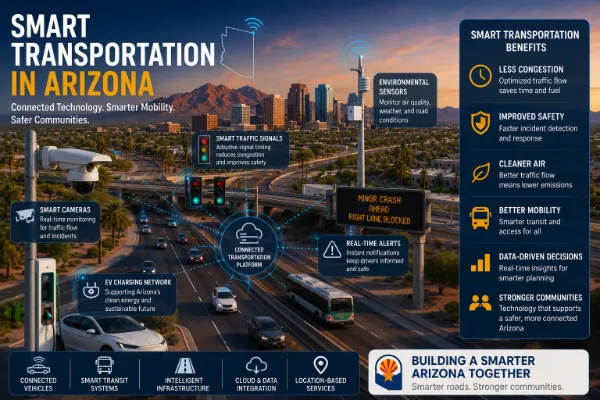
Smart transportation uses connected technology, data, automation, sensors, and communication systems to improve how people and goods move. It may include smart traffic signals, connected cameras, road sensors, transit apps, EV charging systems, fleet tracking, emergency alerts, and real-time transportation dashboards.
| Smart Transportation Technology |
How It Helps Arizona |
| Smart Traffic Signals |
Improve traffic flow and support emergency vehicle priority |
| Connected Cameras |
Monitor intersections, congestion, crashes, and public safety risks |
| Road Sensors |
Track traffic speed, volume, weather, flooding, and road conditions |
| EV Charging Networks |
Support electric vehicle adoption and highway corridor travel |
| Fleet Telematics |
Improve logistics, delivery routing, fuel use, and vehicle maintenance |
| Emergency Alerts |
Warn drivers, residents, and agencies about road hazards or closures |
Smart traffic signals use sensors, cameras, timing data, and analytics to improve traffic flow. In fast-growing Arizona cities, this can help reduce bottlenecks, improve pedestrian safety, and support emergency response.
Smart signal systems may help with:
- Adaptive signal timing
- Pedestrian crossing detection
- Emergency vehicle priority
- Transit signal priority
- School zone safety
- Traffic queue detection
- Intersection crash analysis
Smart cameras are becoming an important part of Arizona’s transportation network. They can help transportation teams monitor traffic flow, confirm incidents, improve public safety, and understand how roads are being used.
Camera-based transportation analytics may support:
- Vehicle counting
- Congestion detection
- Wrong-way movement alerts
- Pedestrian and cyclist detection
- Crash confirmation
- Event traffic monitoring
- Parking and curbside management
Related reading: Smart Cameras in Arizona
Arizona drivers may face dust storms, flash flooding, crashes, construction delays, wildfire smoke, road closures, and extreme heat-related vehicle issues. Emergency notification systems help deliver faster alerts to affected people.
Smart transportation becomes more useful when road sensors, weather data, cameras, and public alerts work together.
Related reading: Emergency Notification Systems in Arizona
Arizona’s desert environment makes air quality and visibility part of transportation safety. Dust events can reduce visibility quickly, creating risk on highways and rural roads. Air quality monitoring can also help cities understand how traffic corridors affect public health.
Connected environmental sensors can support:
- Dust visibility alerts
- Air quality monitoring near busy roads
- Construction corridor monitoring
- Public safety warnings
- Transportation planning around pollution exposure
Related reading: Air Quality Monitoring in Arizona
EV charging is now part of smart transportation planning. Arizona’s highway corridors, cities, commercial centers, logistics hubs, apartment communities, and workplaces all need charging infrastructure that is reliable, visible, and connected.
ADOT’s EV infrastructure implementation program includes phased planning for charging infrastructure, with Phase 3 anticipated for state roads in summer 2026. ADOT EV infrastructure implementation
Smart EV charging systems can help with:
- Station availability monitoring
- Load management
- Payment systems
- Route planning
- Fleet charging
- Utility coordination
- Grid demand planning
Related category: Energy & Sustainability
Arizona’s logistics corridors are expanding, especially around Phoenix, Goodyear, Glendale, Mesa, Chandler, and Tucson. Warehouses, distribution centers, manufacturers, and freight operators depend on reliable transportation data.
Smart transportation can help logistics operators improve:
- Fleet routing
- Loading dock coordination
- Delivery timing
- Fuel and energy use
- Driver safety
- Predictive vehicle maintenance
- Traffic-aware scheduling
Related category: Industrial IoT
Transportation and public safety are closely connected. Traffic incidents, emergency vehicle access, large events, road closures, construction zones, and weather hazards all require fast coordination.
Public safety IoT can connect transportation systems with emergency dispatch, smart cameras, alerts, and city operations centers.
Related reading: Public Safety IoT in Arizona
| City |
Smart Transportation Opportunity |
Internal Link |
| Phoenix |
Congestion management, smart signals, EV charging, airport-area mobility, public safety corridors |
Smart Cities in Phoenix |
| Mesa |
Growth corridor planning, road safety, smart intersections, public infrastructure |
Smart Cities in Mesa |
| Chandler |
Industrial mobility, semiconductor-area traffic, employee commuting, smart corridors |
Smart Cities in Chandler |
| Scottsdale |
Tourism, resort traffic, event mobility, pedestrian safety, parking technology |
Smart Cities in Scottsdale |
| Tempe |
Campus mobility, pedestrian corridors, transit data, micromobility, nightlife safety |
Smart Cities in Tempe |
| Glendale |
Sports district traffic, event alerts, parking management, logistics corridors |
Smart Cities in Glendale |
| Goodyear |
Warehouse logistics, truck routing, industrial corridors, EV fleet charging |
Logistics & Transportation in Goodyear |
| Gilbert |
Residential growth, school zones, road safety, municipal mobility planning |
Smart Cities in Gilbert |
| Tucson |
Transit corridors, university-area mobility, road safety, environmental monitoring |
Smart Cities in Tucson |
Smart transportation is one of the most important parts of any smart city strategy. A city cannot become truly connected if roads, transit, parking, freight, emergency response, and public alerts remain disconnected.
Transportation data can help cities understand how people move, where congestion forms, which corridors need investment, and how infrastructure should evolve.
Related reading: How Phoenix Is Becoming a Smart City
Explore category: Smart Cities & Government
Commercial properties are affected by transportation every day. Offices, warehouses, hospitals, hotels, retail centers, schools, and apartment communities all depend on access, parking, deliveries, pedestrian safety, emergency routing, and employee commuting.
Smart transportation data can help property owners understand:
- Parking demand
- Traffic flow around entrances
- Loading dock congestion
- EV charging needs
- Pedestrian safety issues
- Emergency access routes
Related reading: IoT Building Automation in Arizona
Smart transportation depends on smart utilities. EV charging requires electric grid planning. Traffic signals require reliable power. Connected cameras and sensors require communication networks. Road alerts depend on emergency systems.
Transportation technology is strongest when connected with Smart Utilities, smart electric grids, and connected infrastructure planning.
| Benefit |
Why It Matters |
| Reduced Congestion |
Better signal timing and traffic visibility can improve movement through busy corridors |
| Improved Safety |
Connected cameras, alerts, and sensors can help detect incidents faster |
| Better Freight Movement |
Logistics operators can plan routes, reduce delays, and improve delivery timing |
| EV Readiness |
Charging data helps cities, utilities, and businesses plan for electric mobility |
| Stronger Public Alerts |
Drivers and residents can receive faster information about hazards and closures |
| Better Infrastructure Planning |
Transportation data helps agencies prioritize investment based on real demand |
Smart transportation is powerful, but it also creates challenges. Technology must be planned carefully so systems are secure, useful, equitable, and connected to real operational workflows.
- Cybersecurity for connected transportation systems
- Privacy concerns around cameras and vehicle data
- Cost of upgrading signals, sensors, and communications
- Interoperability between city, county, state, and private systems
- Reliable performance during extreme heat
- Data quality and maintenance
- Ensuring benefits reach growing suburbs and underserved areas
- Installing sensors without a decision process: Data should support action.
- Ignoring maintenance: Roadside technology must survive heat, dust, vibration, and weather.
- Overusing cameras without privacy rules: Transportation monitoring needs clear governance.
- Planning EV charging without grid coordination: Charging sites need power capacity and reliability.
- Keeping systems separate: Traffic, public safety, utilities, and city operations should share relevant data.
Smart transportation depends on sensors, semiconductors, cameras, communications, cloud systems, connected vehicles, edge computing, and public safety platforms. Arizona’s broader technology ecosystem includes companies connected to many of these enabling areas.
The future of smart transportation in Arizona will likely include more adaptive traffic signals, connected road sensors, EV charging corridors, smart parking systems, freight visibility tools, public safety integrations, and data-driven planning.
The most valuable systems will not simply collect more transportation data. They will help cities and businesses make better decisions: where to invest, when to alert drivers, how to reduce congestion, how to improve safety, and how to prepare for electric and connected mobility.
Smart transportation in Arizona is becoming essential infrastructure for a faster-growing, more connected state. IoT sensors, smart cameras, traffic analytics, EV charging systems, emergency alerts, and logistics data can help communities move more safely and efficiently.
For Arizona cities, businesses, and transportation agencies, the opportunity is clear: connect mobility data with real action. Better transportation intelligence can reduce delays, improve safety, support economic growth, and help Arizona build smarter, more resilient communities.
Frequently asked questions
Smart transportation uses sensors, data, automation, communication systems, and connected infrastructure to improve mobility, safety, traffic flow, public alerts, and transportation planning.
It is important because Arizona faces rapid growth, congestion, logistics expansion, extreme heat, road safety challenges, EV charging demand, and long commute distances.
IoT devices such as cameras, road sensors, traffic signal controllers, air quality monitors, and fleet trackers collect data that helps agencies and businesses make faster decisions.
It can help reduce certain delays by improving signal timing, incident response, traffic visibility, and route planning, though it must be combined with broader transportation investment.
Smart transportation supports EVs through connected charging stations, grid coordination, route planning, charging availability data, and fleet charging management.
Phoenix, Mesa, Chandler, Scottsdale, Tempe, Glendale, Goodyear, Gilbert, Tucson, and other growing communities can benefit from smart transportation systems.
Yes. Transportation is one of the core systems of a smart city because roads, signals, transit, parking, freight, emergency response, and public alerts all affect daily life.
Related articles

 Logistics & Transportation


