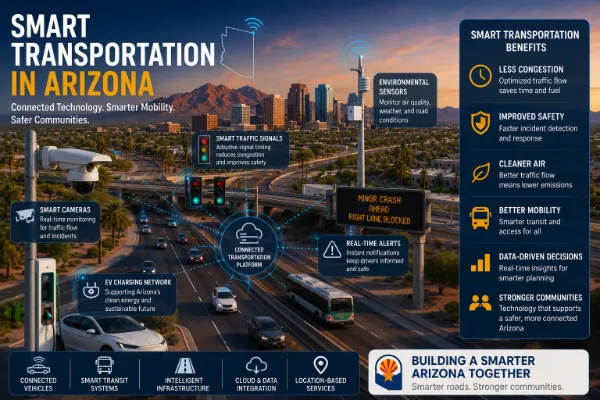
Electric vehicles are no longer a niche technology in Arizona. From Phoenix and Tucson to growing communities like Goodyear, Chandler, Gilbert, and Mesa, EV adoption continues to increase as businesses, homeowners, fleet operators, and local governments prepare for a more electrified transportation future.
However, the success of electric vehicles depends on far more than simply installing charging stations. Arizona's future depends on building an intelligent EV charging infrastructure that combines smart grids, IoT sensors, connected software, renewable energy, utility coordination, predictive maintenance, and real-time analytics.
Most discussions focus on the physical charger. In reality, the charging station is only one piece of a much larger digital ecosystem.
Every modern charging station generates data including:
- Power consumption
- Charging duration
- Vehicle demand
- Peak electricity usage
- Equipment health
- Payment information
- Grid load
- Station availability
- Maintenance alerts
- Renewable energy production
Together, this data creates an intelligent energy network that benefits utilities, drivers, businesses, and city planners.
Arizona offers several advantages for electric vehicle growth.
- Rapid population growth
- Expanding metropolitan areas
- Long commuter distances
- Year-round driving conditions
- Growing solar energy production
- Major interstate freight corridors
- Increasing manufacturing investment
- Large commercial developments
The Arizona Department of Transportation (ADOT) continues expanding charging infrastructure through the National Electric Vehicle Infrastructure (NEVI) program to improve charging availability across major travel corridors.
Instead of viewing EV chargers as isolated equipment, Arizona increasingly treats charging infrastructure as critical transportation infrastructure.
Smart EV charging uses internet-connected charging stations that communicate with utilities, vehicles, payment systems, building management platforms, and cloud software.
| Traditional Charger |
Smart EV Charger |
| Provides electricity |
Provides electricity and operational intelligence |
| Manual monitoring |
Remote monitoring |
| Basic charging |
Load balancing and scheduling |
| Little operational insight |
Real-time analytics |
| Reactive maintenance |
Predictive maintenance |
| Standalone device |
Connected to utilities and cloud platforms |
Modern charging stations continuously report operational health, charger availability, utilization, software status, and charging sessions.
Charging infrastructure depends on reliable electrical distribution. Smart grids help utilities balance electricity demand as more vehicles begin charging simultaneously.
Related reading:
IoT devices monitor charger temperatures, cabinet conditions, electrical faults, occupancy, parking availability, weather, and energy usage.
Operators manage thousands of chargers from centralized dashboards.
Cloud software tracks:
- Revenue
- Usage trends
- Power consumption
- Fault alerts
- Software updates
- User behavior
Commercial property owners increasingly view EV charging as both an amenity and a business asset.
Smart charging benefits:
- Office buildings
- Shopping centers
- Hotels
- Apartment communities
- Industrial parks
- Hospitals
- Universities
- Municipal buildings
- Airports
- Sports venues
Related reading:
Arizona's logistics industry continues expanding rapidly.
Delivery companies, municipalities, utilities, transit agencies, construction firms, and corporate fleets are gradually electrifying vehicles.
Fleet charging introduces unique challenges:
- Charging hundreds of vehicles overnight
- Managing peak electricity demand
- Scheduling chargers efficiently
- Preventing grid overload
- Monitoring charger uptime
- Predicting maintenance
Fleet management software can coordinate charging schedules automatically based on electricity pricing, route planning, and vehicle availability.
Arizona receives some of the highest solar radiation levels in the United States, making renewable-powered charging especially attractive.
Many commercial developments are exploring combinations of:
- Solar canopies
- Battery storage
- Smart chargers
- Building energy management
- Demand response
- Microgrids
This creates opportunities to reduce peak electricity demand while improving charging reliability.
| Property Type |
Charging Opportunity |
| Office Buildings |
Employee workplace charging |
| Retail Centers |
Customer charging while shopping |
| Hotels |
Guest charging overnight |
| Apartment Communities |
Resident charging |
| Industrial Parks |
Fleet charging |
| Hospitals |
Staff and visitor charging |
| Airports |
Long-term parking charging |
| Municipal Buildings |
Government fleet charging |
Electric vehicle infrastructure is becoming one of the most important components of Arizona's smart transportation strategy.
Charging stations integrate with:
- Traffic management
- Navigation systems
- Parking platforms
- Fleet software
- Utility networks
- Public safety systems
Related reading:
| City |
EV Infrastructure Opportunity |
Internal Link |
| Phoenix |
Commercial charging, airport mobility, fleet electrification |
EV Charging in Phoenix |
| Mesa |
Residential growth, retail charging, public facilities |
EV Charging in Mesa |
| Chandler |
Technology campuses, office charging, semiconductor workforce |
EV Charging in Chandler |
| Scottsdale |
Hotels, luxury retail, tourism charging |
EV Charging in Scottsdale |
| Tempe |
University campuses, apartments, mixed-use developments |
EV Charging in Tempe |
| Goodyear |
Warehouse fleets, logistics charging |
EV Charging in Goodyear |
| Gilbert |
Residential neighborhoods and commercial centers |
EV Charging in Gilbert |
| Tucson |
Regional transportation corridors and public charging |
EV Charging in Tucson |
Modern charging stations use IoT sensors to monitor:
- Connector temperature
- Cabinet humidity
- Electrical load
- Equipment health
- Occupancy
- Power quality
- Security events
- Remote diagnostics
Instead of waiting for failures, operators receive maintenance alerts before equipment breaks.
Connected charging stations are network devices and should be protected accordingly.
Best practices include:
- Encrypted communications
- Multi-factor authentication
- Secure firmware updates
- Network segmentation
- Continuous monitoring
- Role-based access controls
Arizona's technology ecosystem includes companies developing semiconductors, embedded systems, sensors, networking equipment, industrial electronics, and connected technologies that indirectly support intelligent transportation infrastructure.
- Installing chargers without considering future demand.
- Ignoring utility coordination.
- Overlooking predictive maintenance.
- Choosing locations with insufficient electrical capacity.
- Ignoring accessibility and user experience.
- Deploying chargers without cybersecurity planning.
- Failing to integrate chargers with building management systems.
The next generation of Arizona's charging infrastructure will include AI-driven energy optimization, vehicle-to-grid communication, renewable energy integration, predictive maintenance, dynamic pricing, autonomous fleet charging, battery storage, and intelligent transportation planning.
The charger itself will become only one component of a much larger connected energy ecosystem.
Arizona is uniquely positioned to become one of America's leaders in intelligent EV infrastructure. The combination of abundant solar resources, rapid population growth, expanding logistics operations, advanced manufacturing investment, and smart city initiatives creates an ideal environment for connected charging technologies.
Organizations that invest today in intelligent, IoT-enabled charging infrastructure will be better prepared for the next generation of transportation, commercial real estate, fleet management, and sustainable energy systems.
Frequently asked questions
Smart EV charging uses internet-connected charging stations that communicate with utilities, cloud software, and energy management systems.
Population growth, commercial development, logistics expansion, tourism, and increasing EV adoption are driving infrastructure investment.
IoT sensors monitor charger health, power usage, occupancy, maintenance needs, and operational performance in real time.
Yes. Arizona's solar resources make renewable-powered charging an attractive option for businesses and municipalities.
Office buildings, retail centers, hotels, apartment communities, industrial parks, hospitals, airports, and municipal facilities all benefit from connected charging infrastructure.
Smart grids help utilities balance electricity demand, reduce peak loads, and improve reliability as EV adoption increases.
Connected chargers are network devices that require secure communications, software updates, authentication, and monitoring to protect infrastructure.
Related articles


 Logistics & Transportation