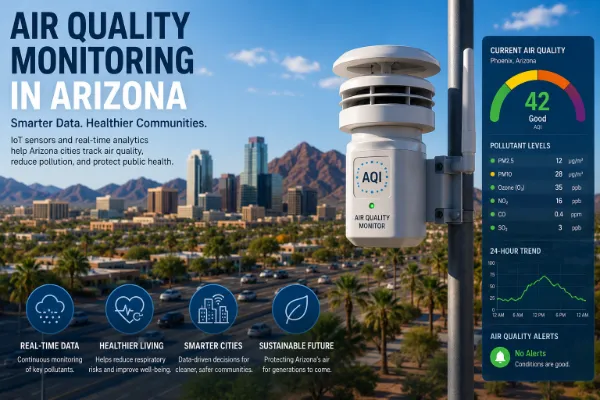
Air quality monitoring in Arizona is becoming more important as cities grow, summers get hotter, wildfire smoke travels across regions, construction expands, and dust events affect transportation, schools, businesses, and public health. For Arizona, air quality is not only an environmental topic. It is also a smart city, public safety, building management, and infrastructure planning issue.
This article takes an Arizona-specific approach: how connected air sensors, public monitoring stations, indoor air quality systems, smart buildings, schools, cities, and businesses can use air quality data to make better decisions.
Most air quality articles stop at “check the AQI.” That is useful, but incomplete. Arizona needs a deeper view because air quality can change by neighborhood, time of day, weather pattern, road activity, construction zone, wildfire smoke movement, and indoor building condition.
Air quality monitoring is becoming Arizona’s environmental intelligence layer. It helps communities understand what is happening in the air across roads, schools, buildings, industrial corridors, neighborhoods, parks, and public facilities.
In Arizona, air quality monitoring can help with:
- Ozone tracking during hot weather
- PM10 dust monitoring during windy conditions
- PM2.5 monitoring during wildfire smoke or combustion events
- Indoor air quality management in schools and commercial buildings
- Construction site dust management
- Warehouse and industrial air visibility
- Public health alerts
- Smart city planning
- Heat and pollution resilience
Arizona has a unique air quality profile. The state’s dry climate, desert dust, vehicle traffic, construction activity, wildfire smoke exposure, extreme heat, and urban growth can all influence air quality conditions. The Arizona Department of Environmental Quality issues forecasts for pollutants such as ozone and particulate matter in Maricopa County and other parts of the state when unhealthy pollution levels are expected. ADEQ air quality forecasts
ADEQ also conducts ambient air quality monitoring across Arizona, including criteria pollutants such as ozone, PM10, PM2.5, carbon monoxide, nitrogen oxides, sulfur dioxide, lead, and air toxics. ADEQ air quality monitoring
That official monitoring network is essential. IoT sensors and lower-cost monitors can add more localized visibility when used correctly, especially for buildings, campuses, neighborhoods, and temporary projects.
Air quality monitoring is the process of measuring pollutants and environmental conditions in the air. Monitoring can happen outdoors through regulatory stations, city sensor networks, mobile monitors, or temporary sensors. It can also happen indoors through building air quality systems.
| Pollutant or Condition |
Why It Matters in Arizona |
Common Monitoring Use Case |
| Ozone (O3) |
Often associated with hot, sunny conditions and urban emissions |
Regional AQI forecasting, public health alerts |
| PM10 |
Coarse particles often related to dust, disturbed soil, roads, and wind |
Dust monitoring, construction, transportation safety |
| PM2.5 |
Fine particles associated with smoke, combustion, and regional pollution |
Wildfire smoke tracking, indoor filtration decisions |
| Carbon Dioxide (CO2) |
Useful indoor ventilation indicator |
Schools, offices, healthcare, commercial buildings |
| Temperature and Humidity |
Important for heat risk, comfort, and sensor interpretation |
Indoor air quality, public spaces, smart buildings |
| VOCs |
May indicate chemical sources, cleaning products, materials, or poor ventilation |
Indoor air monitoring, industrial and commercial spaces |
Arizona’s official monitoring stations provide high-quality regulatory and public health data. IoT air sensors are different. They are often lower-cost, easier to deploy, and useful for localized visibility, but they may not be as accurate as regulatory monitors.
The EPA explains that low-cost air pollution monitors use sensors and components to detect and report pollutants such as particulate matter, carbon dioxide, temperature, or humidity. EPA also notes that air sensor users should understand sensor performance, setup, data interpretation, and limitations. EPA low-cost air monitors and EPA air sensor guidebook
| Monitoring Type |
Strength |
Limitation |
| Regulatory Monitoring Stations |
High-quality data used for official monitoring and compliance |
Fewer locations and less neighborhood-level detail |
| Low-Cost IoT Sensors |
More localized visibility and easier deployment |
May require calibration, validation, and careful interpretation |
| Indoor Air Monitors |
Useful for building ventilation, filtration, and comfort decisions |
Usually not a substitute for professional investigation or certified alarms |
| Mobile Monitoring |
Can identify spatial patterns across roads, corridors, and neighborhoods |
Data may vary by route, time, season, and weather |
Dust is one of Arizona’s most important air quality challenges. PM10 can increase during windy conditions, construction activity, disturbed soil, unpaved lots, agricultural operations, and traffic movement over dusty surfaces.
Dust monitoring matters because it affects health, visibility, road safety, construction compliance, and community comfort. For cities and developers, localized dust sensors can help identify when conditions are worsening and when mitigation may be needed.
Smart dust monitoring may support:
- Construction site dust control
- Road corridor visibility monitoring
- Industrial yard management
- School outdoor activity decisions
- Neighborhood air quality transparency
- Public works response during wind events
Related category: Construction & Real Estate
Related reading: IoT for Construction Site Monitoring in Arizona
Ozone is another major Arizona concern, especially during hot, sunny weather. Ozone is not emitted directly from one pipe or stack in the same way as some pollutants. It forms through chemical reactions involving emissions and sunlight, which makes forecasting and regional monitoring important.
ADEQ meteorologists issue air quality forecasts for ozone and particulate matter to inform the public when unhealthy pollution levels are anticipated. ADEQ forecast page
For Arizona smart cities, ozone data can help agencies plan public alerts, outdoor worker guidance, school activity recommendations, and community health messaging.
Wildfire smoke can travel long distances and affect communities far from the fire itself. PM2.5 monitoring is especially important during smoke events because fine particles can enter indoor spaces and affect sensitive groups.
For Arizona schools, senior living communities, healthcare facilities, offices, and public buildings, PM2.5 monitoring can help guide decisions about filtration, ventilation, and indoor protection. Outdoor smoke conditions may also affect events, sports, construction work, and public safety planning.
Indoor air quality is a growing part of smart building management. In Arizona, indoor air monitoring is especially important because buildings often stay closed and air-conditioned for long periods during extreme heat. HVAC performance, filtration, ventilation, occupancy, humidity, and pollutant sources can all affect indoor conditions.
Indoor air quality systems may monitor:
- CO2
- PM2.5
- PM10
- Temperature
- Humidity
- VOCs
- Ventilation performance
When connected to building automation, air quality data can help facility teams adjust ventilation, filtration, HVAC schedules, and maintenance priorities.
Related reading: IoT Building Automation in Arizona
Explore category: Smart Building & Commercial IoT
Arizona schools and campuses can benefit from air quality monitoring because students, teachers, and staff spend long hours indoors, while outdoor activities may be affected by heat, ozone, dust, or smoke.
Useful school applications include:
- CO2 monitoring to understand ventilation
- PM2.5 monitoring during wildfire smoke events
- PM10 monitoring during dust events
- Gym, classroom, and cafeteria air visibility
- Outdoor activity decision support
- HVAC maintenance prioritization
Air monitoring does not replace good building maintenance, but it gives administrators and facility teams better information for decisions.
Warehouses, factories, logistics facilities, and industrial sites may need air monitoring for worker comfort, dust control, ventilation, equipment areas, and regulatory awareness. Arizona’s industrial growth makes this more relevant in cities such as Phoenix, Chandler, Goodyear, Mesa, Glendale, and Tucson.
Industrial air monitoring may include particulate sensors, VOC monitoring, temperature and humidity tracking, ventilation data, and alerts tied to facility management platforms.
Related category: Industrial IoT
Related reading: Industrial IoT Solutions for Phoenix Manufacturing
Air quality monitoring also connects with public safety. Dust storms can affect road visibility. Smoke can affect emergency planning. Heat and pollution can increase risk for vulnerable residents. Poor indoor air can disrupt public buildings.
Connected sensors can help cities and agencies see environmental risks earlier and communicate more effectively.
Related reading: Public Safety IoT in Arizona
Explore category: Public Safety
| City |
Air Quality Monitoring Opportunity |
Internal Link |
| Phoenix |
Ozone, dust, heat, traffic corridors, smart buildings, public health alerts |
Public Safety in Phoenix |
| Mesa |
Growth corridors, construction dust, schools, transportation visibility |
Public Safety in Mesa |
| Chandler |
Industrial corridors, semiconductor-area infrastructure, commercial buildings |
Public Safety in Chandler |
| Scottsdale |
Resorts, healthcare facilities, schools, commercial indoor air quality |
Public Safety in Scottsdale |
| Tempe |
Campus areas, dense traffic, commercial buildings, public spaces |
Public Safety in Tempe |
| Goodyear |
Warehouses, logistics corridors, dust and industrial facility monitoring |
Public Safety in Goodyear |
| Glendale |
Event districts, traffic movement, commercial areas, public infrastructure |
Public Safety in Glendale |
| Gilbert |
Schools, residential growth, municipal facilities, outdoor activity planning |
Public Safety in Gilbert |
| Tucson |
Dust, ozone, smoke, university-area monitoring, regional environmental visibility |
Public Safety in Tucson |
IoT air quality sensors can fill practical information gaps when they are planned and interpreted correctly. For example, a city may use official monitoring data for regional air quality but deploy localized sensors near schools, roads, parks, construction zones, or public buildings to understand neighborhood-level conditions.
Good sensor programs should include:
- Clear monitoring goals
- Proper sensor placement
- Calibration or comparison with reference data where possible
- Maintenance and cleaning schedules
- Data quality checks
- Public communication rules
- Action plans tied to sensor readings
- Assuming low-cost sensors are regulatory monitors: They are useful, but they need careful interpretation.
- Placing sensors poorly: A sensor near a grill, exhaust vent, or dusty corner may not represent broader conditions.
- Collecting data without action: Monitoring should support decisions, not just dashboards.
- Ignoring maintenance: Dust, heat, and weather can affect device performance.
- Overreacting to one reading: Trends, context, and calibration matter.
- Using indoor monitors as safety alarms: Some monitors are informational and not certified emergency devices.
Arizona businesses can use air quality data to protect workers, improve building operations, and support sustainability reporting. Commercial buildings, warehouses, schools, healthcare facilities, resorts, and industrial sites may all benefit from better air visibility.
| Business Type |
Useful Air Quality Data |
Possible Action |
| Office Buildings |
CO2, temperature, humidity, PM2.5 |
Adjust ventilation and filtration |
| Warehouses |
Dust, PM10, temperature, ventilation |
Improve air movement and dust controls |
| Schools |
CO2, PM2.5, PM10 |
Guide HVAC maintenance and outdoor activity decisions |
| Healthcare Facilities |
Filtration performance, PM2.5, humidity |
Protect sensitive occupants and maintain comfort |
| Construction Sites |
PM10, wind, dust trends |
Improve dust suppression timing |
| Resorts and Hospitality |
Indoor comfort, outdoor air, smoke events |
Improve guest experience and facility planning |
Air quality monitoring is becoming a core smart building feature. Modern commercial properties can use air data alongside HVAC performance, occupancy, energy use, and maintenance data.
For example, a building automation system may detect rising CO2 in a meeting area, increased PM2.5 during a smoke event, or humidity conditions that affect comfort. Facility teams can then adjust ventilation, filtration, or schedules.
Related reading: Smart HVAC Monitoring in Arizona’s Extreme Heat
Smart city air monitoring can help Arizona communities identify environmental patterns that are invisible from a single monitoring station. Sensors may be placed near corridors, parks, schools, transit stops, construction zones, or municipal facilities.
However, smart city monitoring should be transparent. Residents should understand what is measured, how accurate the data is, and what actions the city may take based on the readings.
Related reading: IoT Applications in Arizona Municipalities
Air quality monitoring depends on sensors, semiconductors, connectivity, edge computing, dashboards, automation, and analytics. Arizona’s broader IoT ecosystem includes companies connected to many of these enabling technologies.
These companies do not all provide air quality monitors directly, but they represent parts of the larger sensing, connectivity, semiconductor, automation, and public safety technology ecosystem that supports smart infrastructure.
The right system depends on the goal. A school may need classroom CO2 and PM2.5 monitoring. A construction site may need PM10 and wind data. A city may need outdoor sensor networks. A warehouse may need dust and ventilation visibility.
- Are you monitoring indoor air, outdoor air, or both?
- Which pollutant matters most: PM2.5, PM10, ozone, CO2, VOCs, or temperature?
- Is the system for public information, operational decisions, or compliance support?
- How accurate does the data need to be?
- Can the sensor be compared with official or reference data?
- How will the system handle Arizona heat, dust, and outdoor exposure?
- Who receives alerts?
- What actions will be taken when readings rise?
- How will data be stored, shared, and explained?
The future of air quality monitoring in Arizona will likely include more localized sensors, better public dashboards, improved indoor air systems, smart building integration, heat-risk mapping, mobile monitoring, and AI-assisted interpretation.
The most valuable systems will not simply collect more air data. They will help people act on it: when to adjust HVAC, when to limit outdoor activity, when to suppress dust, when to change filters, when to alert residents, and when to investigate a recurring pollution source.
Air quality monitoring in Arizona is becoming a practical tool for healthier buildings, smarter cities, safer public spaces, and better infrastructure planning. Official monitoring networks remain essential, while IoT sensors can add local visibility when used responsibly.
For Arizona communities, the opportunity is clear: use air quality data to make better decisions about dust, ozone, smoke, indoor air, construction, transportation, and public safety. In a state shaped by heat, growth, and desert conditions, seeing the air more clearly is a smart infrastructure advantage.
Frequently asked questions
Air quality monitoring measures pollutants and environmental conditions such as ozone, PM2.5, PM10, CO2, VOCs, temperature, and humidity.
It is important because Arizona faces ozone, dust, wildfire smoke, construction activity, traffic emissions, extreme heat, and rapid urban growth.
Common pollutants include ozone, PM10, PM2.5, carbon monoxide, nitrogen oxides, sulfur dioxide, lead, and air toxics.
Low-cost sensors can provide useful local information, but they may not match regulatory-grade monitors. Calibration, placement, and interpretation matter.
They can help facility teams monitor ventilation, filtration, CO2, particulates, comfort, and HVAC performance.
Yes. PM2.5 monitoring can help schools, businesses, and public agencies make decisions about filtration, indoor protection, and outdoor activity.
It gives cities better visibility into neighborhood-level conditions, transportation corridors, public spaces, schools, and environmental risks.
Many businesses monitor CO2, PM2.5, temperature, humidity, and VOCs depending on building type, occupancy, and HVAC systems.
Related articles

 Public Safety