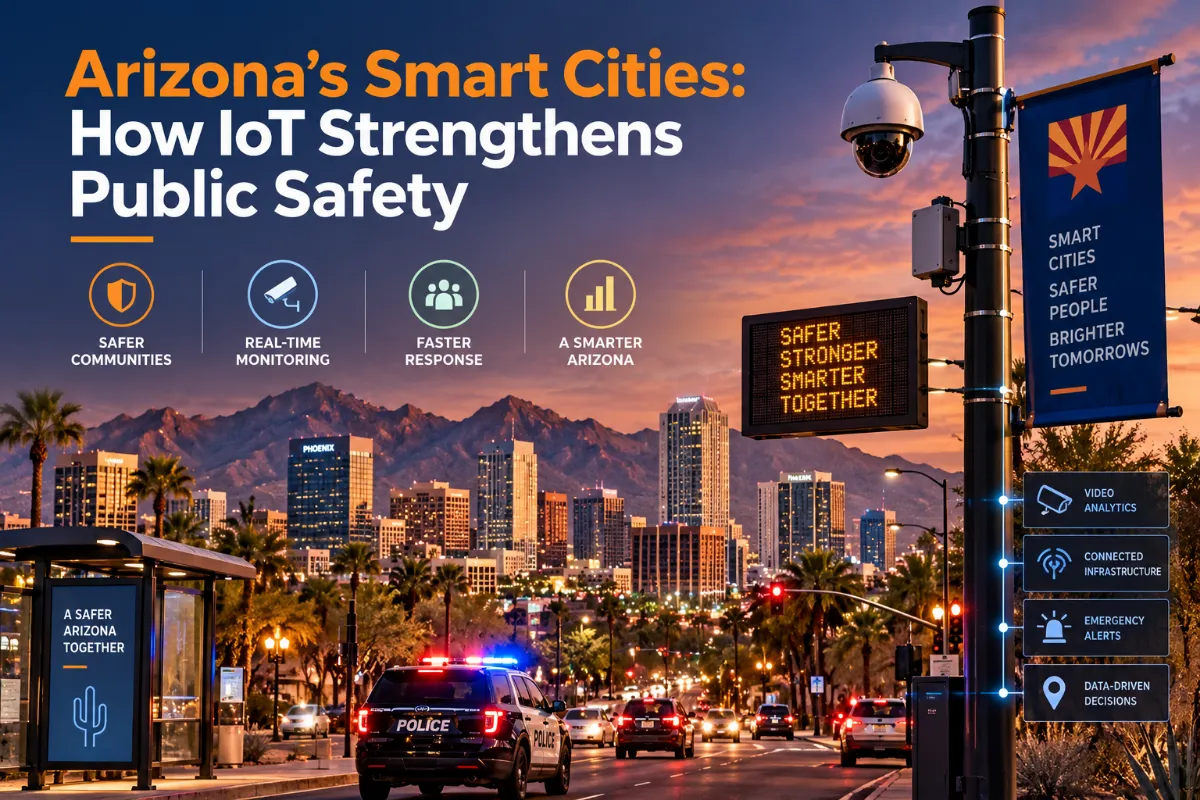
Public safety in Arizona is becoming more connected. As cities grow, roads get busier, weather events become more disruptive, and public infrastructure becomes more complex, communities need better ways to detect risks, coordinate emergency response, and protect residents, businesses, schools, transportation corridors, and public spaces.
That is where public safety IoT comes in. Internet of Things technology allows cities, utilities, buildings, transportation systems, and emergency agencies to collect real-time data from cameras, sensors, traffic systems, weather stations, lighting networks, and connected infrastructure.
Arizona has a unique public safety environment. Phoenix, Mesa, Chandler, Scottsdale, Tempe, Glendale, Goodyear, Gilbert, and Tucson all face different combinations of population growth, transportation demand, extreme heat, large events, utility pressure, industrial expansion, and emergency response needs.
Traditional public safety systems often depend on phone calls, manual monitoring, and delayed reporting. Smart public safety systems add another layer: real-time visibility. Sensors, cameras, alerts, and connected platforms can help identify incidents earlier and give agencies better information before, during, and after an event.
- Detecting traffic incidents faster
- Monitoring extreme heat risks in public spaces
- Improving emergency response coordination
- Supporting connected street lighting and safer corridors
- Monitoring critical infrastructure
- Improving situational awareness during large events
- Helping cities move from reactive response to proactive prevention
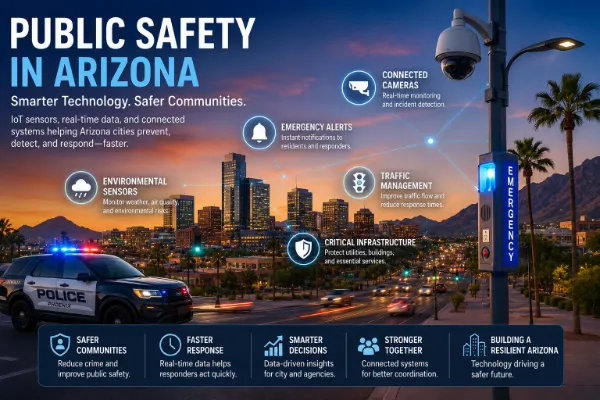
Public safety IoT refers to connected technologies that help communities monitor, detect, alert, and respond to risks. These systems may include sensors, cameras, emergency communication tools, smart traffic systems, environmental monitoring, connected lighting, drones, utility alerts, and building safety systems.
The goal is not to replace first responders. The goal is to give emergency teams, city operators, utility managers, and public agencies better information when time matters.
| Technology |
Public Safety Use |
Arizona Example |
| Connected Cameras |
Improve visibility in public areas, intersections, facilities, and event zones |
Downtown districts, stadium areas, transit corridors |
| Smart Streetlights |
Support lighting control, sensors, and connected safety infrastructure |
City streets, parks, parking areas, pedestrian zones |
| Traffic Sensors |
Detect congestion, crashes, wrong-way driving risks, and emergency routing needs |
Phoenix metro roads, commercial corridors, school zones |
| Environmental Sensors |
Monitor heat, air quality, flooding risk, smoke, and weather conditions |
Public spaces, campuses, industrial zones, desert-edge communities |
| Utility Monitoring |
Detect power, water, and infrastructure disruptions |
Smart grids, leak detection, water pressure monitoring |
| Emergency Alerts |
Send faster notifications to agencies, residents, or facility teams |
Heat alerts, evacuation notices, facility alarms, outage notifications |
Public safety in Arizona is not limited to crime prevention or emergency calls. The state’s safety needs are spread across transportation, utilities, heat exposure, water systems, commercial buildings, industrial sites, large events, schools, and neighborhoods.
This is why public safety IoT must be treated as connected infrastructure. A traffic signal, streetlight, smart building sensor, water leak alert, grid outage notification, and emergency dispatch system may all affect public safety in different ways.
Smart city planning is one of the most important reasons public safety IoT is growing. A city with better infrastructure data can make faster, more informed decisions during emergencies.
Public safety systems connect naturally with Smart Cities & Government because modern cities need more than cameras or emergency vehicles. They need connected systems that help agencies understand what is happening across roads, buildings, utilities, parks, and public facilities.
Related reading: How Phoenix Is Becoming a Smart City
Streetlights are becoming more than lights. In smart city planning, connected street lighting can provide a platform for public safety sensors, wireless communication, environmental monitoring, traffic visibility, and better lighting control.
For Arizona cities, connected streetlights can help improve visibility in pedestrian areas, parking lots, transit stops, downtown corridors, parks, and event districts. They can also support energy efficiency by adjusting lighting based on time, motion, or location needs.
Related reading: Connected Street Lighting Systems
Arizona’s heat makes environmental monitoring a public safety issue. Extreme temperatures can affect outdoor workers, unhoused residents, older adults, children, transit riders, athletes, and people waiting in exposed public spaces.
IoT sensors can help cities and facility teams monitor surface temperatures, shade conditions, indoor facility temperatures, equipment stress, and public cooling infrastructure. This does not replace public health programs, but it can support better planning and faster response.
Examples of heat-related public safety monitoring include:
- Temperature sensors in public spaces
- Cooling center equipment monitoring
- Smart HVAC alerts in public buildings
- Outdoor worker safety alerts
- Energy demand monitoring during heat events
- Heat mapping for parks, sidewalks, and transit stops
Related reading: Smart HVAC Monitoring in Arizona’s Extreme Heat
Traffic is one of the clearest public safety use cases for IoT. Connected traffic systems can help cities monitor congestion, detect incidents, manage signals, improve emergency vehicle movement, and identify dangerous intersections.
In fast-growing Arizona communities, road safety is tied to development. New housing, warehouses, schools, entertainment districts, and industrial corridors can change traffic patterns quickly. Smart sensors and analytics help transportation teams respond to those changes with better data.
- Crash detection support
- Traffic signal optimization
- Emergency vehicle prioritization
- Pedestrian and cyclist detection
- School zone monitoring
- Wrong-way driving alerts
- Work zone safety monitoring
Public safety is also a building issue. Commercial properties need to manage access control, fire safety, water leaks, HVAC failures, indoor air quality, equipment rooms, parking areas, and emergency communication.
In Arizona, commercial buildings may also face heat-related equipment strain and high energy demand. When safety systems connect with building automation, property teams can monitor risks before they become emergencies.
Related reading: IoT Building Automation in Arizona
Utilities are part of public safety. Power outages, water main breaks, sewer problems, streetlight failures, and communication disruptions can all affect emergency response and community resilience.
Smart utility systems help cities and providers detect issues earlier and coordinate repairs faster. This is why public safety IoT overlaps with Smart Utilities.
Examples include:
| City |
Public Safety IoT Opportunity |
Internal Link |
| Phoenix |
Heat monitoring, traffic safety, smart lighting, downtown infrastructure, emergency response coordination |
Public Safety in Phoenix |
| Mesa |
Growth corridor safety, municipal infrastructure monitoring, school and road safety |
Public Safety in Mesa |
| Chandler |
Industrial corridor safety, semiconductor-area infrastructure, traffic and facility monitoring |
Public Safety in Chandler |
| Scottsdale |
Resort district safety, commercial building monitoring, event and pedestrian safety |
Public Safety in Scottsdale |
| Tempe |
Urban mobility, campus-area safety, smart lighting, pedestrian monitoring |
Public Safety in Tempe |
| Glendale |
Event district safety, logistics corridors, commercial areas, traffic management |
Public Safety in Glendale |
| Goodyear |
Warehouse and logistics safety, road growth, industrial infrastructure monitoring |
Public Safety in Goodyear |
| Gilbert |
Residential growth, school zone safety, municipal infrastructure monitoring |
Public Safety in Gilbert |
| Tucson |
Heat resilience, university-area safety, transportation corridors, environmental monitoring |
Public Safety in Tucson |
Arizona’s industrial growth creates another public safety use case. Warehouses, factories, logistics yards, semiconductor facilities, and manufacturing corridors need monitoring for access control, fire safety, worker safety, equipment risk, traffic movement, and utility reliability.
Public safety technology in industrial settings may include connected cameras, environmental sensors, access control, emergency alarms, predictive equipment alerts, and smart traffic management around large sites.
Related category: Industrial IoT
Related reading: Industrial IoT Solutions for Phoenix Manufacturing
Public safety IoT creates useful data, but cities and businesses must handle it responsibly. Camera systems, sensors, license plate data, building access logs, and emergency alerts raise legitimate questions about privacy, cybersecurity, transparency, and retention policies.
Strong public safety programs should define:
- What data is collected
- Why the data is collected
- Who can access it
- How long it is stored
- How systems are secured
- How residents and stakeholders are informed
The goal should be safer, more resilient communities without unnecessary data collection or unclear surveillance practices.
Connected public safety systems must be secure. A camera network, emergency alert platform, traffic control system, or utility monitoring tool can become a risk if it is not properly protected.
Important cybersecurity controls include:
- Encrypted communication
- Strong user access controls
- Device authentication
- Regular software updates
- Vendor security reviews
- Incident response planning
- Network segmentation
Public safety technology should improve resilience, not introduce new vulnerabilities.
Public safety IoT depends on sensors, semiconductors, cameras, edge computing, communications, automation, and analytics. Arizona’s broader technology ecosystem includes companies connected to many of these enabling technologies.
These organizations represent different parts of the broader connected technology environment that supports safer infrastructure, communications, sensing, automation, and emergency visibility.
The strongest public safety IoT projects start with a real operational problem, not with a technology purchase. Cities and organizations should first identify the risk they are trying to reduce.
- What incident or risk are we trying to detect earlier?
- Who needs to receive the alert?
- What action should happen after the alert?
- Does the system integrate with existing emergency operations?
- How will privacy and data governance be handled?
- What happens if the network fails?
- How will success be measured?
- Buying devices without a response plan: Sensors are only useful if alerts lead to action.
- Creating isolated systems: Public safety technology should connect with relevant city, utility, or facility workflows.
- Ignoring privacy concerns: Public trust matters, especially with camera and location-based systems.
- Underestimating cybersecurity: Connected safety systems must be protected from misuse.
- Measuring success only by device count: The real metric is better response, lower risk, and stronger resilience.
The future of public safety in Arizona will likely include more connected streetlights, smarter traffic systems, environmental monitoring, emergency dashboards, AI-assisted video review, building safety automation, utility alerts, and real-time coordination across agencies.
The most valuable public safety systems will not be the ones with the most sensors. They will be the ones that help people make faster, better, and more accountable decisions.
Public safety IoT in Arizona is becoming part of the state’s broader smart infrastructure future. From heat monitoring and traffic safety to connected buildings, utility alerts, smart lighting, and emergency response coordination, these technologies can help communities detect risks earlier and respond more effectively.
For Arizona cities, businesses, and public agencies, the opportunity is clear: use connected infrastructure to improve visibility, reduce response delays, protect people, and build more resilient communities.
Frequently asked questions
Public safety IoT refers to connected sensors, cameras, alerts, traffic systems, utility monitors, and emergency platforms that help detect risks and improve response.
It is important because Arizona faces rapid growth, extreme heat, traffic pressure, utility demands, large events, and infrastructure expansion.
IoT can provide real-time alerts, better situational awareness, faster incident detection, and more coordinated response across agencies or facility teams.
Yes. Smart streetlights can improve visibility, support sensors, provide infrastructure for connected devices, and help cities manage public spaces more effectively.
Yes. Temperature sensors, cooling center monitoring, HVAC alerts, and heat mapping can support public safety planning during extreme heat events.
Yes. Camera systems, location data, and access logs should be governed with clear policies for data collection, retention, access, and security.
Phoenix, Mesa, Chandler, Scottsdale, Tempe, Glendale, Goodyear, Gilbert, Tucson, and other growing communities can benefit from connected public safety systems.
Related articles

 Public Safety