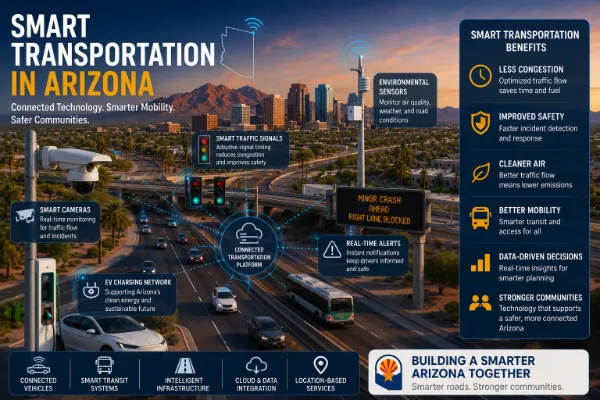
Fleet telematics is becoming one of the most practical IoT technologies for Arizona businesses, public agencies, logistics operators, contractors, utilities, and service companies. As Arizona grows, more vehicles are moving through Phoenix, Mesa, Chandler, Tempe, Scottsdale, Glendale, Goodyear, Tucson, and regional freight corridors. That creates new pressure around routing, driver safety, fuel use, maintenance, insurance risk, compliance, and customer delivery expectations.
For Arizona, fleet telematics is not just GPS tracking. It is becoming a connected operating layer for transportation, logistics, construction, utilities, field service, delivery, municipal fleets, and electric vehicle operations.
Most fleet telematics articles explain basic vehicle tracking. That is useful, but too limited. In Arizona, the bigger opportunity is connected operations. Fleet telematics can help organizations understand where vehicles are, how they are being driven, when maintenance is needed, how routes are performing, which assets are underused, and how rising EV adoption changes energy planning.
Arizona fleets can use telematics to manage:
- Route efficiency across long metro and regional distances
- Driver safety in high-growth traffic corridors
- Vehicle maintenance during extreme heat
- Fuel consumption and idling
- Delivery timing and customer service
- Asset security for trailers, tools, and equipment
- Fleet electrification and charging schedules
- Compliance and reporting
- Public works and municipal service response
Fleet telematics is the use of connected devices, GPS, vehicle diagnostics, sensors, software, and communication networks to monitor and manage vehicles and mobile assets. A telematics system collects data from vehicles and sends it to a fleet management platform where managers can analyze performance and make decisions.
Modern fleet telematics may include GPS tracking, vehicle diagnostics, driver behavior monitoring, electronic logging, fuel monitoring, route optimization, dash cameras, maintenance alerts, trailer tracking, EV battery data, and mobile driver workflows.
| Telematics Feature |
What It Tracks |
Arizona Use Case |
| GPS Tracking |
Vehicle location, route history, arrival times |
Delivery, field service, public works, construction |
| Vehicle Diagnostics |
Engine codes, battery health, odometer, faults |
Preventive maintenance during extreme heat |
| Driver Behavior |
Speeding, harsh braking, acceleration, cornering |
Safety programs and insurance risk reduction |
| Fuel and Idling Data |
Fuel use, idle time, inefficient routes |
Cost control for service and logistics fleets |
| Asset Tracking |
Trailers, equipment, tools, containers |
Construction, logistics yards, utility operations |
| EV Fleet Data |
Battery state, charging status, range, energy use |
Fleet electrification and charging planning |
Arizona’s transportation environment makes fleet visibility especially valuable. The state has long driving distances, extreme summer heat, rapid suburban growth, expanding logistics hubs, construction activity, tourism, and major freight corridors. The Maricopa Association of Governments plays a major role in regional transportation planning across freeways, arterial streets, and transit, reflecting how important mobility is to the region’s growth. MAG transportation planning
For fleets, these conditions create practical questions:
- Which routes create the most delay?
- Which vehicles idle too long in summer heat?
- Which drivers need safety coaching?
- Which assets are being underused?
- Which vehicles are due for maintenance?
- Which service areas are growing fastest?
- Where will EV fleet charging be needed?
GPS location is still important, but fleet telematics has moved far beyond “dots on a map.” Modern fleet systems combine vehicle data, driver behavior, maintenance intelligence, routing, safety tools, cameras, mobile workflows, and business reporting.
Leading telematics platforms commonly emphasize real-time GPS tracking, vehicle diagnostics, routing, driver safety, fuel or energy monitoring, and compliance features. Samsara fleet telematics overview
For Arizona fleet operators, the real value is not just knowing where a truck is. The value is knowing what is happening, why it matters, and what action should happen next.
Arizona’s logistics growth makes telematics especially important. Warehouses and distribution centers across Phoenix, Goodyear, Glendale, Mesa, Chandler, and Tucson need reliable vehicle visibility to manage delivery windows, driver productivity, routing, and customer expectations.
Fleet telematics can help logistics teams:
- Improve route planning
- Reduce missed delivery windows
- Monitor driver behavior
- Track trailers and containers
- Reduce idle time
- Improve dispatch decisions
- Document arrival and departure times
- Coordinate yard and dock activity
Related reading: Smart Transportation in Arizona
Explore city topic: Logistics & Transportation in Goodyear
Construction companies, HVAC contractors, plumbing companies, electrical contractors, landscaping crews, telecom teams, and mobile service businesses all rely on vehicles and equipment. In Arizona, crews often move between growing suburbs, new developments, commercial properties, and industrial sites.
Telematics can help these businesses see where crews are, which jobs are delayed, where equipment is located, and which vehicles need maintenance. It can also help document site visits and improve customer communication.
Related reading: IoT for Construction Site Monitoring in Arizona
Explore category: Construction & Real Estate
Arizona heat affects vehicles, drivers, batteries, tires, cooling systems, and roadside operations. Fleet telematics can help managers identify vehicle stress earlier and improve maintenance planning before failures disrupt service.
Heat-related telematics signals may include:
- Battery voltage problems
- Engine fault codes
- High coolant temperature
- Excessive idle time
- Tire pressure issues where supported
- Air conditioning performance complaints
- Delayed routes during peak heat
Fleet managers can use this data to schedule preventive maintenance, rotate vehicles, reduce unnecessary idling, and protect drivers during extreme heat periods.
Driver safety is one of the strongest reasons to invest in fleet telematics. Speeding, harsh braking, aggressive acceleration, distracted driving, and unsafe lane behavior can increase crash risk, insurance costs, vehicle wear, and customer complaints.
Telematics systems can support driver coaching through data rather than guesswork. Some systems also integrate dash cameras or AI video analytics to help review incidents and identify risky patterns.
Related reading: Smart Cameras in Arizona
Explore category: Public Safety
Cities, counties, school districts, utilities, and public agencies operate many types of vehicles: police support units, public works trucks, inspectors, buses, maintenance vehicles, sanitation trucks, emergency support vehicles, and parks department equipment.
Telematics can improve public service delivery by helping agencies monitor:
- Vehicle availability
- Fuel use
- Route coverage
- Emergency response support
- Maintenance needs
- Idle time
- Snow, dust, storm, or flood response assets where relevant
- Service verification for public works tasks
Related reading: Public Safety IoT in Arizona
EV fleet management is becoming more important as organizations electrify light-duty, medium-duty, delivery, municipal, and service vehicles. EV fleet software and telematics are expected to grow significantly as commercial fleets scale electric vehicles, with one 2026 market report projecting strong growth in EV fleet management through 2030. EV fleet management market report
EV telematics adds new data points that traditional fleet systems did not need to track:
- Battery state of charge
- Remaining range
- Charging session status
- Energy consumption per route
- Charger availability
- Depot charging schedules
- Peak demand management
- Vehicle-to-grid readiness where supported
Related reading: EV Charging Infrastructure in Arizona
Related reading: Smart Electric Grids in Arizona
Fuel and energy costs can be one of the largest fleet expenses. Telematics can help reduce waste by showing where vehicles idle too long, where routes are inefficient, which drivers use more fuel, and which vehicles are ready for replacement.
For businesses with sustainability goals, telematics can support reporting around:
- Fuel consumption
- Idle time
- Route efficiency
- EV adoption progress
- CO2 emissions estimates
- Maintenance-related fuel waste
Explore category: Energy & Sustainability
| City |
Fleet Telematics Opportunity |
Internal Link |
| Phoenix |
Delivery fleets, service vehicles, public works, airport-area logistics, EV fleet planning |
Logistics & Transportation in Phoenix |
| Goodyear |
Warehouse fleets, truck routing, trailer tracking, industrial corridor visibility |
Logistics & Transportation in Goodyear |
| Glendale |
Event traffic support, logistics corridors, municipal fleet coordination |
Logistics & Transportation in Glendale |
| Mesa |
Field service routing, public works fleets, construction growth corridors |
Logistics & Transportation in Mesa |
| Chandler |
Technology campus service fleets, industrial mobility, employee shuttle planning |
Logistics & Transportation in Chandler |
| Tempe |
Urban delivery, campus fleets, parking enforcement, micromobility coordination |
Logistics & Transportation in Tempe |
| Scottsdale |
Hospitality fleets, service contractors, event and resort transportation |
Logistics & Transportation in Scottsdale |
| Gilbert |
Residential service fleets, school transportation support, municipal operations |
Logistics & Transportation in Gilbert |
| Tucson |
Regional fleets, university services, public works, freight corridor planning |
Logistics & Transportation in Tucson |
Fleet telematics is one of the data sources that can make transportation smarter. When fleets share or use routing, congestion, charging, parking, and delivery data responsibly, cities and businesses can understand mobility patterns more clearly.
Telematics can support:
- Traffic-aware dispatching
- Delivery zone planning
- EV charging demand forecasting
- Road safety analysis
- Service area optimization
- Public works response tracking
Related category: Smart Cities & Government
Fleet telematics is not limited to vehicles. Many Arizona businesses also track trailers, containers, generators, compressors, skid steers, utility equipment, tools, and mobile assets.
Asset tracking is especially useful for construction, logistics, utilities, and field service companies because equipment often moves between job sites, yards, warehouses, and customer locations.
| Asset Type |
Telematics Value |
| Trailers |
Location, utilization, theft prevention, yard visibility |
| Construction Equipment |
Usage hours, job site location, maintenance planning |
| Generators |
Runtime, fuel status, service needs, deployment tracking |
| Utility Equipment |
Service readiness, field deployment, response planning |
| Tools and Containers |
Loss reduction, inventory visibility, site accountability |
Fleet telematics systems collect sensitive operational data, including vehicle locations, driver behavior, routes, customer sites, and sometimes video or audio from cameras. This makes cybersecurity and privacy important.
Fleet operators should define:
- Who can access vehicle location data
- How long route history is stored
- Whether driver behavior data is used for coaching or discipline
- How dash camera footage is reviewed
- How vendor systems are secured
- How employee privacy is communicated
- How data is protected from unauthorized access
Responsible telematics programs improve safety and operations without creating unclear surveillance practices.
The best fleet telematics system depends on the fleet type. A delivery company, city public works department, HVAC contractor, school transportation provider, logistics yard, and EV fleet all need different features.
- Do you need basic GPS, full fleet management, or EV fleet support?
- Will the system integrate with dispatch or work order software?
- Can it monitor vehicle diagnostics?
- Does it support driver safety coaching?
- Does it include dash camera integration?
- Can it track trailers or equipment?
- Does it provide fuel or energy reporting?
- Can it handle Arizona heat and field conditions?
- Does it support compliance reporting if needed?
- How strong are its privacy and cybersecurity controls?
- Buying GPS only when operations need analytics: Location is useful, but diagnostics, safety, maintenance, and routing often provide deeper value.
- Ignoring driver communication: Drivers should understand how data is used and how it supports safety.
- Not connecting telematics to maintenance: Fault codes and mileage data should feed real service workflows.
- Failing to measure outcomes: Track fuel savings, reduced idle time, fewer incidents, better on-time performance, and maintenance improvements.
- Overlooking EV readiness: New fleet systems should be ready for battery and charging data.
- Skipping cybersecurity review: Vehicle and route data must be protected.
Fleet telematics depends on semiconductors, sensors, connectivity, GPS hardware, edge computing, cloud platforms, cameras, and analytics. Arizona’s broader IoT ecosystem includes companies connected to many of these enabling technologies.
These companies do not all sell fleet telematics systems directly, but they represent the broader connected device, semiconductor, sensing, public safety, and manufacturing ecosystem that supports modern fleet technology.
The next phase of fleet telematics in Arizona will likely include more AI-assisted routing, EV fleet optimization, predictive maintenance, integrated dash cameras, automated compliance workflows, real-time customer updates, and stronger connections with smart transportation platforms.
The most valuable fleet systems will not simply collect more data. They will help managers answer operational questions faster: which route is best, which vehicle needs service, which driver needs coaching, which charger is available, which asset is missing, and which customer will be delayed.
Fleet telematics in Arizona is becoming essential for organizations that depend on vehicles, drivers, equipment, and mobile operations. GPS tracking is only the beginning. The real value comes from connecting location, diagnostics, driver safety, maintenance, fuel, EV charging, and routing data into one decision-making system.
For Arizona businesses and public agencies, fleet telematics can reduce waste, improve safety, support growth, prepare for electrification, and make transportation operations more reliable in a fast-moving state.
Frequently asked questions
Fleet telematics uses GPS, sensors, vehicle diagnostics, software, and communication networks to monitor and manage vehicles, drivers, routes, and mobile assets.
It is important because Arizona has rapid growth, long driving distances, extreme heat, expanding logistics corridors, construction activity, and increasing EV fleet planning needs.
No. GPS tracking is one feature. Modern telematics can also include vehicle diagnostics, driver safety data, fuel monitoring, route optimization, dash cameras, maintenance alerts, and EV battery data.
It can identify speeding, harsh braking, rapid acceleration, unsafe driving patterns, route risks, and incident trends that support driver coaching and risk reduction.
Yes. EV telematics can track battery state, charging sessions, range, energy use, charger availability, and route suitability for electric vehicles.
Delivery companies, contractors, utilities, municipalities, school transportation providers, logistics operators, warehouses, field service companies, and construction firms can benefit.
Yes. It can reduce fuel costs by identifying idling, inefficient routing, aggressive driving, maintenance issues, and underused vehicles.
Companies should consider GPS accuracy, diagnostics, driver safety tools, maintenance workflows, EV support, cybersecurity, privacy, integrations, and reporting needs.
Related articles


 Logistics & Transportation