Smart cameras are becoming one of the most visible parts of Arizona’s connected infrastructure. From public safety and traffic visibility to commercial buildings, warehouses, schools, parking areas, utilities, and smart city projects, camera systems are no longer just passive recording devices. Modern smart cameras can detect motion, recognize patterns, send alerts, support emergency response, and connect with broader IoT platforms.
For Arizona, this matters because the state’s cities are growing quickly, commercial districts are expanding, logistics and manufacturing activity are increasing, and public agencies need better visibility across roads, facilities, utility assets, and high-traffic areas.
Most articles about smart cameras focus only on security. That is too narrow for Arizona. A more useful way to understand smart cameras is to see them as the visual layer of smart infrastructure. They help buildings, cities, businesses, utilities, and emergency teams understand what is happening in the real world.
In Arizona, smart cameras may support:
- Public safety monitoring
- Traffic and intersection visibility
- Parking lot and garage safety
- Warehouse and logistics monitoring
- Construction site security
- School and campus safety
- Commercial building operations
- Utility site monitoring
- Event and pedestrian area awareness
- Heat and environmental response when paired with sensors
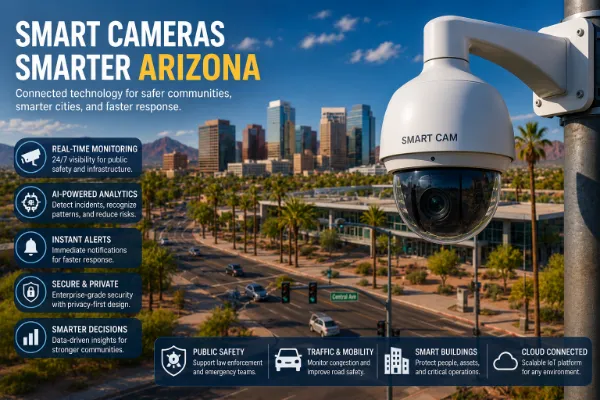
A smart camera is a connected camera that can capture video and use built-in or cloud-based intelligence to analyze what it sees. Unlike traditional CCTV systems, smart cameras can identify events, trigger alerts, integrate with access control, connect to IoT platforms, and help teams respond faster.
Common smart camera capabilities include:
- Motion detection
- Object detection
- Vehicle detection
- People counting
- License plate recognition
- Perimeter monitoring
- Queue and occupancy analytics
- Remote access
- Cloud storage
- Edge AI processing
- Integration with alarms and access systems
| Feature |
Traditional Camera |
Smart Camera |
| Primary Function |
Records video for later review |
Detects events and supports real-time response |
| Connectivity |
Often local or closed-system |
Connected through cloud, network, or IoT platform |
| Analytics |
Limited or manual review |
AI video analytics, alerts, and pattern detection |
| Use Cases |
Security footage |
Security, operations, traffic, safety, and infrastructure monitoring |
| Response |
Reactive |
Proactive alerts and faster decision-making |
Arizona’s camera needs are different from many other states because of the state’s growth patterns, climate, and infrastructure mix. Cities like Phoenix, Mesa, Chandler, Scottsdale, Tempe, Glendale, Goodyear, Gilbert, and Tucson include dense urban districts, industrial zones, logistics corridors, campuses, resorts, construction sites, and desert-edge communities.
Smart cameras can help these areas improve visibility, reduce blind spots, support first responders, document incidents, and improve daily operations. In fast-growing areas, cameras can also help organizations understand traffic flow, pedestrian movement, parking demand, and security risks.
Public safety is one of the strongest use cases for smart cameras. Connected cameras can help emergency teams and facility managers see incidents faster, confirm what is happening, and coordinate response more effectively.
Smart cameras can support:
- Incident detection
- Emergency response visibility
- Public space monitoring
- Parking lot safety
- School zone monitoring
- Traffic incident review
- Event security
- Critical infrastructure protection
Related reading: Public Safety IoT in Arizona
Explore category: Smart Cities & Government
Traffic visibility is a major smart camera opportunity in Arizona. Metro areas experience commuter traffic, event congestion, school zone safety concerns, construction activity, pedestrian corridors, and logistics movement. Smart cameras can help transportation teams understand how roads are being used and where risks are increasing.
Camera-based traffic analytics may help with:
- Intersection monitoring
- Pedestrian and cyclist detection
- Vehicle counting
- Congestion analysis
- Wrong-way movement alerts
- Incident confirmation
- Emergency vehicle routing support
When paired with smart signals and transportation sensors, cameras become part of a larger smart mobility system rather than just a video feed.
Commercial buildings in Arizona use smart cameras for more than security. Offices, medical buildings, hotels, retail centers, schools, warehouses, multifamily properties, and industrial sites can use camera analytics to improve safety, operations, staffing, and maintenance planning.
Smart camera use cases in commercial buildings include:
- Lobby and access point monitoring
- Parking lot and garage visibility
- Loading dock monitoring
- After-hours alerts
- Occupancy and queue analytics
- Restricted area monitoring
- Emergency evacuation support
- Integration with access control systems
Related reading: IoT Building Automation in Arizona
Explore category: Smart Building & Commercial IoT
Arizona’s industrial growth makes smart cameras especially useful for warehouses, manufacturing plants, logistics yards, and distribution centers. These facilities often need visibility across large spaces, loading areas, storage zones, equipment paths, and vehicle routes.
Smart cameras can help industrial sites monitor:
- Forklift and vehicle movement
- Loading dock activity
- Restricted areas
- Worker safety zones
- Inventory movement
- Perimeter access
- Equipment rooms
- Fire lanes and emergency routes
This connects directly with Industrial IoT because cameras can become another sensor layer inside connected operations.
Related reading: Industrial IoT Solutions for Phoenix Manufacturing
Construction sites are temporary, high-risk, and constantly changing. Arizona’s growth in residential communities, commercial buildings, manufacturing facilities, and infrastructure projects creates strong demand for smarter site monitoring.
Smart cameras can help construction teams monitor theft risk, after-hours access, material storage, equipment movement, safety compliance, weather conditions, and project progress.
Related reading: IoT for Construction Site Monitoring in Arizona
Explore category: Construction & Real Estate
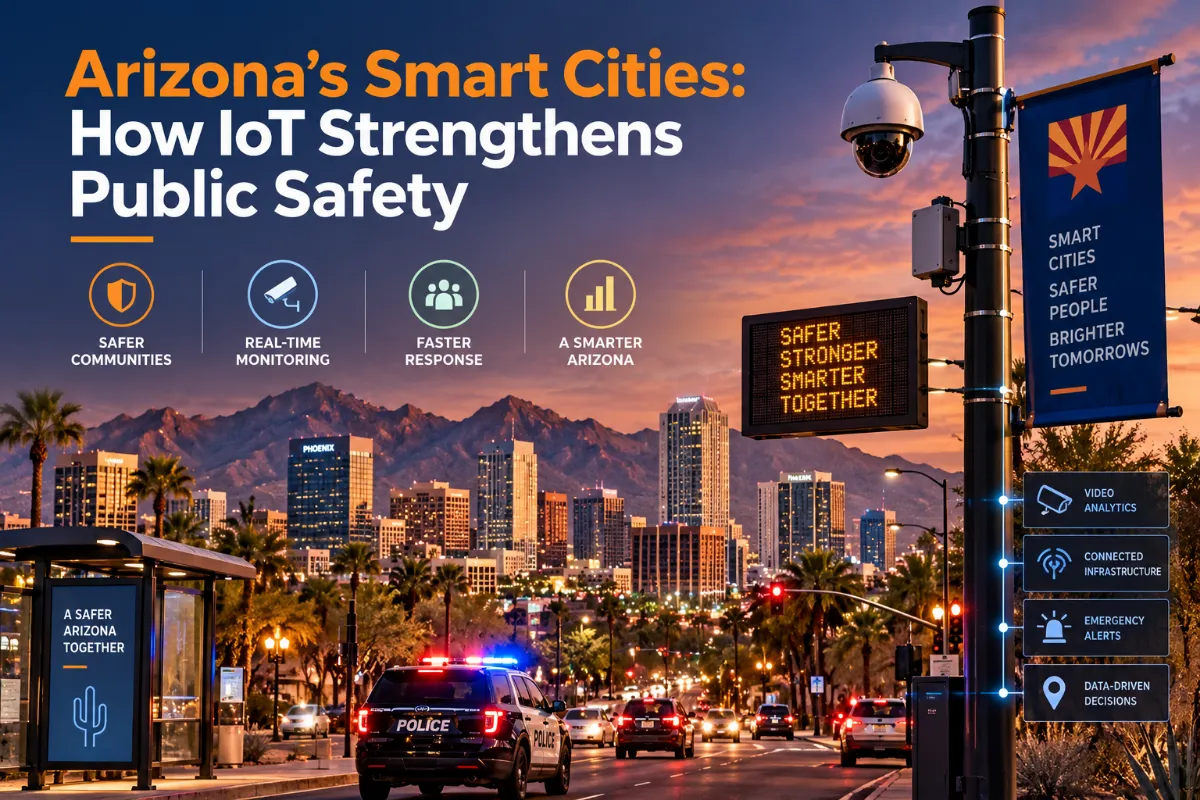
Connected streetlights can act as mounting points and network locations for smart cameras, environmental sensors, traffic devices, and public safety systems. In Arizona cities, this can help improve visibility in downtown districts, parking areas, transit stops, pedestrian zones, and event corridors.
Streetlight-based camera systems should be planned carefully with privacy, governance, cybersecurity, and public communication in mind. The value is strongest when the system solves a defined safety or operations problem, not when cameras are deployed without a clear purpose.
Related reading: Connected Street Lighting Systems
Smart cameras can improve safety, but they also create privacy concerns. Public agencies and businesses should be clear about why cameras are used, what data is collected, who can access footage, how long data is stored, and whether analytics such as license plate recognition or facial recognition are involved.
Privacy concerns around smart city technology and IoT are widely recognized, especially as monitoring and data collection increase in public spaces. Responsible deployments should use privacy-by-design, strong access controls, data minimization, and clear governance policies.
- Define the safety or operational problem first
- Avoid collecting unnecessary data
- Limit access to authorized users
- Use encryption and secure storage
- Set clear retention periods
- Document whether AI analytics are used
- Review vendor cybersecurity standards
- Communicate with residents, tenants, employees, or stakeholders
Smart cameras are network-connected devices, so cybersecurity must be part of every deployment. Poorly secured cameras can create vulnerabilities for buildings, cities, and businesses.
Important security practices include:
- Changing default passwords
- Using multi-factor authentication
- Keeping firmware updated
- Encrypting video streams
- Segmenting camera networks from core systems
- Limiting admin access
- Reviewing vendor security documentation
- Monitoring for unauthorized access
| City |
Smart Camera Opportunity |
Internal Link |
| Phoenix |
Downtown safety, traffic monitoring, commercial districts, smart city infrastructure |
Public Safety in Phoenix |
| Mesa |
Growth corridors, schools, road visibility, municipal facilities |
Public Safety in Mesa |
| Chandler |
Industrial site monitoring, semiconductor-area infrastructure, commercial corridors |
Public Safety in Chandler |
| Scottsdale |
Resorts, commercial properties, parking areas, event districts |
Public Safety in Scottsdale |
| Tempe |
Campus-area safety, pedestrian corridors, nightlife districts, parking systems |
Public Safety in Tempe |
| Glendale |
Sports and entertainment districts, traffic movement, parking and crowd visibility |
Public Safety in Glendale |
| Goodyear |
Logistics corridors, warehouses, construction growth, industrial safety |
Public Safety in Goodyear |
| Gilbert |
Residential growth, school zones, municipal facilities, retail centers |
Public Safety in Gilbert |
| Tucson |
University-area monitoring, traffic corridors, public spaces, environmental visibility |
Public Safety in Tucson |
Smart cameras depend on semiconductors, sensors, edge computing, cloud platforms, connectivity, AI analytics, storage, and cybersecurity. Arizona’s technology ecosystem includes companies connected to many of these enabling areas.
Axon, headquartered in Scottsdale, is especially relevant to the public safety technology conversation because of its work around connected devices, body-worn cameras, evidence platforms, and real-time communication tools.
The best smart camera system depends on the use case. A school, warehouse, city intersection, resort, HOA, construction site, and office building all have different needs.
- What problem should the camera system solve?
- Is real-time alerting needed?
- Will video be stored locally, in the cloud, or both?
- Does the system need AI analytics?
- Will cameras integrate with access control or alarms?
- What privacy policies are required?
- Who can access footage?
- How long will footage be retained?
- Does the system work in Arizona heat and outdoor conditions?
- How will cybersecurity be managed?
- Buying cameras without a response plan: Alerts need a clear workflow.
- Ignoring privacy: Public trust and legal review matter.
- Using weak cybersecurity: Cameras must be secured like any other network device.
- Overcollecting data: More footage is not always better.
- Skipping integration: Cameras are more useful when connected with access control, lighting, alarms, or city systems.
- Choosing indoor-rated devices for harsh outdoor conditions: Arizona heat and dust should be considered.
The future of smart cameras in Arizona will likely include more edge AI, better privacy controls, stronger cybersecurity, smarter traffic analytics, real-time emergency integrations, and tighter connections with smart buildings and smart city platforms.
The most valuable systems will not simply record more video. They will help people make faster, safer, and more responsible decisions.
Smart cameras in Arizona are becoming part of a larger connected infrastructure strategy. They support public safety, traffic visibility, commercial building operations, warehouse monitoring, construction security, and smart city planning.
For Arizona cities and businesses, the opportunity is clear: use smart cameras as a practical intelligence layer, not just a surveillance tool. When deployed responsibly, smart cameras can improve visibility, reduce response times, protect assets, support safer public spaces, and help Arizona communities become more resilient.
Frequently asked questions
Smart cameras are connected cameras that use software, AI analytics, or IoT integration to detect events, send alerts, and support real-time monitoring.
They are used for public safety, traffic monitoring, commercial building security, construction site monitoring, warehouse visibility, parking safety, and smart city projects.
Yes. Smart cameras are IoT devices when they connect to networks, cloud platforms, dashboards, alerts, or other building and city systems.
Yes. They can improve situational awareness, support faster incident confirmation, monitor public spaces, and help emergency teams respond more effectively.
Yes. Smart camera projects should include clear data policies, access controls, retention limits, cybersecurity protections, and transparent communication.
Warehouses, offices, schools, resorts, hospitals, construction companies, retail centers, multifamily properties, logistics yards, and industrial facilities can all benefit.
They should consider the use case, privacy requirements, cybersecurity, outdoor durability, storage needs, alert workflows, and integration with other systems.
Related articles

 Public Safety