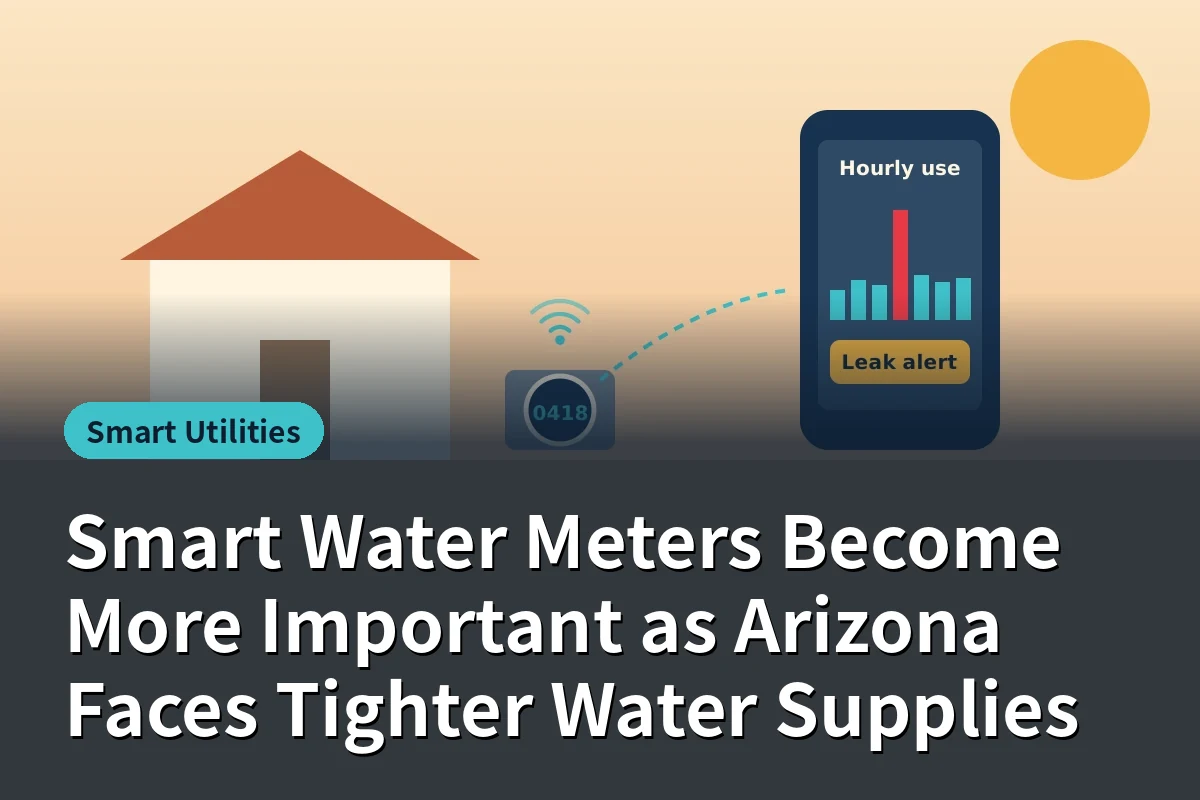
Arizona has always understood the value of water. As one of the fastest-growing states in the U.S., communities across Arizona continue balancing population growth, commercial development, agriculture, manufacturing, and long-term sustainability. While reservoirs, pipelines, and treatment facilities remain critical infrastructure, today’s water challenges increasingly require digital solutions. Smart water meters are becoming one of the most important technologies helping utilities modernize how water is measured, monitored, and managed.
Unlike traditional water meters that require manual readings, smart water meters automatically collect usage data and securely transmit it to utility providers. Combined with smart utilities, IoT technology, and advanced analytics, these connected devices provide better visibility into water consumption, leak detection, infrastructure performance, and customer usage patterns.
Across Arizona, smart water meters are helping utilities move from reactive maintenance toward proactive water management while giving homeowners and businesses greater visibility into one of the state’s most valuable resources.
Arizona faces a unique combination of infrastructure challenges. Rapid growth, extreme heat, aging underground water systems, industrial expansion, and long-term drought planning all place pressure on municipal utilities.
Traditional water systems often rely on delayed readings and customer-reported issues. Smart water meters change that by giving utilities more frequent and accurate information. This helps cities and providers understand where water is being used, where losses may be happening, and where future investment may be needed.
- Where is water demand increasing?
- Which neighborhoods have abnormal usage patterns?
- Are hidden leaks occurring before customers notice them?
- Which commercial properties are using water inefficiently?
- Where should infrastructure upgrades be prioritized?
A smart water meter is a digital meter that measures water consumption and sends usage data to the utility automatically. Instead of requiring a technician to manually read the meter, the system transmits data through a secure communication network.
Most smart water meter systems include:
- Digital water meter hardware
- Flow sensors
- Wireless communication modules
- IoT gateways
- Cloud-based utility dashboards
- Customer usage portals
- Leak detection alerts
Smart water meters are part of Arizona’s broader Industrial IoT and utility modernization ecosystem. IoT allows thousands of meters to communicate with centralized platforms where utilities can analyze trends, identify anomalies, and automate decisions.
| Component |
Role in Smart Water Metering |
| Smart Water Meter |
Measures water consumption automatically |
| IoT Gateway |
Transfers meter data securely to utility systems |
| Cloud Platform |
Stores and organizes water usage data |
| Analytics Engine |
Detects leaks, unusual patterns, and abnormal usage |
| Utility Dashboard |
Helps operators monitor system performance |
| Customer Portal |
Allows residents and businesses to view usage trends |
Hidden leaks can waste large amounts of water before anyone notices. Smart water meters help identify continuous flow, unusual overnight usage, and sudden spikes that may indicate a leak inside a building, irrigation system, or underground service line.
Smart meters reduce estimated bills and manual reading errors. Customers receive more accurate usage data, while utilities can improve billing consistency.
Automated meter reading reduces the need for manual field visits. This can help utilities save time, reduce labor demands, and redirect teams toward maintenance and infrastructure improvement.
Water usage data helps utilities understand demand by neighborhood, property type, and season. This supports better long-term planning for pipelines, pumps, storage, and treatment capacity.
Commercial properties often consume far more water than residential properties. Hotels, hospitals, warehouses, schools, office buildings, shopping centers, and manufacturing facilities can all benefit from smart water monitoring.
For Arizona commercial properties, smart water meters can help detect plumbing leaks, monitor irrigation systems, track cooling tower usage, reduce waste, and improve sustainability reporting.
When combined with IoT building automation in Arizona, water data can become part of a larger facility performance strategy that also includes HVAC, electricity, lighting, occupancy, and equipment monitoring.
Smart water infrastructure is an important part of Arizona’s connected city future. As cities invest in smart traffic systems, connected streetlights, public safety technology, and digital services, water infrastructure also needs better visibility.
Smart water meters support broader Smart Cities initiatives by giving municipalities better data about water demand, infrastructure stress, and conservation opportunities.
Related city pages:
Conservation is not only about asking customers to use less water. It is also about helping them understand how, when, and where water is being used.
Smart water meters can help residents and businesses monitor daily consumption, receive leak alerts, compare usage trends, and identify seasonal irrigation spikes. This type of visibility makes conservation more practical because customers can act on real data instead of waiting for a monthly bill.
Outdoor water use is a major consideration in Arizona. Homes, golf courses, resorts, campuses, HOAs, parks, and commercial landscapes may all rely on irrigation systems that can waste water when leaks, broken valves, or poor scheduling go unnoticed.
Smart water meters can help detect abnormal irrigation usage and support more efficient outdoor water management. For larger properties, meter data may be combined with weather data, soil sensors, and smart irrigation controllers to reduce unnecessary watering.
| Use Case |
How Smart Water Meters Help |
Who Benefits |
| Residential Leak Detection |
Identifies continuous or abnormal water flow |
Homeowners, utilities |
| Commercial Water Monitoring |
Tracks usage across large buildings and campuses |
Property managers, businesses |
| Irrigation Management |
Detects excessive outdoor water use |
HOAs, resorts, golf courses, municipalities |
| Utility Planning |
Shows demand trends by service area |
City planners, water utilities |
| Billing Accuracy |
Reduces manual reading and estimated billing |
Customers, utility providers |
Smart water meter programs require careful planning. Technology alone does not solve water infrastructure challenges. Utilities need strong cybersecurity, reliable communication networks, customer education, and integration with older billing and asset management systems.
- Cybersecurity protection for utility networks
- Data privacy for customer usage information
- Reliable wireless coverage
- Integration with legacy billing systems
- Training for utility teams
- Customer communication before deployment
Smart water meters are not isolated devices. They connect with several other Arizona IoT trends, including Energy & Sustainability, Smart Buildings, and connected infrastructure planning.
For example, a commercial property that monitors water usage may also monitor energy use through IoT energy management systems. A city using smart water meters may also invest in connected street lighting systems or public infrastructure sensors.
Smart water infrastructure depends on sensors, semiconductors, automation, cloud platforms, analytics, and secure communications. Arizona’s technology ecosystem includes companies connected to these broader fields, including Honeywell Aerospace, Microchip Technology, onsemi, and TSMC Arizona.
While smart water meters are usually deployed by utilities and specialized water technology providers, Arizona’s broader semiconductor, automation, and IoT ecosystem supports the technologies that make connected infrastructure possible.
Smart water meters are only the beginning. Future water systems may combine smart meters with pressure sensors, water quality monitors, AI-driven analytics, predictive maintenance, and digital twins that simulate how water infrastructure performs under different demand scenarios.
For Arizona, this matters because water planning is tied directly to growth, economic development, housing, commercial construction, agriculture, and climate resilience.
The most valuable smart water systems will not simply collect data. They will help utilities make better decisions, reduce losses, improve service reliability, and support long-term conservation.
Smart water meters are becoming a practical part of Arizona’s utility modernization strategy. By using IoT, automated readings, leak detection, and usage analytics, water providers can improve efficiency while helping customers understand and manage consumption more effectively.
As Arizona continues to grow, connected water infrastructure will become increasingly important for cities, businesses, and residents. Smart water meters are not just a meter replacement project. They are part of a larger shift toward smarter, more resilient, and more transparent utility systems across the state.
Frequently asked questions
Smart water meters are digital meters that automatically measure water usage and transmit the data to utility providers through a secure communication network.
They help utilities detect leaks, improve billing accuracy, monitor demand trends, reduce manual meter reading, and plan infrastructure upgrades more effectively.
Yes. Smart water meters are IoT devices because they collect data and communicate with connected utility systems.
Yes. Smart water meters can identify continuous flow, abnormal usage patterns, and sudden spikes that may indicate leaks.
Yes. Businesses can use smart water meter data to monitor usage, detect leaks, reduce waste, improve sustainability reporting, and manage operating costs.
They are important because Arizona faces rapid growth, extreme heat, water conservation needs, and increasing pressure on utility infrastructure.
Homes, offices, warehouses, hotels, hospitals, schools, resorts, HOAs, industrial facilities, and municipal properties can all benefit from smart water monitoring.
Related articles


 Smart Utilities