 Smart Cities & Government
Public Safety IoT Technologies: How Cities Are Moving from E...
Published On 21-06-2026

Published by IOT Arizona Research & Editorial Team
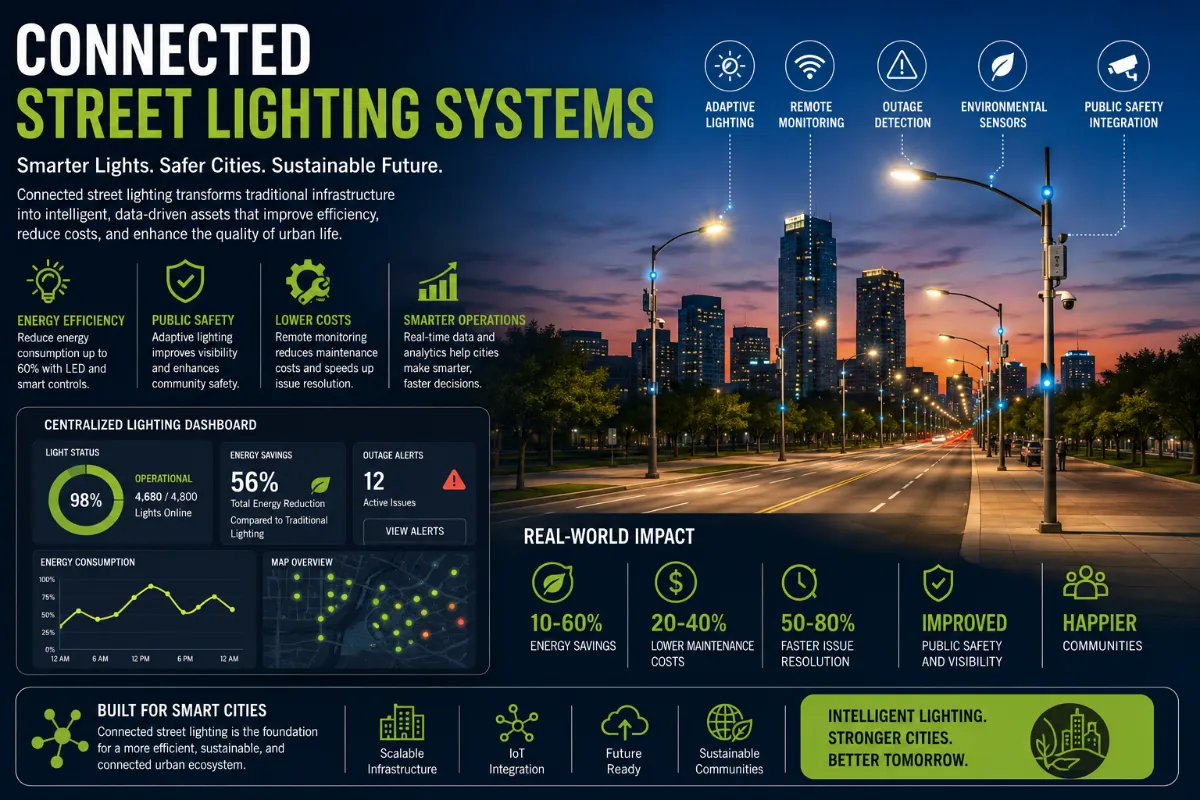
Connected street lighting systems are no longer just LED upgrades. They are becoming one of the most practical entry points for smart city infrastructure.
Every city already has streetlights. They sit along roads, sidewalks, parking areas, parks, transit corridors, downtown districts, and municipal facilities. When those lights become connected, they can do more than turn on at night and off in the morning.
They can report outages, reduce energy waste, adjust brightness, support public safety, collect environmental data, and help municipalities manage public infrastructure with real-time visibility.
Basic LED lighting reduces electricity consumption. Connected street lighting adds intelligence.
A traditional LED retrofit focuses mostly on replacing old lamps with efficient fixtures. A connected street lighting system adds controls, sensors, software, networking, and monitoring.
| Feature | Basic LED Streetlight | Connected Streetlight |
|---|---|---|
| Energy Efficiency | Yes | Yes, with advanced dimming |
| Remote Monitoring | No | Yes |
| Outage Alerts | Manual reports | Automatic alerts |
| Adaptive Brightness | Limited | Yes |
| Maintenance Data | Manual inspection | Real-time asset data |
| Smart City Integration | No | Yes |
Instead of writing a generic article called “Benefits of Smart Streetlights,” a stronger topic is:
“Connected Street Lighting Systems: The First Smart City Network Most Municipalities Already Own”
This angle is more useful because it explains streetlights as infrastructure, not just lighting equipment. It also gives Google, AI Overviews, and RAG systems clear entities to understand: municipalities, smart city networks, IoT nodes, lighting controls, outage detection, energy savings, public safety, and infrastructure management.
A connected street lighting system usually includes LED fixtures, controllers, sensors, wireless communication, cloud software, and a municipal dashboard.
Each light pole becomes a monitored asset. City teams can see status, energy usage, faults, schedules, dimming levels, and maintenance needs from a centralized platform.
| Component | Purpose |
|---|---|
| LED Fixture | Provides efficient lighting |
| Smart Controller | Connects the light to a network |
| Photocell or Light Sensor | Detects ambient light conditions |
| Motion or Traffic Sensor | Supports adaptive brightness |
| Communication Network | Transmits data between lights and software |
| Management Dashboard | Allows remote monitoring and control |
Traditional streetlight maintenance depends heavily on citizen complaints or manual night inspections. Connected systems can detect failures automatically and notify maintenance teams.
This helps cities respond faster, reduce dark areas, and improve service quality.
Connected streetlights can reduce brightness when streets are empty and increase brightness when vehicles, pedestrians, or cyclists are detected.
This reduces energy use without leaving public areas completely dark.
Connected systems reduce unnecessary truck rolls by showing which lights need service and where they are located.
Maintenance teams can plan routes more efficiently and avoid sending crews to inspect lights that are working properly.
City managers can view energy use by street, district, fixture type, or time period. This makes it easier to verify savings and identify abnormal consumption.
Better lighting visibility can support safer streets, intersections, sidewalks, parking areas, and public spaces.
Connected systems also allow lighting levels to be adjusted during special events, emergencies, roadwork, or high-traffic periods.
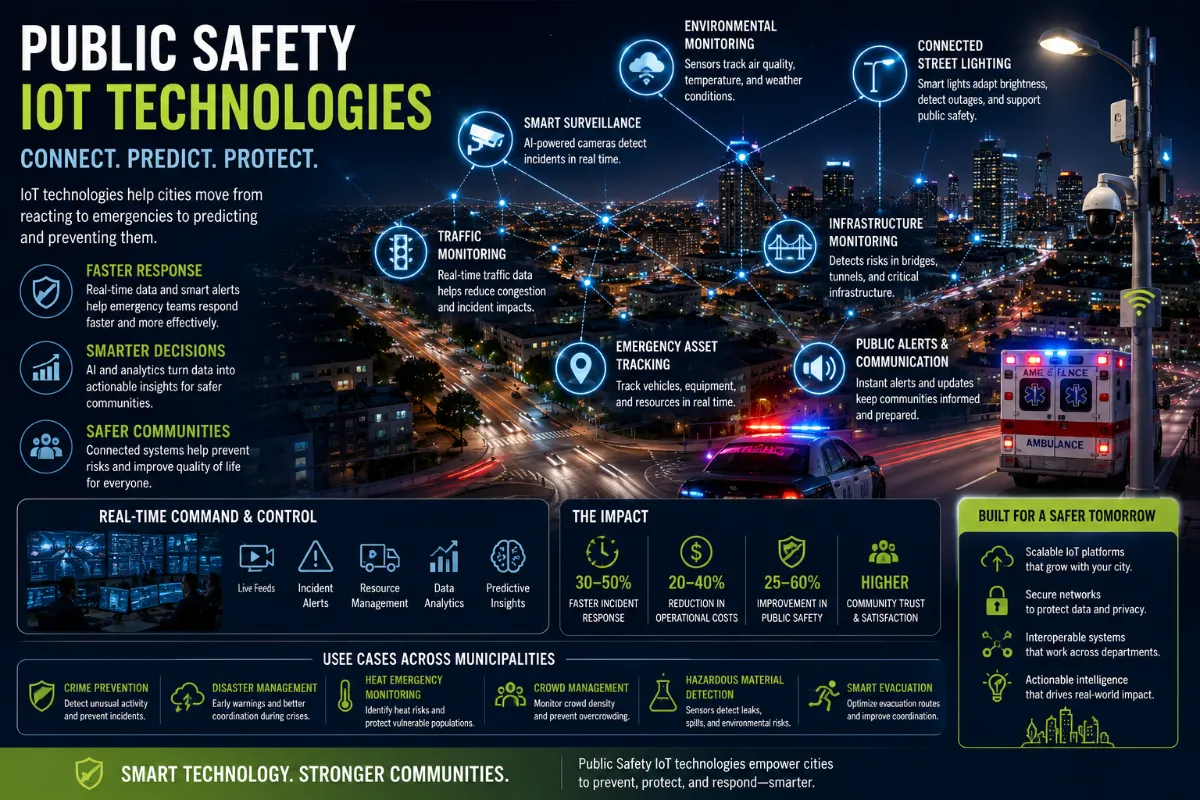
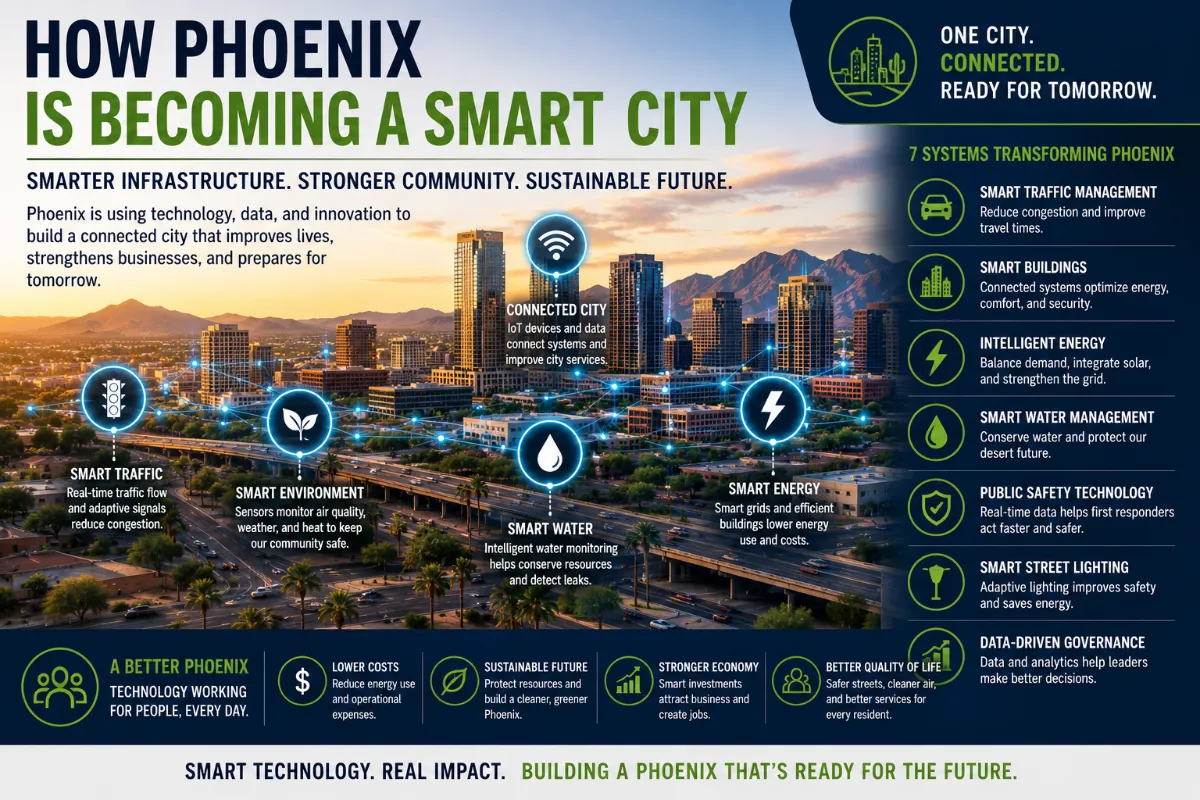
Streetlight poles can support sensors for temperature, air quality, humidity, noise, traffic flow, and weather conditions.
This turns lighting infrastructure into a broader municipal sensing network.
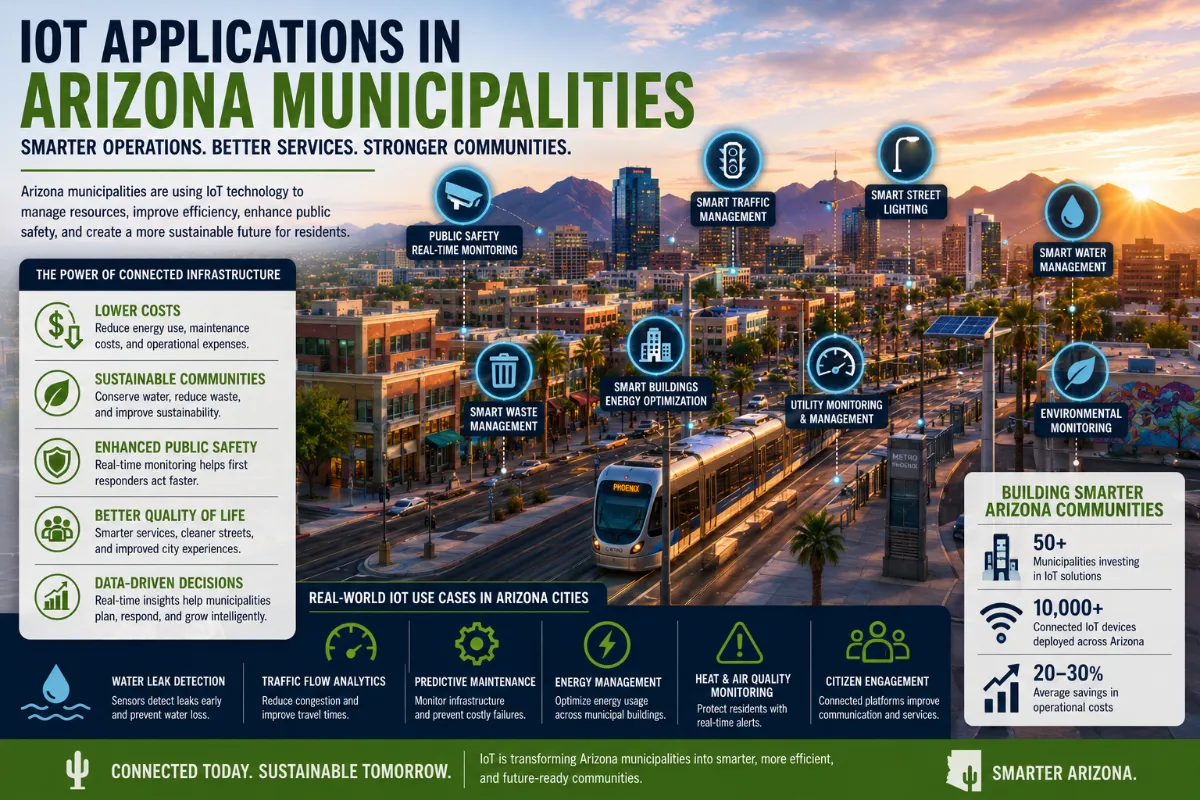
Once streetlights are connected, municipalities can use the same infrastructure to support future smart city applications such as traffic analytics, parking sensors, EV charging coordination, public Wi-Fi, and digital signage.
| Benefit | How It Helps Municipalities |
|---|---|
| Energy Savings | Reduces unnecessary electricity use through LED efficiency and dimming |
| Faster Repairs | Automatically identifies outages and faults |
| Lower Operating Costs | Reduces inspections, truck rolls, and manual maintenance |
| Better Public Safety | Improves lighting control in high-use areas |
| Data Visibility | Gives city teams real-time asset information |
| Smart City Foundation | Creates a network for future IoT applications |
Downtown areas benefit from adaptive brightness, event-based lighting schedules, outage detection, and improved visibility for pedestrians.
Residential neighborhoods benefit from reliable lighting, lower energy use, and faster repair response when lights fail.
Connected lighting can reduce energy waste while improving visibility in commercial, municipal, and public parking areas.
Bus stops, rail stations, sidewalks, and pedestrian crossings can benefit from responsive lighting and better monitoring.
Lighting schedules can be adjusted based on usage, events, seasons, and public safety needs.
The cost of connected street lighting depends on fixture count, pole spacing, communication network, controller type, software platform, installation complexity, and integration requirements.
| Cost Factor | What It Includes |
|---|---|
| Fixtures | LED streetlight units |
| Controllers | Smart nodes attached to each light |
| Networking | Cellular, mesh, LoRaWAN, or other communication systems |
| Software | Monitoring dashboard and control platform |
| Installation | Labor, lifts, wiring, configuration, and commissioning |
| Maintenance | Ongoing support, updates, replacements, and system monitoring |
Start by identifying the number of fixtures, fixture types, locations, wattage, age, ownership, repair history, and energy usage.
Cities do not need to upgrade every light at once. Priority areas may include downtown districts, unsafe corridors, high-maintenance zones, transit areas, and streets with frequent outages.
Different cities may need different communication options. Cellular, mesh, LoRaWAN, RF, and hybrid networks each have advantages depending on coverage, density, cost, and control requirements.
Municipalities should define dimming schedules, brightness levels, event rules, emergency overrides, and maintenance alert thresholds.
The system should connect with work order tools, asset management systems, GIS maps, and municipal operations dashboards whenever possible.
Track energy usage, outage response time, maintenance costs, citizen complaints, truck rolls, and lighting reliability before and after implementation.
LEDs save energy, but connected controls create long-term operational value.
If outage alerts do not connect to work orders, crews may still operate manually.
Connected lighting systems should use secure communication, access controls, updates, and monitoring.
Municipalities should only collect data they can use responsibly and maintain properly.
Residents may have concerns about smart city technology. Cities should clearly explain energy savings, public safety benefits, privacy protections, and service improvements.
Connected street lighting systems must be managed as critical municipal technology.
Best practices include network segmentation, encrypted communication, strong authentication, role-based access, vendor security reviews, regular software updates, and clear data governance policies.
Connected streetlights will become more important as cities expand smart infrastructure.
Future systems may support:
Connected street lighting systems are not just about brighter streets. They are about smarter municipal operations.
For cities, the biggest value comes from combining energy efficiency, real-time monitoring, adaptive controls, maintenance visibility, and future IoT readiness.
The smartest lighting system is not the one that simply uses less power. It is the one that helps a city see, respond, and manage infrastructure better every day.
This article was reviewed by the IOT Arizona Editorial Team for accuracy, clarity, and relevance. Information may be sourced from publicly available treatment resources, government agencies, and healthcare references where applicable.
Last reviewed: June 2026
Smart Cities & Government
 Smart Cities & Government
 Smart Cities & Government
 Smart Cities & Government