 Construction & Real Estate
The Building That Watches Itself: IoT Security Systems for A...
Published On 21-06-2026

Published by IOT Arizona Research & Editorial Team
Most people think construction begins when workers arrive.
In Arizona, that's no longer true.
Some job sites are already awake long before sunrise.
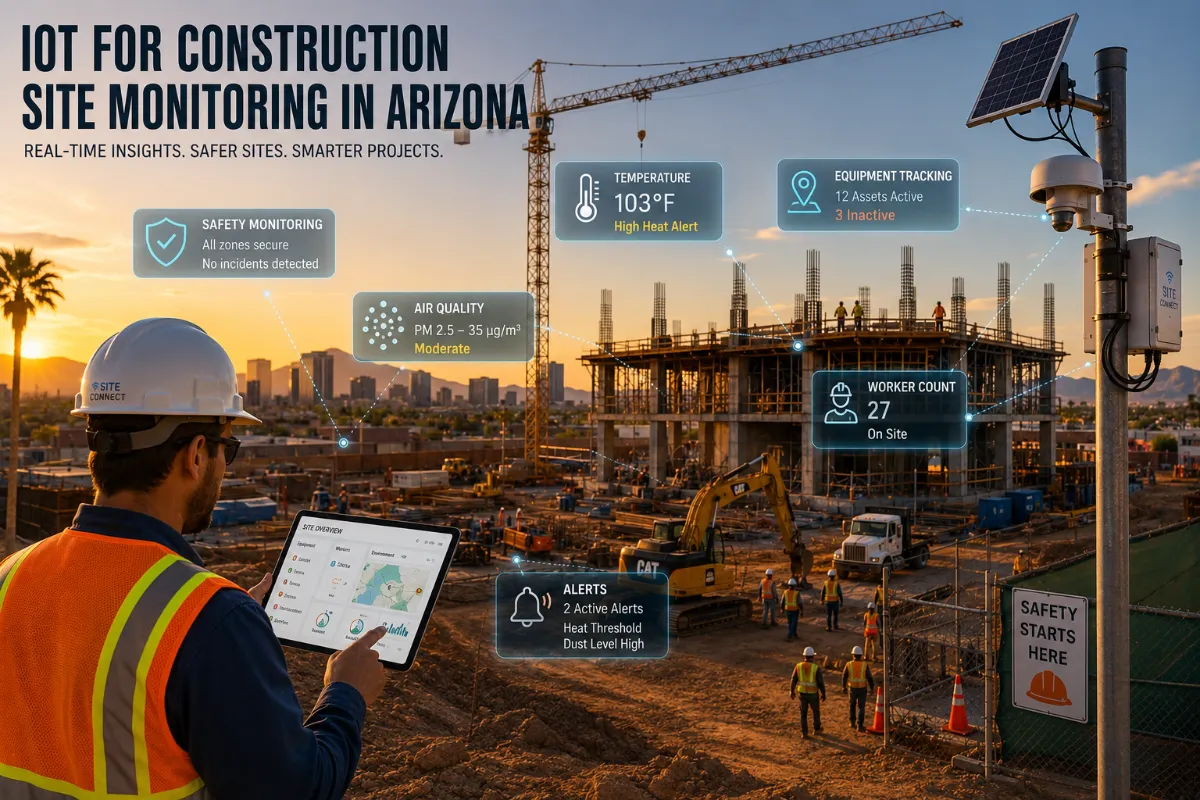
Temperatures are being measured.
Dust levels are being monitored.
Equipment locations are being tracked.
Access points are being secured.
The construction site itself is becoming an active participant.
Quietly.
Without drawing attention.
This is one of the biggest shifts happening across Arizona's booming construction industry.
From Phoenix to Mesa, Glendale to Scottsdale, cranes have become part of the landscape.
Data centers, semiconductor facilities, warehouses, apartment communities, hospitals, and commercial buildings are appearing everywhere.
Arizona is one of the fastest-growing states in America.
That growth creates pressure.
Projects must be completed faster.
Budgets must be controlled.
Worker safety must improve.
Extreme weather conditions add another layer of complexity.
Construction teams need visibility they never had before.
It's 6:00 a.m.
A project manager arrives at a construction site in Phoenix.
Instead of spending an hour inspecting conditions manually, they open a dashboard.
They immediately know:
The goal isn't automation.
The goal is awareness.
Arizona summers can become dangerous quickly.
Temperatures can exceed 110°F.
Heat exposure affects productivity, safety, and worker health.
Construction companies are increasingly using environmental monitoring systems to understand conditions in real time.
Instead of reacting after workers become exhausted, teams can proactively adjust schedules.
Some crews may start earlier.
Break periods may increase.
High-risk zones can be identified before work begins.
This is one of the most valuable changes happening today.
Every construction project expects delays.
Unexpected delays are far more expensive.
Missing equipment.
Idle crews.
Security incidents.
Equipment breakdowns.
Material shortages.
Communication gaps.
These problems create ripple effects that can impact entire project timelines.
Connected monitoring systems help reduce those blind spots.
There are now invisible teammates helping construction crews every day.
Not robots.
Not artificial intelligence.
Tiny sensors and connected devices.
They watch over:
Most people will never see them.
But they are quietly improving how projects operate.
Almost everyone involved.
Developers gain better project visibility.
Project managers make faster decisions.
Workers operate in safer environments.
Equipment operators reduce downtime.
Cities can manage infrastructure projects more efficiently.
Property owners receive projects with fewer surprises.
By 2031, Arizona construction sites may operate very differently.
Job sites could automatically adapt work schedules based on weather.
Equipment could request maintenance before breaking down.
Traffic around large developments could be coordinated with city systems.
Building materials could be tracked from delivery to installation.
Safety alerts could be sent instantly to supervisors.
Entire developments may become connected ecosystems before a building is even completed.
The bigger story is confidence.
Arizona is building an enormous amount of infrastructure.
That growth requires better visibility.
Connected monitoring systems simply give people better information.
The faster Arizona grows, the more valuable that information becomes.
Because the future of construction isn't about building faster.
It's about building smarter from the very first sunrise.
This article was reviewed by the IOT Arizona Editorial Team for accuracy, clarity, and relevance. Information may be sourced from publicly available treatment resources, government agencies, and healthcare references where applicable.
Last reviewed: June 2026