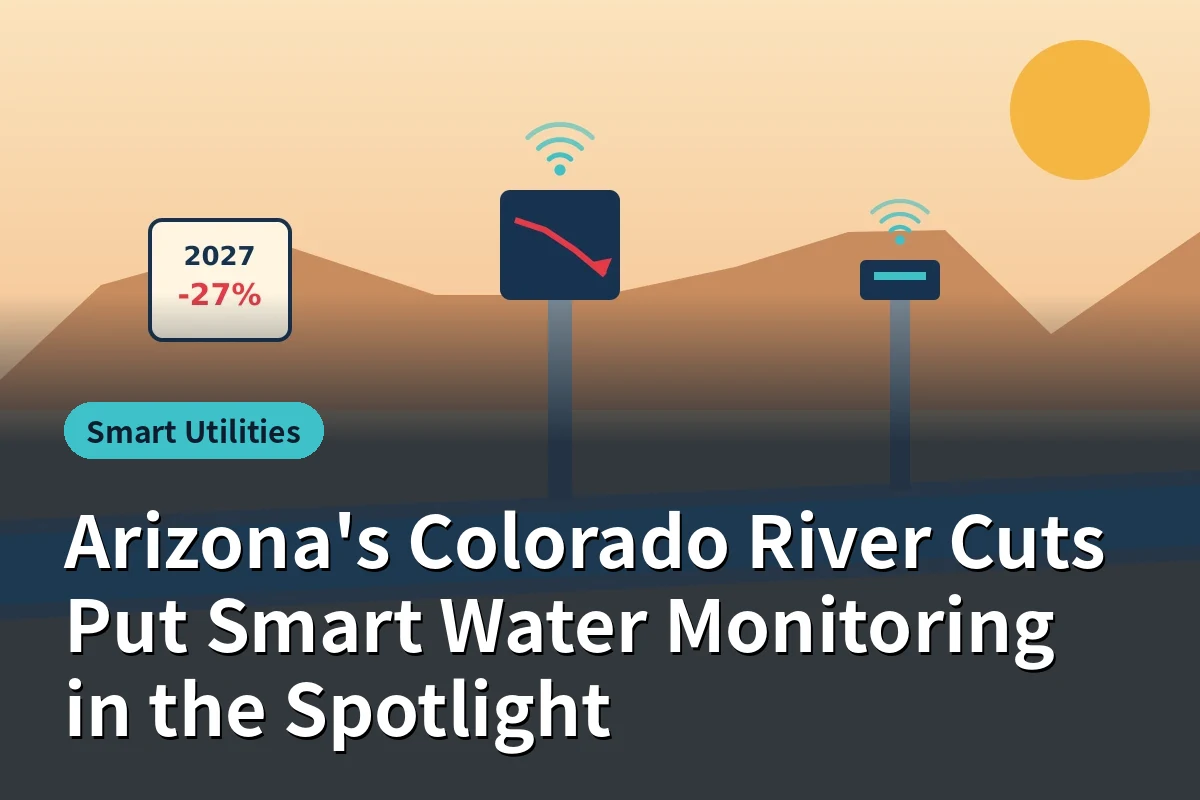
Arizona's water story in 2026 is often told as a story of cuts. The federal decision of August 21 set 2027 and 2028 guidelines that reduce Arizona's Colorado River use by 760,000 acre-feet a year, and new rules will be revisited every two years. But alongside the cuts, Arizona is quietly building one of the most sophisticated water management systems in the country, and connected monitoring sits at the center of it.
Cities can now turn wastewater directly into drinking water under advanced water purification rules that require rigorous, real-time testing. TSMC is building a reclamation plant designed to recycle up to 90 percent of its industrial water. Farms, utilities and businesses are adding meters and sensors at every stage of the water cycle. This article looks at smart water management across that whole cycle, from source to reuse, and explains where IoT adds the most value.
Smart water management is not a single technology. It is the practice of measuring and managing water at every stage, so that each drop is accounted for and used as many times as possible.
| Stage | Arizona Example | What IoT Monitors |
|---|
| Supply | Colorado River via CAP, Salt and Verde rivers, groundwater | Canal flows, reservoir levels, well pumping and aquifer levels |
| Treatment | Municipal water treatment plants | Water quality, chemical dosing, energy use, filter performance |
| Distribution | City pipe networks and storage tanks | Pressure, flow, leaks, tank levels, water quality at points across the network |
| Use | Homes, businesses, farms, industry | Smart meters, irrigation controllers, process water metering |
| Collection and treatment of wastewater | Water reclamation plants | Flow, treatment performance, effluent quality |
| Reuse | Advanced water purification, reclaimed water, aquifer recharge, industrial recycling | Continuous quality testing, recovery rates, recharge volumes |
Arizona's advanced water purification rules allow cities to treat wastewater to drinking water standards and deliver it directly into their systems, rather than only recharging it into aquifers first. A defining feature of the rules is rigorous, real-time testing and oversight at every facility, with the state inspecting facilities and monitoring the data they submit.
Several cities are moving forward. Scottsdale, an early leader, reports recovering roughly 85 percent of the water processed through its purification system. Phoenix plans to deliver its first direct wastewater-to-drinking-water supply from its Cave Creek water reclamation plant by 2030. Tucson secured an $86.7 million federal grant toward a purification plant tied to reducing its reliance on Colorado River water.
For IoT and instrumentation companies, these facilities represent some of the most demanding monitoring environments anywhere: continuous measurement of multiple treatment barriers, automated responses when any barrier underperforms and detailed records for regulators and the public.
Industry is following a similar path. TSMC's Phoenix campus already recycles about 65 percent of its water and is building a 15-acre reclamation plant designed to reach about 85 percent at start-up and 90 percent or better over time. Data centers are shifting toward zero-water or closed-loop cooling, and local ordinances in Tucson, Chandler, Marana and elsewhere set limits on water use. Our articles on IoT and Arizona's semiconductor industry and IoT for data centers cover these sectors.
Water lost from pipes before reaching customers is water that customers are asked to save. Smart distribution networks combine pressure sensors, acoustic leak detectors, district metered areas and smart customer meters to locate losses. Pressure management, which reduces excess pressure that stresses pipes, can lower break rates and background leakage. Our smart water meter guide covers metering infrastructure in detail.
Agriculture still uses most of Arizona's water. Flow meters, soil moisture sensors and weather data help farms apply water precisely and document their use, which matters more under biennial Colorado River guidelines. Our farm water verification guide explains how to build a credible record, and our LoRaWAN guide covers the long-range networks that connect remote fields and canals.
Arizona stores water underground through recharge projects that put excess or reclaimed water into aquifers for later use. Monitoring wells, recharge basin sensors and pumping meters track how much goes in and comes out. In areas outside active management areas, where groundwater oversight is lighter, voluntary monitoring by farms and communities can provide early warning of declining water levels.
Real-time water quality sensors measure parameters such as chlorine residual, turbidity, pH, conductivity and temperature at points throughout distribution systems. They can detect problems faster than periodic grab samples and help utilities maintain disinfection as water travels long distances in hot conditions. Arizona's heat accelerates chlorine decay and can affect water quality in storage tanks, making continuous monitoring especially useful.
Many utilities and large water users have data scattered across separate systems: SCADA for treatment and pumping, billing for customer meters, laboratory systems for quality and spreadsheets for everything else. Integrating them into a shared view, sometimes called a digital twin of the water system, allows operators to see how supply, demand, pressure and quality interact. Integration also supports better forecasting and faster response to emergencies.
Arizona has reused treated wastewater for decades. Reclaimed water irrigates golf courses, parks, school grounds and farms, and treated effluent from Phoenix-area plants helps cool the Palo Verde Generating Station, the nation's largest nuclear plant by generation. Smart management of reclaimed water systems involves the same principles as drinking water: metering deliveries, monitoring quality and detecting leaks. As potable supplies tighten, reclaimed water becomes more valuable, and accurate accounting of where it goes matters for both utilities and users.
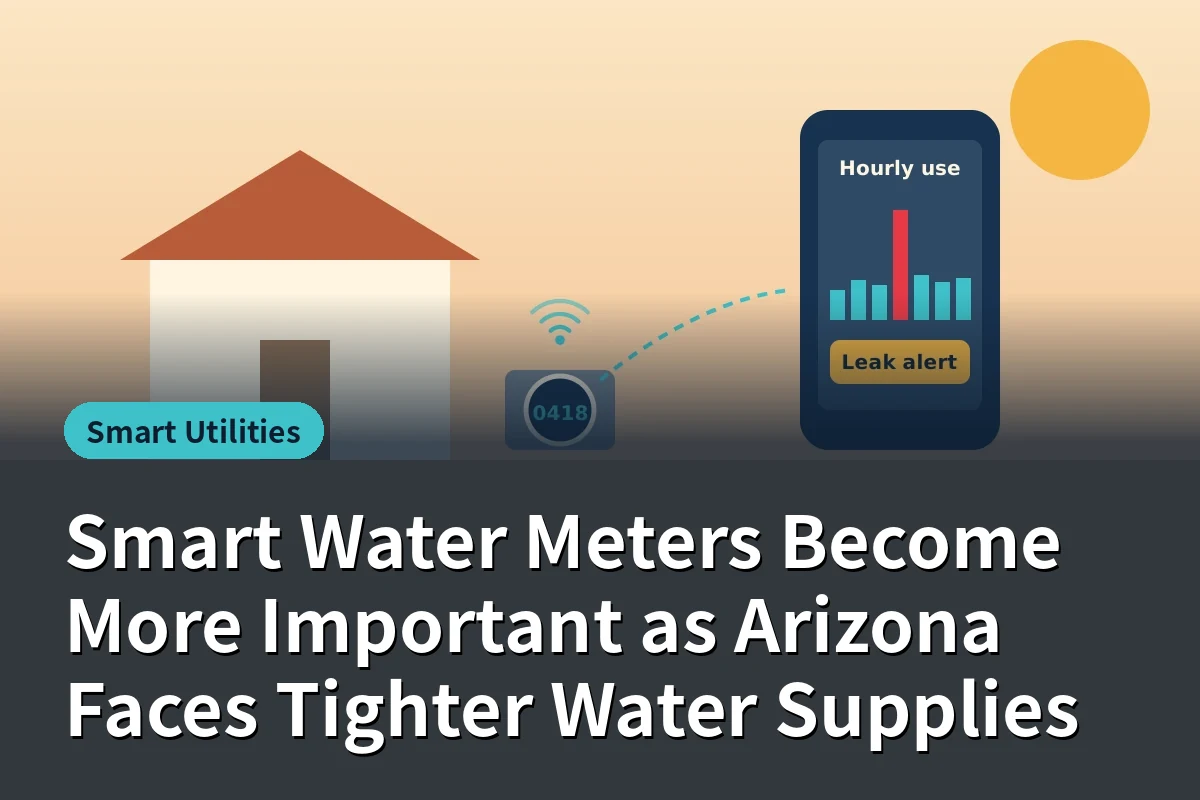
Smart water management also reaches homes and businesses. Utility portals that show hourly use, compare households with similar homes and alert customers to leaks can change behavior without new rules. Smart irrigation controllers that adjust to weather can reduce outdoor watering, which often makes up a large share of residential use in Arizona. Rebate programs for these devices, where available, help customers adopt them. Our leak detection guide covers the property side in detail.
Consider a mid-sized Arizona city serving 80,000 people. It starts by installing pressure sensors and flow meters to divide its network into district metered areas, revealing that two older neighborhoods account for a disproportionate share of losses. Acoustic sensors locate several leaking mains, which crews repair. The city then deploys smart customer meters in phases, starting with large commercial accounts and high-use neighborhoods, and launches leak alerts for customers. Water quality sensors at storage tanks help maintain disinfection during summer. Over several years, the city reduces losses, improves customer service and builds the data foundation needed to plan for advanced purification. The specifics are illustrative, but many Arizona utilities are following similar paths.
Water infrastructure is a target. Beginning July 27, 2026, water and wastewater utilities in at least seven states reported attacks on internet-facing industrial controllers. Smart water systems must be designed with segmentation, controlled remote access and manual fallback. Our PLC security checklist covers the essentials.
- Map your water balance. Know how much water enters, where it goes, how much is lost and how much is reused.
- Close the biggest measurement gaps first, often large users, distribution losses or unmetered sources.
- Add real-time quality monitoring where regulations or risk demand it.
- Integrate systems so operators see one picture rather than many.
- Plan for reuse, whether reclaimed water for irrigation, industrial recycling or advanced purification.
- Secure everything before connecting it.
Smart water systems need people who understand both water operations and data: instrumentation technicians, SCADA engineers, data analysts and cybersecurity specialists. Advanced purification facilities in particular require operators trained in new treatment technologies and monitoring requirements. Community colleges, universities and utility training programs are expanding offerings, and partnerships between utilities and technology companies can help build local skills. Investing in people is as important as investing in sensors, because data only creates value when someone understands and acts on it.
Regional collaboration also helps. Smaller utilities and irrigation districts can share monitoring platforms, training and even networks, lowering costs and spreading expertise across communities that could not build sophisticated systems alone. As advanced purification and reuse expand, sharing lessons among Phoenix, Scottsdale, Tucson and other cities will speed progress for everyone.
Utilities that publish clear progress reports on water losses, reuse volumes and quality monitoring also build public confidence in new supplies such as purified water.
Arizona's water future will depend on policy choices made in negotiations, legislatures and city councils. But the ability to measure and manage water precisely, at every stage of its use, will shape how well the state adapts. Advanced purification, industrial recycling, precise agriculture and smarter distribution all rest on the same foundation: reliable, connected data.
Our IoT water leak detection guide covers the property side of water management. Find water technology partners in the IoT Arizona company directory, including smart utility providers in Tucson. Browse more of our Smart Utilities coverage.
Frequently asked questions
Measuring and managing water at every stage, from supply and treatment to distribution, use, wastewater treatment and reuse, so each drop is accounted for and reused where possible.
They allow cities to treat wastewater to drinking water standards for direct use, with rigorous real-time testing and state oversight of facility data.
Scottsdale is an early leader, Phoenix plans its first direct supply from the Cave Creek plant by 2030, and Tucson received an $86.7 million federal grant toward a purification plant.
TSMC recycles about 65 percent of its Phoenix site water and is building a plant to reach 85 to 90 percent, while many data centers are moving to zero-water cooling.
Heat accelerates chlorine decay in pipes and storage tanks. Continuous sensors detect quality problems faster than periodic samples.
Map the water balance, close the biggest measurement gaps, add real-time quality monitoring, integrate systems, plan for reuse and secure everything before connecting it.
Related articles


 Smart Utilities