 Manufacturing IoT

IoT in Arizona Manufacturing: Finding Hidden Capacity When Hiring Is Hard
Manufacturing IoT
Published by IOT Arizona Research & Editorial Team
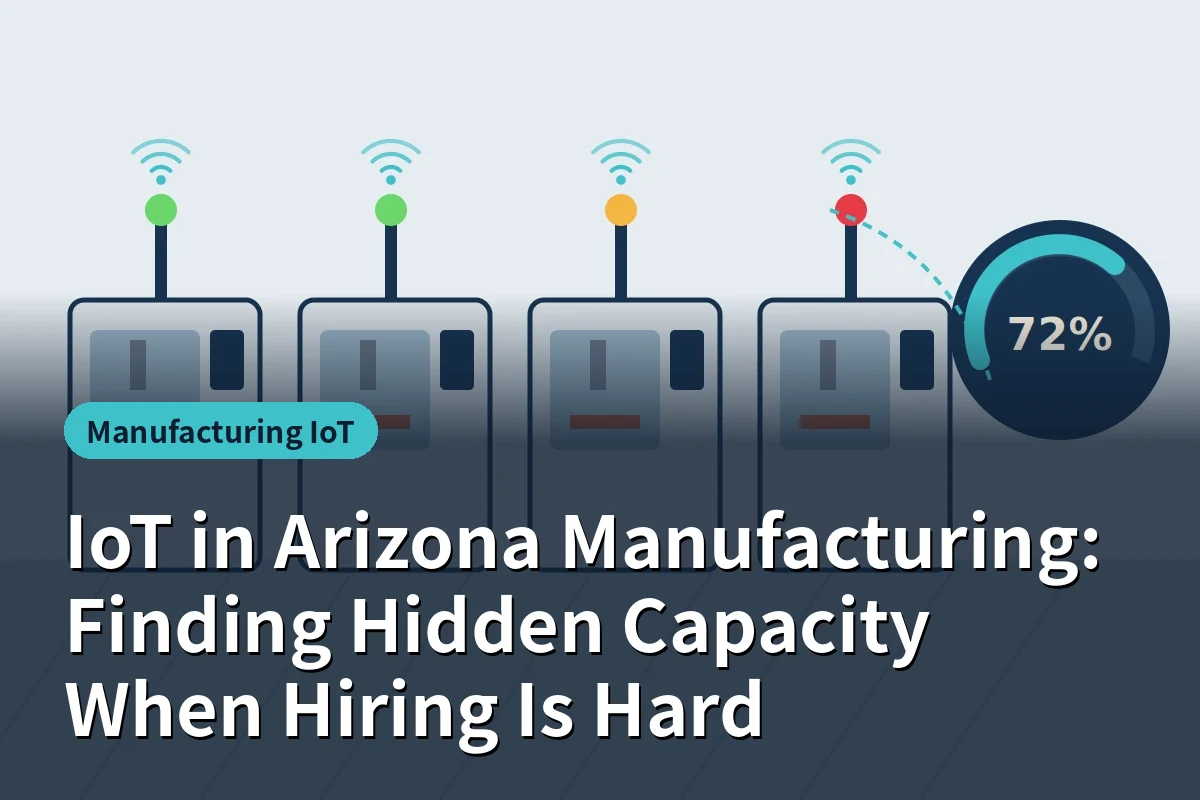
Arizona's manufacturing story in 2026 has two sides. On one side are headline investments: new fabs, advanced packaging plants and battery complexes worth billions. On the other is a quieter reality for most of the state's manufacturers. Statewide manufacturing employment has been roughly flat. The Common Sense Institute reported that Arizona lost about 500 manufacturing jobs year over year as of its April 2026 update, even as mining and other sectors grew.
For a machine shop in Tempe, a food processor in the West Valley or a plastics molder in Tucson, that combination creates a familiar squeeze. Customers expect more, qualified workers are hard to find, and growth has to come from getting more out of the people and equipment already in place. That is where IoT earns its keep in Arizona manufacturing: not as a futuristic vision, but as a practical way to find hidden capacity, cut waste and keep equipment running through desert summers.
Six Use Cases That Pay Off Most Often
| Use Case | What It Finds | Typical Starting Investment | Where Payback Comes From |
|---|---|---|---|
| Machine monitoring | Real run time, idle time, downtime reasons and cycle times | Low: adapters or current sensors on key machines | Hidden capacity, better scheduling, fewer overtime shifts |
| Compressed air monitoring | Leaks, pressure drops, compressors running unloaded | Low: flow and pressure sensors on main headers | Energy savings, fewer compressor failures |
| Condition monitoring | Vibration, temperature and current trends on critical motors, pumps and spindles | Low to medium: wireless sensors on key assets | Fewer unplanned breakdowns, planned repairs |
| Energy submetering | Which equipment drives peak demand and when | Medium: meters on panels and major loads | Lower demand charges, smarter shift timing |
| Quality data capture | Measurements fed directly from gauges and inspection equipment | Medium: connected gauges and SPC software | Less scrap, faster problem detection, customer audits |
| Environmental monitoring | Temperature and humidity in production, storage and clean areas | Low: wireless sensors and alerts | Fewer heat-related defects and spoiled materials |
Machine monitoring is usually the best first step. Many shops discover that machines they considered fully loaded actually cut parts far less of the time than assumed, because of setups, waiting for material, first-article inspection and unrecorded stops. Finding even a modest amount of hidden capacity can delay a major equipment purchase.
How Arizona Heat Affects the Shop Floor
Desert conditions create manufacturing problems that plants in cooler climates rarely face at the same intensity. Connected sensors help manage several of them:
- Thermal growth in machining. Machine tools and parts expand as shop temperatures rise through the day. Tracking shop and spindle temperatures alongside dimensional results helps explain afternoon drift and justifies warm-up routines or climate control investments.
- Compressors and chillers under stress. Air compressors and process chillers lose efficiency and fail more often in extreme heat, especially in poorly ventilated rooms. Monitoring discharge temperature, runtime and power catches problems before a summer breakdown.
- Heat-sensitive materials. Adhesives, resins, coatings, electronics and food ingredients can degrade in hot warehouses. Temperature logging in storage areas prevents costly losses and supports quality records.
- Worker safety. Many Arizona plants are not fully air conditioned. Heat monitoring in production areas supports heat illness prevention plans under the state's updated heat enforcement program.
- Electricity peaks. Summer afternoons bring the highest cooling loads and, for many rate plans, the highest demand charges. Knowing which equipment runs during peaks allows smarter scheduling.
A 90-Day Pilot That Proves Value
- Weeks 1 and 2: Choose the constraint. Identify the bottleneck machine, the most expensive recurring failure or the biggest energy cost. Pick one.
- Weeks 3 and 4: Install and verify. Connect three to five machines or assets. Confirm the data matches what operators see on the floor.
- Weeks 5 to 8: Establish a baseline. Let the system collect data without changes. Record downtime reasons consistently, ideally with a simple operator input at the machine.
- Weeks 9 to 12: Act and measure. Make targeted changes, such as setup reductions, material staging or maintenance fixes, and compare results with the baseline.
- Day 90: Decide. If the pilot found meaningful capacity or savings, expand to similar equipment. If not, learn why before spending more.
Choosing Technology Without Getting Locked In
The market for manufacturing IoT platforms is crowded. A few principles protect smaller manufacturers:
- Prefer open standards. MTConnect and OPC UA are widely supported on machine tools and industrial equipment. Retrofit adapters can connect older machines.
- Own your data. Contracts should guarantee raw data export at any time and after cancellation.
- Start with subscriptions you can cancel. Avoid long commitments until the pilot proves value.
- Check integration. Data becomes far more useful when it flows into scheduling, maintenance and ERP systems. Ask vendors for proof of integration with the systems you already use.
- Secure the network. Keep machine networks separate from office IT, change default passwords and control vendor remote access.
The People Side
Technology projects succeed or fail on the shop floor. Operators may see machine monitoring as surveillance if it is introduced poorly. Explain that the goal is to find problems that slow everyone down, such as missing material, unclear drawings or unreliable equipment, not to blame individuals. Share the data with the floor. When operators see that downtime data led to a fixed fixture or better material staging, they tend to support the system.
Assign a clear owner. In a mid-sized plant, that might be a production supervisor or maintenance lead who reviews data daily and brings findings to a weekly meeting. Without an owner, dashboards fade into background noise within months.
Consider rotating a curious technician or supervisor into the owner role for a few hours each week. People who already understand the machines usually spot meaningful patterns in the data faster than outside analysts, and the experience builds valuable in-house skills.
Where the Big Projects Fit In
The semiconductor, battery and advanced packaging investments across the Valley affect even manufacturers who will never sell to a fab. They compete for the same technicians and engineers, raise wage expectations and bring customers who expect documented process control and traceability. Manufacturers that build connected operations now are better positioned both to hold onto their workforce, by making jobs less frustrating, and to win work from the larger supply chain forming around these projects.
A Closer Look: A Hypothetical Valley Job Shop
Consider a 45-person precision machining company in the East Valley with 18 CNC machines, running two shifts. The owner believes the shop is at capacity and is weighing a $400,000 machine purchase to take on a new aerospace contract.
Before buying, the shop connects its six busiest machines. After a month, the data shows that spindle run time on those machines averages well under half of scheduled hours. The biggest losses turn out to be long setups on the second shift, waiting for first-article inspection approval, and machines sitting idle while operators search for tooling.
The shop standardizes setups for its most common jobs, creates tool kits for recurring parts and adds a second trained inspector on the evening shift. Within three months, run time on the connected machines rises noticeably. The new contract fits on existing equipment, and the machine purchase is postponed. Meanwhile, compressed air monitoring reveals several leaks that had forced a second compressor to run constantly through the summer.
The numbers in any real shop will differ, but this pattern is common. The first value of manufacturing IoT is usually not artificial intelligence or automation. It is simply seeing where time goes.
Funding and Support
Arizona manufacturers do not have to go it alone. Regional manufacturing extension programs, community colleges and state workforce initiatives offer training, assessments and sometimes grants for adopting new technology. Utility programs may still offer incentives for energy projects, though the landscape is shifting after the 2026 repeal of state energy efficiency standards. Check current availability before building a budget around any incentive.
Finally, remember that the data can support sales as well as operations. Shops that can show customers documented on-time delivery, process capability and quality trends have a stronger story in quoting and supplier reviews.
Mistakes to Avoid
- Connecting everything at once. Broad rollouts overwhelm staff and bury useful signals. Start narrow.
- Ignoring downtime reasons. Knowing a machine stopped is less useful than knowing why. Simple operator inputs make data actionable.
- Letting IT and operations work separately. Machine networks touch both. Plan together from the start.
- Skipping the baseline. Without before-and-after data, it is impossible to prove value or decide what to expand.
Measuring Success
Track a small set of metrics before and after each project: overall equipment effectiveness on connected machines, unplanned downtime hours, scrap rates, energy cost per unit and on-time delivery. Improvements in those numbers, not the sophistication of a dashboard, show whether IoT is working. For many Arizona manufacturers, the most valuable result is simple: more output from the same people and equipment, with fewer surprises when the temperature climbs.
Manufacturers looking for automation, machine connectivity and industrial IoT partners can explore the IoT Arizona company directory, including firms serving Tempe, Glendale and Tucson.
Our guide to semiconductor supplier readiness covers the data chipmakers expect from suppliers, and our smart manufacturing roadmap shows where these first projects lead over time. Browse more of our Manufacturing IoT coverage.
Tags:
Related articles
Manufacturing IoT
 Manufacturing IoT
Arizona Advanced Manufacturing Growth: Companies and IoT Technologies to Watch
 Manufacturing IoT
Intel's Arizona Manufacturing Operations: Where Smart Factory Technology Fits as 18A Ramps in Chandler
 Manufacturing IoT