 Manufacturing IoT

Smart Manufacturing in Arizona: A Five-Level Roadmap for a State Building the Future of Industry
Manufacturing IoT
Published by IOT Arizona Research & Editorial Team
- A Working Definition
- The Arizona Ecosystem Taking Shape
- What Smart Manufacturing Means for Smaller Arizona Manufacturers
- Digital Twins Without the Hype
- Data Architecture That Scales
- AI on the Factory Floor: Real Uses, Real Limits
- Risks Arizona Manufacturers Must Plan Around
- Collaboration as a Competitive Advantage
- Five Questions for Leadership Teams
- The Road to 2030
"Smart manufacturing" gets used so loosely that it can mean almost anything: a new robot, a cloud dashboard, an AI pilot, a fully automated fab. In Arizona, the term deserves a sharper definition, because the state is now home to both ends of the spectrum. At one end are some of the most advanced factories being built anywhere, from TSMC's Phoenix fabs to Amkor's Peoria packaging campus. At the other are thousands of established manufacturers still running largely on paper travelers, spreadsheets and experienced people who know every machine by sound.
This article offers a practical framework for what smart manufacturing means, maps the ecosystem forming in Arizona, and outlines where manufacturers of different sizes should place their bets over the next few years.
A Working Definition
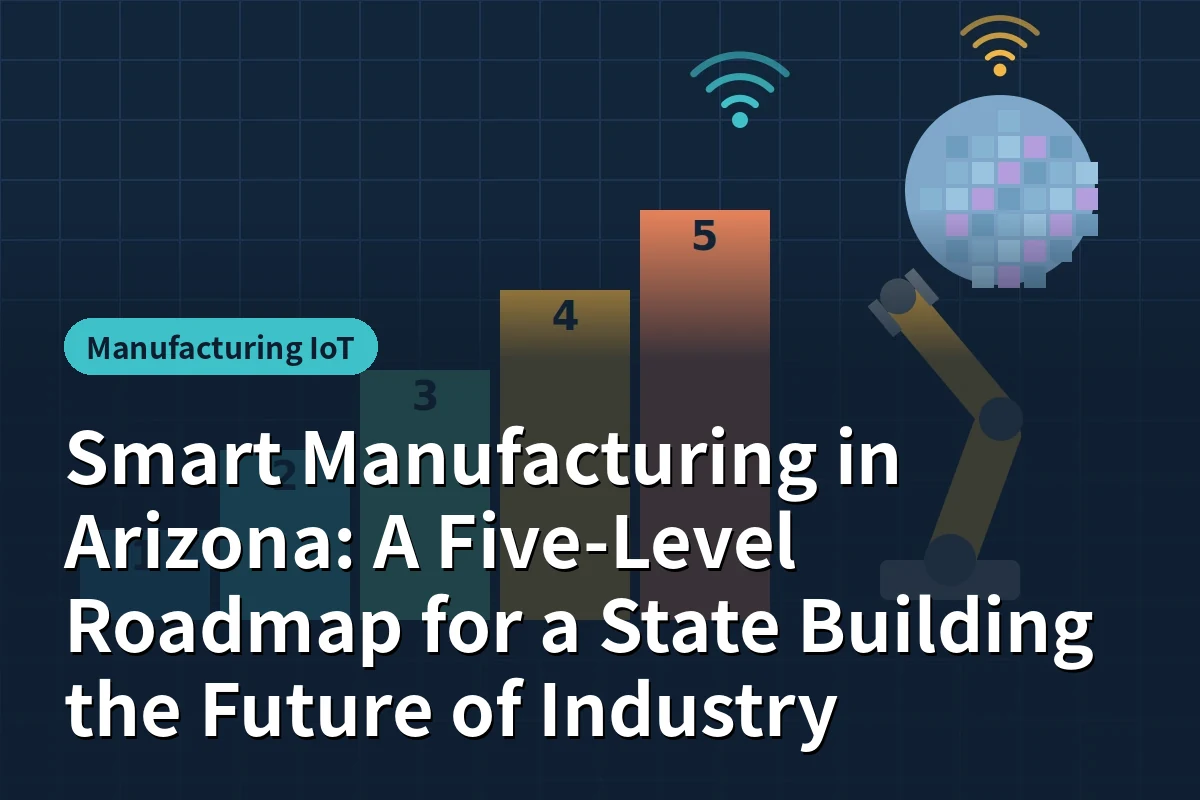
Smart manufacturing is the use of connected equipment, data and software to make production decisions faster and more accurately than people could alone. It is less about any single technology and more about a progression: from seeing what is happening, to understanding why, to predicting what will happen, to letting systems act automatically where it is safe and sensible.
| Level | What It Looks Like | Key Technologies | Typical Arizona Example |
|---|---|---|---|
| 1. Connected | Machines and environments report status automatically | Machine adapters, sensors, gateways | A job shop tracking spindle run time on its CNC machines |
| 2. Visible | Data is organized so people see performance in real time | Dashboards, OEE tracking, alerts | A food plant watching cooler temperatures and line stops from one screen |
| 3. Analytical | Data explains causes of downtime, scrap and cost | SPC, root cause tools, historians | A molder linking afternoon defects to resin temperature |
| 4. Predictive | Models forecast failures and quality issues before they happen | Machine learning, condition monitoring, digital twins | A supplier predicting pump failures from vibration trends |
| 5. Adaptive | Systems adjust processes automatically within set limits | Closed-loop control, AI at the edge, autonomous equipment | A fab adjusting process parameters in real time; a mine running autonomous haulage |
Most Arizona manufacturers sit at level one or two. The largest new facilities are designed for levels four and five from the start. The gap between them is where much of the state's competitive opportunity lies.
The Arizona Ecosystem Taking Shape
Anchor investments
TSMC has announced plans that bring its total Arizona investment to $265 billion, covering additional fabs, advanced packaging facilities and an R&D center. Its first fab has been in volume production since late 2024, and the second is expected to begin volume production in 2027. Amkor broke ground in October 2025 on a $7 billion advanced packaging and test campus in Peoria, planned to include more than 750,000 square feet of cleanroom space and up to 3,000 jobs, with production expected to start in early 2028. Amkor has said its 2026 capital spending, projected at $2.5 billion to $3.0 billion, rises mainly because of the Arizona facility.
Beyond semiconductors, LG Energy Solution's $5.5 billion battery complex in Queen Creek was slated to begin production in 2026, and state officials count more than 70 semiconductor expansions in Arizona since 2020, representing over $314 billion in investment.
Research and equipment
The Materials-to-Fab Center in Tempe, a $270 million-plus shared research and prototyping facility created by Applied Materials and Arizona State University, is designed to speed the move from lab ideas to fab-ready processes. Semiconductor equipment companies such as ASM have expanded their Arizona presence. These organizations bring deep expertise in process data, automation and equipment connectivity to the region.
Workforce pipelines
Arizona has built training partnerships aimed at advanced manufacturing, including Future48 Workforce Accelerators developed with community colleges and industry, one of them battery-focused in Apache Junction. Universities and community colleges across the Phoenix and Tucson areas are expanding programs in semiconductor technology, mechatronics and industrial automation.
What Smart Manufacturing Means for Smaller Arizona Manufacturers
A 50-person manufacturer does not need a digital twin of its entire plant. It does need to avoid falling so far behind that it cannot meet customer expectations or retain workers. A realistic path looks like this:
- Reach level one on the machines that matter most. Connect bottleneck equipment and critical assets first.
- Replace paper where it slows decisions. Digital work instructions, electronic travelers and connected inspection data reduce errors and speed audits.
- Build analytical habits. Hold a short weekly review of downtime, scrap and delivery data. The habit matters more than the software.
- Add prediction selectively. Apply condition monitoring and predictive tools to assets where a failure is expensive, such as compressors, spindles or chillers that struggle in summer heat.
- Automate where the case is clear. Robots and cobots make sense for repetitive, ergonomically difficult or hard-to-staff tasks, especially when data shows consistent demand.
Digital Twins Without the Hype
A digital twin is a virtual model of a machine, line or facility that updates with real data. In large fabs and new battery plants, detailed twins help engineers test changes, plan maintenance and train staff without disrupting production. For smaller manufacturers, a useful twin can be much simpler: a model of one critical line that combines machine data, scheduling and quality results to test what happens if a shift pattern, batch size or maintenance window changes.
The lesson from early adopters is to build twins around specific decisions. A twin created to answer "can we add a third shift on this line without new equipment?" tends to deliver value. A twin created because the technology is interesting often does not.
Data Architecture That Scales
As manufacturers move up the maturity ladder, the way data is organized matters more than any single tool. Many successful plants adopt a shared data layer, sometimes called a unified namespace, where machines, sensors and business systems publish information in a consistent structure that any application can use. This avoids a tangle of point-to-point connections that becomes impossible to maintain. Open protocols such as MQTT and OPC UA make this approach practical for companies of all sizes, and they reduce dependence on any one vendor.
AI on the Factory Floor: Real Uses, Real Limits
Artificial intelligence is the most discussed part of smart manufacturing, and it has genuine applications: visual inspection that spots defects faster than people, anomaly detection in sensor data, scheduling optimization and assistants that help technicians find answers in manuals and maintenance history. Newer industrial devices can run models at the edge, keeping decisions fast even when network connections are unreliable.
But AI depends on clean, well-labeled data from connected equipment. Manufacturers that skip the fundamentals often find that AI pilots stall for lack of reliable inputs. In practice, the path to AI runs through levels one to three of the framework above.
Risks Arizona Manufacturers Must Plan Around
- Water. The August 2026 Colorado River decision and ongoing groundwater limits mean water use will influence siting, permitting and process design. Metering and recycling data will matter.
- Power. Record grid peaks and rising rates make energy monitoring and demand management part of smart manufacturing, not a separate project.
- Cybersecurity. Connected factories are targets. Semiconductor customers increasingly reference standards such as SEMI E187 for equipment security, and attacks on industrial controllers in 2026 show the cost of exposed systems.
- Talent competition. Large projects compete for the same technicians and engineers that smaller firms need. Automation and better tools can help retain people by making jobs more rewarding.
- Heat. Equipment, materials and workers all feel extreme temperatures. Environmental monitoring and heat safety programs are part of resilient operations.
Collaboration as a Competitive Advantage
Arizona's smaller manufacturers can compete more effectively by working together. Shared training programs, joint purchasing of connectivity and software, and peer groups that compare metrics and lessons learned all reduce the cost and risk of adopting new technology. Industry associations, economic development organizations and university partnerships can help convene these groups. In a market where large projects set the pace, collaboration lets smaller firms move faster than they could alone.
Five Questions for Leadership Teams
- Which customer requirements for data, traceability or security will we be unable to meet in two years if we change nothing?
- Where is our biggest hidden capacity, and do we have data to find it?
- Which single equipment failure would hurt us most this summer, and can we see it coming?
- Who in our company owns manufacturing data, and do they have time to use it?
- If a customer asked tomorrow how we secure our connected equipment, what would we say?
Honest answers to these questions usually point to a short, achievable list of next steps rather than a sweeping transformation program.
The Road to 2030
By the end of the decade, Arizona will likely host several operating leading-edge fabs, a large advanced packaging campus, expanded battery production and a supply chain reshaped around them. Smart manufacturing capability will increasingly decide which local companies participate. The good news is that the entry point remains modest: connect the machines that matter, use the data every week and build from there.
Manufacturers looking for automation, industrial software and smart factory partners can browse the IoT Arizona company directory, including providers in Phoenix, Chandler, Gilbert and Goodyear.
Our practical guide to IoT in Arizona manufacturing covers level one and two projects in detail, and our semiconductor supplier readiness guide explains what it takes to sell into the fabs. Browse more of our Manufacturing IoT coverage.
Tags:
Related articles
Manufacturing IoT
 Manufacturing IoT
Arizona Advanced Manufacturing Growth: Companies and IoT Technologies to Watch
 Manufacturing IoT
Intel's Arizona Manufacturing Operations: Where Smart Factory Technology Fits as 18A Ramps in Chandler
 Manufacturing IoT