Most discussions of chip fab water focus on one number: how many gallons a fab uses each day. Reported figures for TSMC's first Phoenix fab put daily use around 4.75 million gallons. That number matters, but it hides how fabs actually manage water. Inside a fab, water is not one stream but many, each with different contaminants, different treatment needs and different destinations. Managing water well is largely a sorting problem, and sensors are what make the sorting possible.
Arizona offers two of the clearest examples anywhere. Intel's Ocotillo campus in Chandler runs a 12-acre on-site water reclamation facility that can treat up to 9.1 million gallons a day, including removing total dissolved solids, alongside the Ocotillo Brine Reduction Facility, a partnership with the City of Chandler since 1995 that can treat up to 2.8 million gallons a day. TSMC is building a 15-acre Industrial Reclamation Water Plant in north Phoenix, scheduled for completion in 2028 and designed to recycle about 85 percent of water at start-up, with a goal of 90 percent or better. This article explains how sensors make that kind of reuse work.
A fab draws municipal water and purifies it into ultrapure water, which rinses wafers between process steps. After use, that water carries different contaminants depending on where it was used: traces of acids, solvents, metals, slurry particles or nothing more than slightly elevated conductivity. Cooling towers, scrubbers and other facility systems produce their own streams.
Mixing everything together makes treatment harder and reuse less likely. Keeping streams separate, and routing each to the right treatment, is what allows high recovery rates. That is where online sensors come in.
| Measurement | What It Indicates | Where It Is Used |
|---|
| Resistivity and conductivity | Dissolved ions; overall water purity | Ultrapure water production and distribution; first screen for reusable rinse water |
| Total organic carbon | Organic contamination from solvents and photoresist chemicals | Ultrapure water quality and reclaim decisions |
| Particle counts | Particles that could cause defects | Ultrapure water loops and points of use |
| Dissolved oxygen and silica | Trace impurities affecting sensitive processes | Ultrapure water polishing |
| pH | Acidity or alkalinity of used streams | Waste segregation and neutralization |
| Specific ion analyzers | Contaminants such as fluoride, ammonia or metals | Routing streams to dedicated treatment |
| Flow and level | Volumes in, out and stored | Water balance, tank management, reporting |
Exact configurations are proprietary and vary by fab, but the principle is widely used in the industry: measure each stream continuously and let the data decide where it goes.
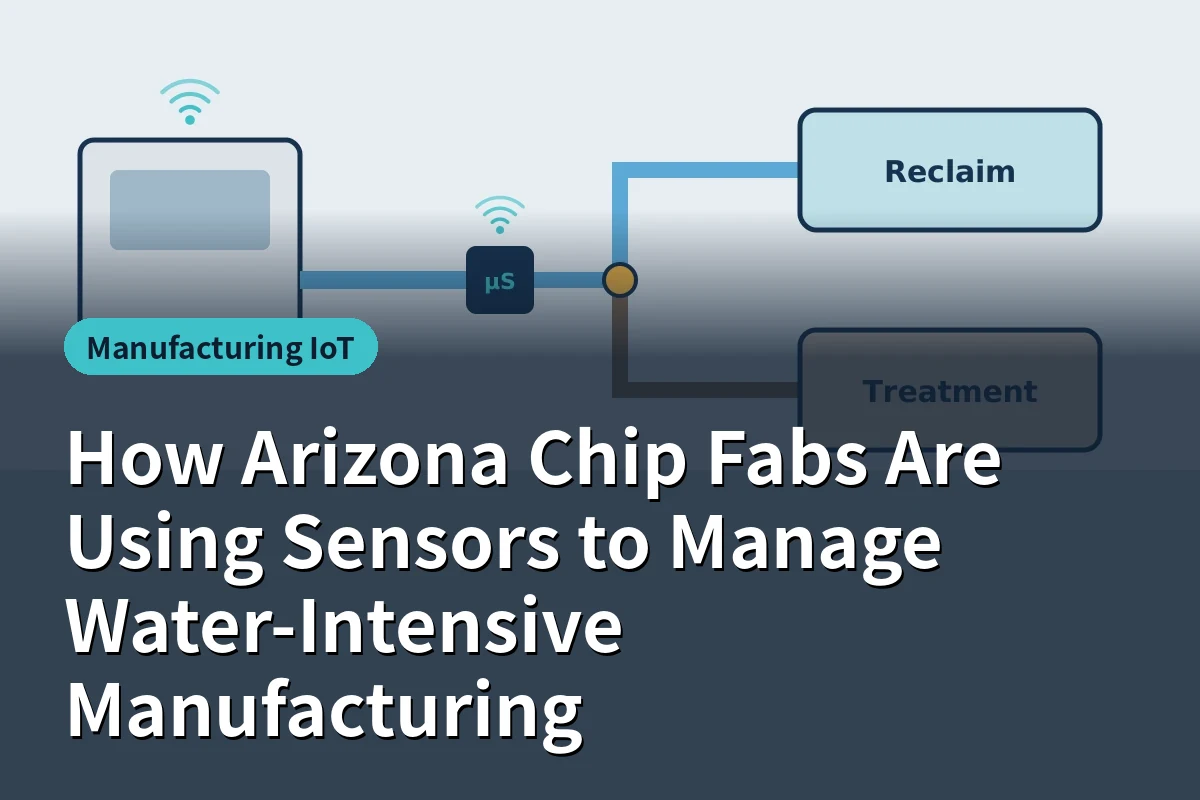
- Measure at the source. Sensors on drain lines from tools and wet benches track conductivity, pH or specific contaminants.
- Classify in real time. Control logic compares readings with thresholds for each destination.
- Divert automatically. Valves route clean rinse water back toward reclaim, while contaminated water goes to the appropriate treatment train.
- Verify after treatment. Sensors confirm treated water meets the quality needed for its next use, whether ultrapure water makeup, cooling towers or other systems.
- Record everything. Data supports permits, sustainability reporting and investigations if quality drifts.
The value of this approach is that each liter is handled according to its actual condition, rather than worst-case assumptions. A sensor that drifts can quietly send good water to waste or, worse, send contaminated water to a reuse system, so calibration and redundancy matter as much as the sensors themselves.
Phoenix's water contains more dissolved minerals, such as calcium and magnesium, than the water TSMC treats in Taiwan. Higher total dissolved solids mean more work to produce ultrapure water and more concentrated brine left over after treatment. Intel's emphasis on removing dissolved solids at Ocotillo, and its long-running brine reduction partnership with Chandler, reflect that reality. Continuous measurement of dissolved solids, scaling indicators and membrane performance helps operators run treatment efficiently and plan maintenance.
Fab water management does not stop at the property line. Intel reports that its Arizona operations have been net positive for water since 2021, returning and restoring more water than they consume through on-site conservation and funding for watershed restoration projects. In an April 2026 presentation, an Intel water stewardship lead reported 3.3 billion gallons conserved on site in 2024 and more than 1.3 billion gallons restored through 21 restoration projects benefiting Arizona.
Those claims depend on measurement at scale: metered intake, metered discharge, verified conservation and documented restoration. Partnerships with cities, such as Chandler's brine facility and reclaimed water interconnections, require shared data and trust between public and private operators. As Phoenix designs a recycling facility expected to produce nearly 70,000 acre-feet a year by 2030, according to the Greater Phoenix Economic Council, the boundary between industrial and municipal water systems will matter more.
Because reuse decisions are automated, sensor failures have consequences in both directions. A conductivity probe that reads too high may send clean water to waste, quietly reducing recovery rates. One that reads too low may route contaminated water to a reuse system, risking product quality or damage to treatment membranes. Fabs typically address this with redundant sensors on critical streams, regular calibration against reference instruments, automatic alarms when paired sensors disagree and conservative defaults that send water to treatment when readings are uncertain. These practices add cost, but they protect both yield and recovery targets. They also provide the audit trail regulators and community partners expect when a facility reports its water performance.
Water monitoring also connects to production. When new tools come online or product mix changes, water demand and wastewater composition shift. Fabs that track water by tool group and process step can forecast how a ramp will affect treatment capacity, chemical consumption in treatment plants and brine volumes. That foresight matters during expansions like those underway in Phoenix and Chandler, where new fabs share or extend existing water infrastructure.
Most Arizona manufacturers do not need ultrapure water, but the fab approach scales down:
- Meter by process, not just at the main. Knowing which process uses which water reveals opportunities.
- Separate streams where practical. Clean rinse water, cooling tower blowdown and contaminated process water often deserve different handling.
- Use conductivity as a first screen. It is inexpensive and indicates whether water might be reused.
- Calibrate and verify. Reuse decisions are only as good as the sensors behind them.
- Report with data. Under the new Colorado River guidelines and local large-water-user rules, verified figures carry more weight than estimates.
Our guides to smart water management in Arizona and choosing industrial sensors go further on these topics.
Water use by large industrial users is closely watched in Arizona, especially after the federal government's August 2026 decision cutting the state's Colorado River use for 2027 and 2028. Fabs that publish clear, consistent data on intake, recycling rates and discharges give communities and regulators a factual basis for discussion. Sensor networks are what make that reporting credible, because figures can be traced back to measured flows rather than engineering estimates. As more manufacturers and data centers arrive, transparent water reporting may become an expectation rather than a choice.
Fab and supplier water systems create demand for analyzer installation, calibration services, data integration, maintenance of treatment equipment and secure connections between plant systems and reporting platforms. Chemical suppliers moving into Casa Grande and Phoenix need their own water monitoring too. Firms that combine water chemistry knowledge with instrumentation and data skills are especially valuable.
Chemical makers and parts cleaners moving into Arizona face their own water questions. A practical start is to meter intake and each major process separately, install conductivity and pH sensors on main wastewater streams, and track recycling and discharge volumes monthly. Those basics support permits, customer questionnaires and future reuse projects, and they cost far less to design in than to add later.
Water treatment controls at fabs are critical infrastructure in their own right. The 2026 attacks on internet-facing controllers at U.S. water utilities, covered in our PLC security checklist, show why reclamation plant controls must be segmented and tightly managed.
TSMC's reclamation plant, Intel's continued operations and the chemical suppliers growing around them will make Arizona one of the most water-instrumented industrial regions in the country. The real measure of success will not be daily gallon totals alone, but how much of each gallon is measured, sorted and reused. That depends on sensors working reliably, day after day, in a desert where every drop counts.
Our article on how semiconductor manufacturing uses IoT covers the other monitoring layers inside a fab, and our look at Intel's Arizona operations explores the Chandler campus further. Find water technology partners in the IoT Arizona company directory, including manufacturing IoT providers in Chandler. Browse more of our Manufacturing IoT coverage.
Frequently asked questions
Used water from different tools carries different contaminants. Keeping streams separate and routing each to the right treatment, guided by sensors, enables high recovery rates.
Resistivity and conductivity, total organic carbon, particle counters, dissolved oxygen and silica, pH, specific ion analyzers and flow and level instruments.
Its 12-acre on-site facility can treat up to 9.1 million gallons a day, and the Ocotillo Brine Reduction Facility with the City of Chandler can treat up to 2.8 million gallons a day.
A 15-acre Industrial Reclamation Water Plant, due in 2028, designed to recycle about 85 percent of water at start-up with a goal of 90 percent or better.
Higher dissolved minerals mean more treatment to make ultrapure water and more concentrated brine afterward, so dissolved solids and membrane performance need close monitoring.
Meter by process, separate streams where practical, use conductivity as a first screen, calibrate sensors that drive reuse and report water performance with measured data.
Related articles

 Manufacturing IoT