 Industrial IoT (IIoT)
Reducing Downtime with Industrial IoT: Smarter Factory Opera...
Published On 21-06-2026

Published by IOT Arizona Research & Editorial Team
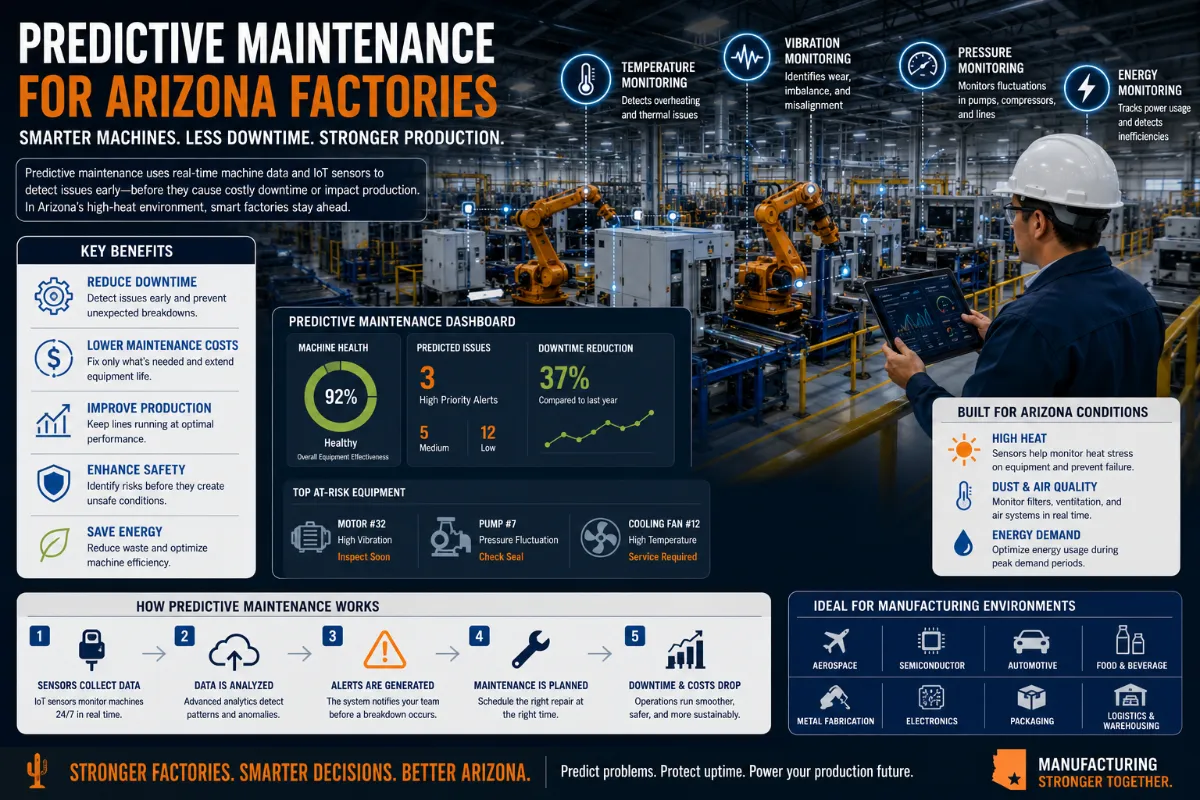
Arizona factories operate in a demanding environment. Extreme heat, high energy demand, equipment stress, labor shortages, and tight production schedules all increase the cost of unexpected downtime.
For manufacturers in Phoenix, Mesa, Chandler, Tempe, Tucson, Glendale, and other Arizona industrial markets, predictive maintenance is becoming one of the most valuable smart factory strategies.
Instead of waiting for machines to fail, factories use sensors, machine data, and analytics to detect early warning signs before production stops.
Recommended unique topic: Predictive Maintenance for Arizona Factories: How Heat, Machine Data, and IoT Are Changing Plant Reliability
This angle is stronger than a generic “benefits of predictive maintenance” article because it connects the topic to Arizona factory conditions, extreme heat, plant uptime, machine health, energy waste, and production risk.
Factory equipment in Arizona often runs under difficult conditions. Heat can increase stress on motors, compressors, HVAC systems, pumps, conveyors, electrical panels, robotics, and production machinery.
When one critical machine fails, the impact can spread across the entire production line.
Predictive maintenance helps factories move from reactive repair to planned action.
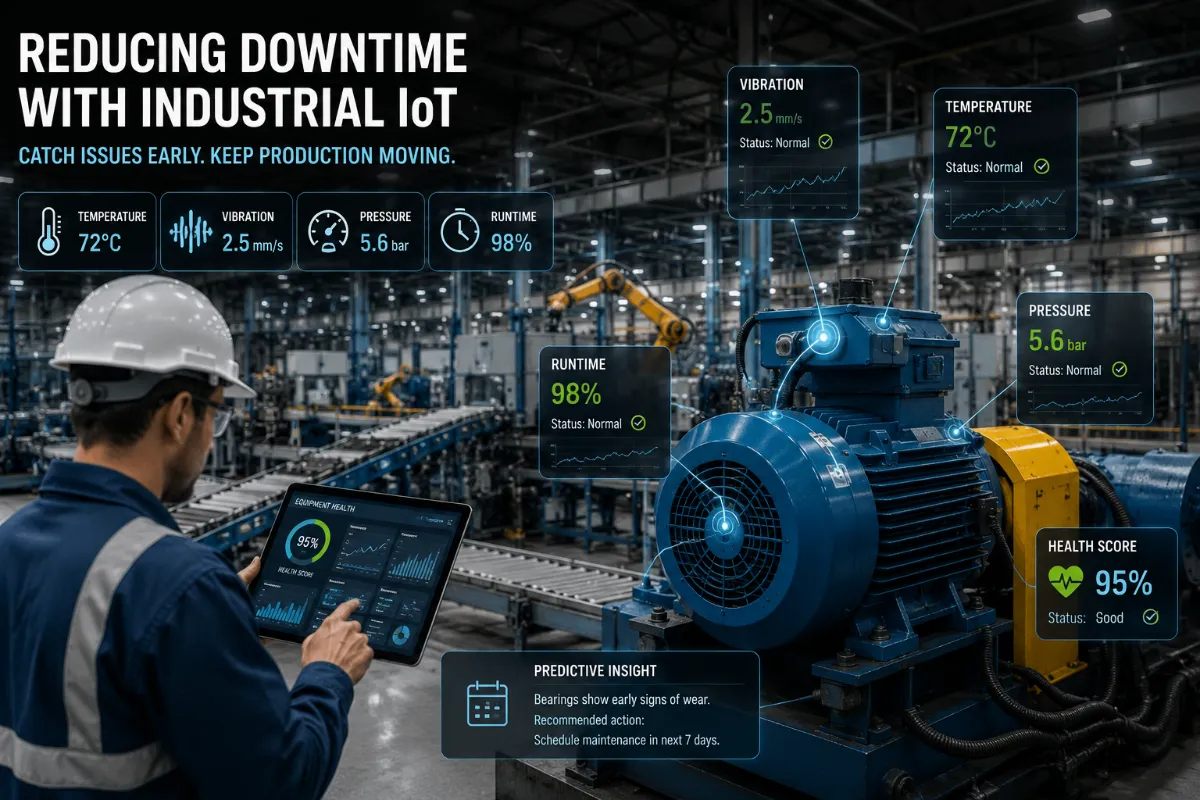
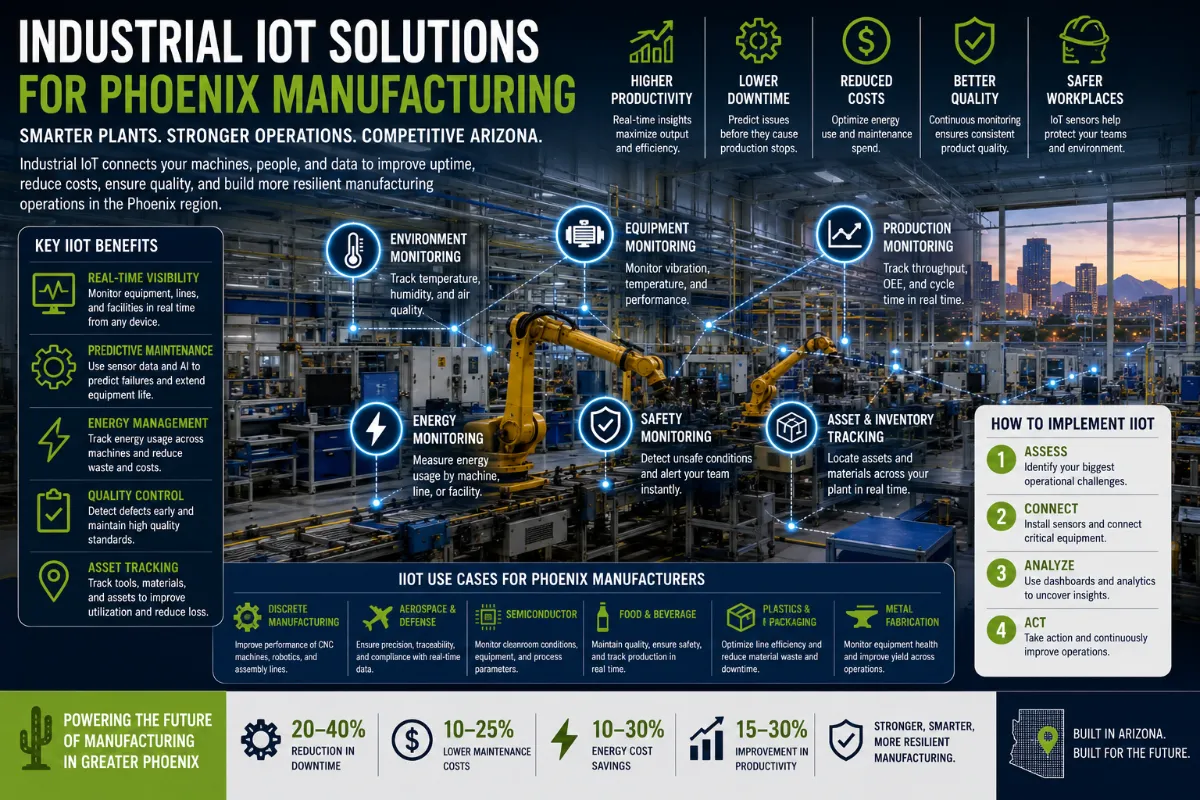
Predictive maintenance uses real-time equipment data to identify early signs of failure. Sensors monitor how machines perform during normal operations. Software then analyzes patterns and alerts maintenance teams when something changes.
The goal is simple: fix the right problem at the right time before it becomes a shutdown.
| Maintenance Type | How It Works | Main Limitation |
|---|---|---|
| Reactive Maintenance | Repair equipment after it fails | Causes downtime and emergency costs |
| Preventive Maintenance | Service equipment on a fixed schedule | May replace parts too early or too late |
| Predictive Maintenance | Use sensor data to predict equipment issues | Requires clean data, sensors, and team training |
| Equipment | What Predictive Maintenance Monitors | Why It Matters |
|---|---|---|
| Motors | Vibration, heat, current draw | Detects wear before failure |
| Compressors | Pressure, temperature, runtime | Prevents costly production interruptions |
| Conveyors | Speed, vibration, belt condition | Keeps production flow moving |
| Pumps | Flow rate, pressure, vibration | Identifies blockage or mechanical stress |
| Robotics | Cycle time, movement accuracy, motor load | Protects precision and throughput |
| Electrical Panels | Heat, load, abnormal current | Reduces electrical failure risk |
| Industrial HVAC | Temperature, airflow, runtime | Protects equipment, workers, and process conditions |
Abnormal vibration can reveal bearing wear, alignment problems, imbalance, loose components, or motor stress.
Unexpected heat can signal friction, electrical issues, cooling problems, or overworked equipment.
Machines that suddenly use more power may be working harder because of mechanical inefficiency or hidden wear.
Pressure changes can reveal leaks, clogged filters, pump issues, or compressed air problems.
When a machine takes longer to complete the same task, it may be developing a mechanical or control issue.
Predictive maintenance gives teams more time to act. Instead of discovering a failure during production, maintenance teams can schedule service during planned downtime, order parts earlier, and assign technicians before the issue becomes urgent.
This helps factories protect uptime while reducing emergency repairs.
Failing equipment often consumes more energy before it breaks. A motor with bearing wear, a clogged filter, a leaking air system, or an overworked compressor may continue operating while quietly increasing utility costs.
Predictive maintenance identifies these hidden inefficiencies earlier.
Start with machines that would stop production, create safety risk, or cause expensive downtime if they failed.
Use vibration sensors, temperature sensors, pressure sensors, current sensors, flow meters, humidity sensors, and runtime monitors based on the equipment type.
Measure normal machine behavior before setting alerts. Without a baseline, teams may receive too many false alarms.
Set alerts for unusual vibration, heat, pressure, runtime, energy use, or cycle-time changes.
Predictive maintenance works best when alerts create clear action. Connect system alerts to maintenance tickets, technician assignments, and parts planning.
Track downtime, repair costs, energy use, false alerts, response time, and machine availability.
| Metric | Why It Matters |
|---|---|
| Unplanned Downtime | Shows whether failures are decreasing |
| Maintenance Cost | Shows savings from fewer emergency repairs |
| Energy Use | Shows whether equipment is running more efficiently |
| Machine Availability | Shows how often equipment is ready for production |
| Scrap and Rework | Shows whether machine health is improving quality |
| Parts Usage | Shows whether replacements are better planned |
Start with the most critical assets. Expanding too quickly can create too much data and too little action.
Operators often know when a machine sounds, feels, or behaves differently. Combine sensor data with plant-floor experience.
An alert is not enough. The system should tell teams what happened, where it happened, how urgent it is, and what action is needed.
Connected factory systems must be protected with network segmentation, access controls, software updates, and continuous monitoring.
Predictive maintenance connects operational technology with digital systems. That makes cybersecurity essential.
The future of predictive maintenance will move beyond alerts. Arizona factories will increasingly use AI, digital twins, edge computing, robotics data, and automated scheduling to create self-optimizing production environments.
Future systems may predict failures, recommend repairs, order parts, schedule technicians, and adjust production plans automatically.
Predictive maintenance for Arizona factories is not just a technology upgrade. It is a production reliability strategy.
The strongest programs focus on critical machines, clean data, clear alerts, measurable ROI, and maintenance workflows that turn insight into action.
For Arizona manufacturers, the goal is simple: fewer surprises, less downtime, lower costs, and stronger factory performance.
This article was reviewed by the IOT Arizona Editorial Team for accuracy, clarity, and relevance. Information may be sourced from publicly available treatment resources, government agencies, and healthcare references where applicable.
Last reviewed: June 2026
Industrial IoT (IIoT)
 Industrial IoT (IIoT)
 Industrial IoT (IIoT)
 Industrial IoT (IIoT)