Intel has manufactured in Arizona for more than four decades, and its Ocotillo campus in Chandler is now the company's largest manufacturing site. In October 2025, Intel announced that Fab 52, the fifth high-volume fab on the campus, had begun ramping production on Intel 18A, its most advanced process, starting with Panther Lake client processors and followed by Clearwater Forest server chips. Reports citing CNBC say Fab 52 is designed to support more than 10,000 wafer starts per week. The next expansion phase, Fab 62, has been reported to target production around 2028.
An Intel Arizona executive described the direction plainly: Oregon has generally served as the company's research and development center, while Arizona is its largest manufacturing site and, over time, will become the center for its manufacturing. That shift, from developing a process in one state to running it at volume in another, is where smart factory technology matters most at Intel Arizona. This article looks at the campus through that lens.
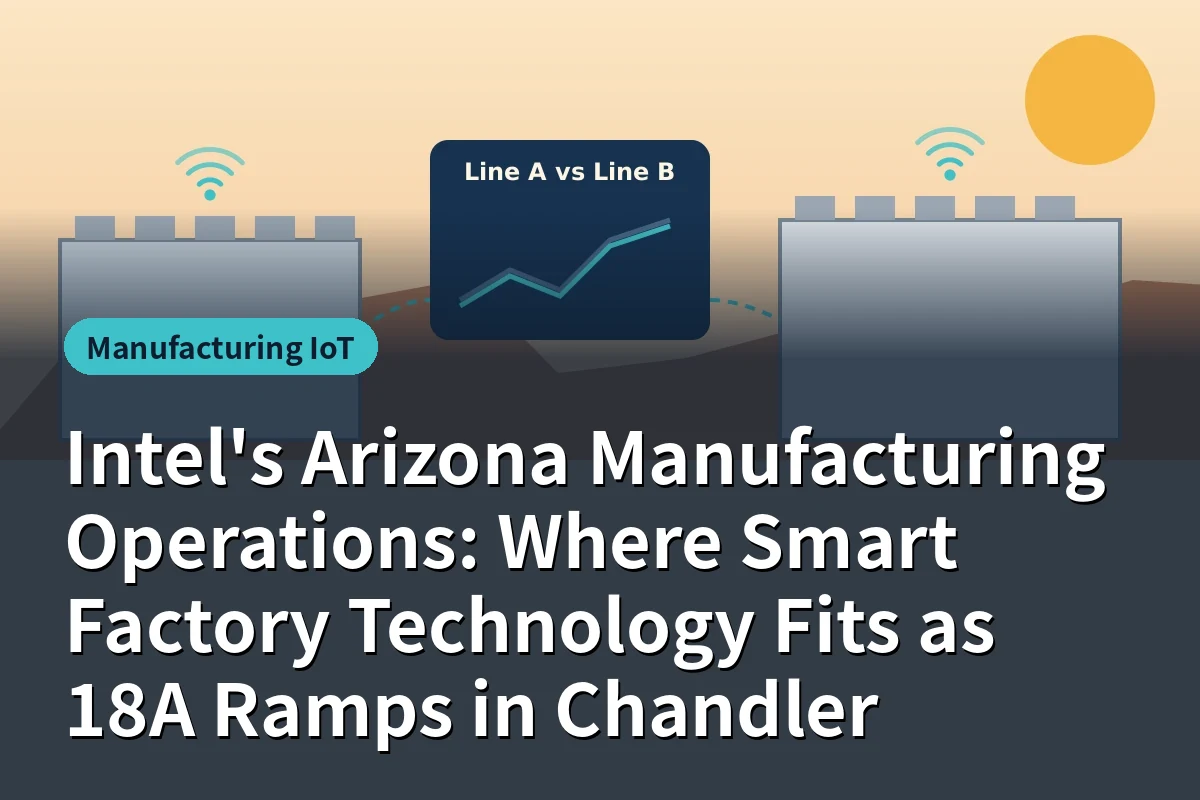
A new process is born in a development fab and then moved to high-volume fabs. Intel has long described a methodology, often called Copy Exactly, that aims to replicate equipment, settings and procedures precisely when transferring a process, so that results match. The underlying challenge is universal in advanced manufacturing: two factories rarely behave identically, even with the same tools.
Connected sensing is what makes replication measurable. If tool data, environmental conditions, utility quality and process results are captured the same way in both locations, engineers can compare them directly and find differences before they affect yield. Without that data, matching becomes guesswork. Every move of production volume from Oregon to Arizona depends on this kind of comparison.
| Area | Smart Factory Role | Why It Matters at Ocotillo |
|---|
| Process tools | High-frequency sensor data, fault detection, run-to-run control | Matching performance across fabs and catching drift early during the 18A ramp |
| Cleanrooms | Continuous particle, temperature, humidity and pressure monitoring | Stable environments across multiple fabs on one campus |
| Material handling | Automated wafer transport and tracking | Moving thousands of wafers a week efficiently and traceably |
| Equipment maintenance | Condition monitoring and predictive maintenance on pumps, chillers and tool components | Avoiding unplanned downtime in a high-volume fab |
| Water | Online quality sensors, stream segregation, reclamation monitoring | Supporting on-site treatment of up to 9.1 million gallons a day |
| Energy and utilities | Power quality, chilled water, exhaust and gas monitoring | Protecting sensitive tools from disturbances on a stressed grid |
| Yield analytics | Linking tool, metrology, test and material data | Turning the ramp into learning that improves output |
A new process in early volume production generates more surprises than a mature one. Industry coverage in 2025 described 18A as being in the middle of its yield ramp. During this phase, the speed at which engineers can connect a defect to its cause directly affects how quickly output rises. That depends on how well tool data, inspection images, electrical test results and material records are linked. Smart factory investments made before and during a ramp tend to pay off more than those made later, because they accelerate learning when learning is most valuable.
Our article on how semiconductor manufacturing uses IoT explains fault detection, process control and yield analytics in more detail.
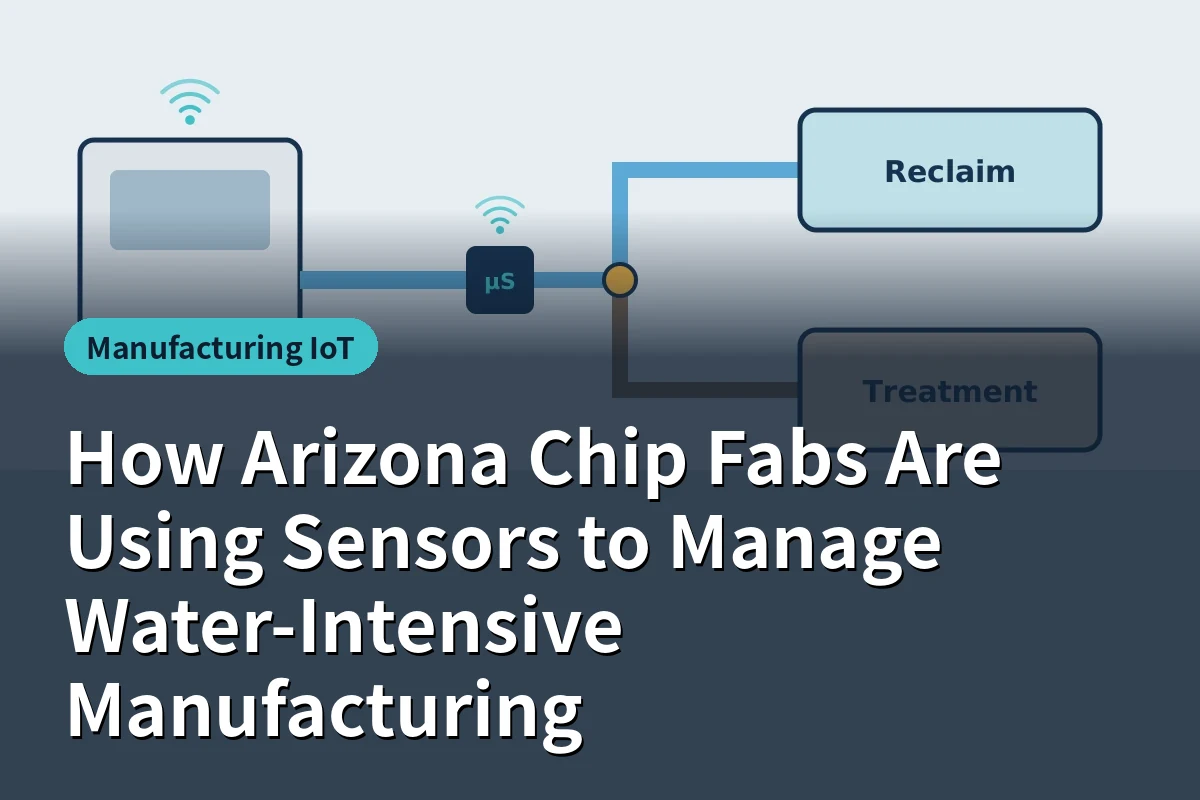
Intel's Ocotillo campus treats water as a managed process in its own right. Its 12-acre on-site facility can treat up to 9.1 million gallons a day, removing dissolved solids, which matters in Arizona's mineral-rich water. The Ocotillo Brine Reduction Facility, operated with the City of Chandler since 1995, adds capacity for treating used process water. Intel reports that its Arizona operations have been net positive for water since 2021. Achieving and documenting that depends on continuous measurement of incoming water, internal reuse and discharges. Our article on how chip fabs use sensors to manage water explains the approach.
Like every Arizona manufacturer, Intel operates through extreme summers. Chillers, cooling towers, exhaust systems and electrical rooms all work harder in heat, and outdoor equipment faces dust storms and monsoon lightning. Monitoring support systems as carefully as process tools is part of keeping a fab running. Our heat-season predictive maintenance playbook covers the failure modes involved.
Ocotillo is not a single factory. Fab 52 is the campus's fifth high-volume fab, which means newer and older processes operate side by side, often sharing utilities, water treatment and support infrastructure. That creates its own smart factory challenge. Utility systems must serve tools with different sensitivities, maintenance teams must manage equipment spanning many generations and data systems must integrate older equipment with modern sensors and analytics.
Connected monitoring helps by giving operators a campus-wide view of shared systems. When a chilled water loop serves several fabs, temperature and flow data show how one area's demand affects another. When new modules are fit out, monitoring confirms that tie-ins to shared utilities do not disturb operating fabs. Older equipment can often gain sensors through retrofits, extending its useful life while bringing its data into the same analytics used for new tools.
Intel has long run supplier development programs in Arizona, including matchmaking events with the Small Business Administration that have drawn hundreds of buyers and suppliers. For local firms, opportunities related to smart factory work include:
- Facility instrumentation: installing and maintaining sensors on utilities, cleanroom systems and support equipment.
- Calibration and verification services for measurement devices across the campus.
- Maintenance support for pumps, chillers and electrical systems, increasingly informed by condition monitoring.
- Construction and fit-out: including commissioning support for new modules and future fabs.
- OT security and integration for facility systems.
Our supplier readiness guide explains the documentation and quality expectations involved.
A campus that combines decades-old buildings with the newest fab presents a broad operational technology footprint. Process tools, building automation, water treatment, power distribution and supplier connections each need appropriate protection. The semiconductor industry's SEMI E187 specification addresses equipment security, and broader practices such as network segmentation, controlled vendor access and continuous monitoring apply across the rest of the site. Our IoT security guide outlines a practical program that applies to large and small facilities alike.
Smart factory tools only work when people can interpret and act on them. Fabs depend on process engineers, equipment technicians, facilities specialists and data analysts who understand both manufacturing and data. Arizona's community colleges and universities have expanded semiconductor and automation programs, and Intel has long participated in local workforce initiatives. For suppliers, the same skills are in demand, and competition for experienced technicians across the Valley remains intense.
Few companies run fabs, but the transfer problem applies widely. Any manufacturer opening a second line, moving production between plants or scaling a product from pilot to volume faces the same question: how do we know the new line matches the old one? The answer is the same at any scale:
- Capture the same data in the same way on the original and new lines.
- Compare equipment behavior, not just final results, to find differences early.
- Treat environmental conditions as process variables, especially in Arizona heat.
- Document changes so differences can be traced.
- Invest in analytics during ramp-up, when learning has the greatest value.
Our smart manufacturing roadmap shows how these practices fit a manufacturer's broader maturity journey.
- If we opened a second line tomorrow, could we prove it matches the first using data?
- Do we capture equipment behavior, or only final inspection results?
- Do our environmental records explain afternoon or summer quality shifts?
- Can we trace a defect back to the tool, material lot and conditions involved within hours?
- Are support systems, such as chillers and compressors, monitored as closely as production equipment?
Honest answers usually point to a short list of practical improvements rather than a large transformation program, and each improvement makes the next expansion easier.
- Fab 52's continued 18A ramp, including server products alongside client processors.
- Fab 62, reported to target production around 2028.
- Intel Foundry customer wins that could bring external designs to Chandler.
- Water and energy reporting as Intel pursues its 2030 sustainability goals.
Intel's Chandler campus is where the company's most advanced process meets high-volume reality. Smart factory technology fits wherever that transition depends on evidence: matching tools across sites, stabilizing environments, managing water and keeping support systems running through Arizona summers. For local firms and manufacturers, the campus offers both opportunities and a model for scaling production with data rather than guesswork.
Our article on TSMC's Arizona expansion and industrial IoT looks at the other major fab campus in the state. Find manufacturing IoT partners in the IoT Arizona company directory, including manufacturing IoT providers in Chandler. Browse more of our Manufacturing IoT coverage.
Frequently asked questions
Fab 52 is the fifth high-volume fab at Intel's Ocotillo campus in Chandler. Intel announced in October 2025 that it was ramping production of 18A chips there, starting with Panther Lake.
Reports citing CNBC say Fab 52 is designed to support more than 10,000 wafer starts per week at full ramp.
Processes developed in Oregon are moved to high-volume fabs in Arizona. Capturing tool, environmental and utility data the same way in both locations lets engineers find and fix differences.
In process tool data and control, cleanroom monitoring, automated wafer handling, predictive maintenance, water reclamation, utility monitoring and yield analytics.
Intel reports its Arizona operations have been net positive for water since 2021 through on-site conservation and funding for restoration projects.
Capture matching data on original and new lines, compare equipment behavior, treat environment as a process variable, document changes and invest in analytics during ramp-up.
Related articles

 Manufacturing IoT