Gunshot detection technology is one of the most debated tools in modern public safety. For Arizona cities, the question is not simply whether the technology sounds impressive. The real question is whether acoustic sensors, AI alerts, smart cameras, and emergency response systems can help communities respond faster while protecting privacy, accuracy, and public trust.
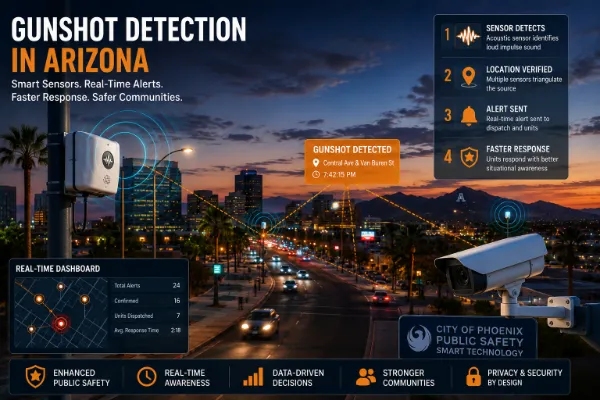
Gunshot detection systems use acoustic sensors placed across selected areas to identify loud impulsive sounds that may be gunfire. When the system classifies a sound as a possible gunshot, it can send an alert to public safety teams with location and time information. These systems are intended to improve response when no one calls 911 or when reports are delayed.
Many articles treat gunshot detection as a single technology. That misses the bigger issue. In practice, gunshot detection only works if it is part of a complete public safety workflow.
A useful Arizona deployment would need to answer:
- Where should sensors be placed?
- Who receives the alert?
- How is the alert verified?
- How are false positives tracked?
- How are residents informed?
- How does the system integrate with dispatch, patrol, cameras, traffic systems, and emergency medical response?
- How is performance measured publicly?
This is why gunshot detection should be discussed as part of Smart Cities & Government and Public Safety, not only as a policing tool.
Gunshot detection technology uses acoustic sensors to detect, classify, and locate sounds that may be gunfire. These sensors are usually installed on buildings, streetlights, utility poles, or other fixed infrastructure. When multiple sensors detect the same sound, software can estimate the location and send an alert.
| Component |
Role in Gunshot Detection |
| Acoustic Sensors |
Listen for loud impulsive sounds that may match gunfire patterns |
| AI Classification |
Analyzes audio signatures to determine whether the sound may be a gunshot |
| Location Triangulation |
Uses multiple sensor readings to estimate where the sound occurred |
| Dispatch Integration |
Sends alerts to public safety teams for review and response |
| Smart Camera Integration |
Can help verify nearby activity when used with clear privacy controls |
| Performance Dashboard |
Tracks alerts, response times, false positives, and outcomes |
Arizona has several conditions that make public safety technology a serious planning topic. Cities such as Phoenix, Mesa, Tucson, Glendale, Tempe, Chandler, Scottsdale, Gilbert, and Goodyear are managing growth, traffic, public events, industrial corridors, school safety concerns, commercial districts, and emergency response demands.
Gunshot detection may be considered in areas where public safety teams need faster awareness of possible gunfire, especially when 911 calls are delayed or incomplete. However, the technology should not be treated as a complete solution. Research and public debate around gunshot detection show mixed results, with some studies pointing to faster response and critics raising concerns about accuracy, cost, over-policing, and civil liberties.
That means Arizona communities should evaluate gunshot detection carefully, with clear performance data and public accountability.
Gunshot detection may alert public safety teams even when no one calls 911. This can be important in areas where residents are unsure what they heard, afraid to call, or unable to provide an exact location.
When the technology works well, sensor triangulation may provide a more specific location than a general 911 report.
Faster awareness may help responders reach victims sooner when a shooting has occurred.
Alerts can create a record of time, location, and audio classification that may support later investigation when combined with other evidence.
Gunshot detection may connect with smart cameras, lighting systems, traffic monitoring, and dispatch platforms to improve situational awareness.
Gunshot detection is controversial because the technology can produce false positives, false negatives, and unclear outcomes. Some communities have discontinued systems due to cost and concerns about effectiveness, while vendors and some agencies argue that the tools help response and evidence gathering.
Recent research and reporting show that evaluation matters. Some studies suggest response-time benefits in certain cities, while critics argue that accuracy, transparency, and community impact remain unresolved issues. :contentReference[oaicite:0]{index=0}
- False positives: Fireworks, vehicles, construction sounds, or other loud noises may be misclassified.
- False negatives: Some actual gunshots may not be detected.
- Cost concerns: Sensor networks, subscriptions, staffing, and integrations can be expensive.
- Equity concerns: Deployments may concentrate in certain neighborhoods, raising over-policing concerns.
- Privacy concerns: Communities may worry about audio recording, cameras, and surveillance expansion.
- Response risk: Inaccurate alerts can send officers into situations based on incomplete information.
Gunshot detection is not meant to replace 911. It is usually positioned as a supplemental alert layer. 911 calls may provide witness details, victim information, suspect descriptions, and context. Acoustic sensors may provide rapid location and time data. The best public safety workflows treat both sources as incomplete but useful signals.
| Signal Source |
Strength |
Limitation |
| 911 Calls |
Can provide human context, witness details, and victim information |
May be delayed, inaccurate, or never made |
| Gunshot Detection |
Can provide fast automated alerts and estimated location |
May misclassify sounds or lack context |
| Smart Cameras |
Can help verify activity near an alert location |
Raises privacy concerns and may not capture the relevant event |
| Officer Reports |
Provide direct field confirmation |
Require response time and may arrive after the incident |
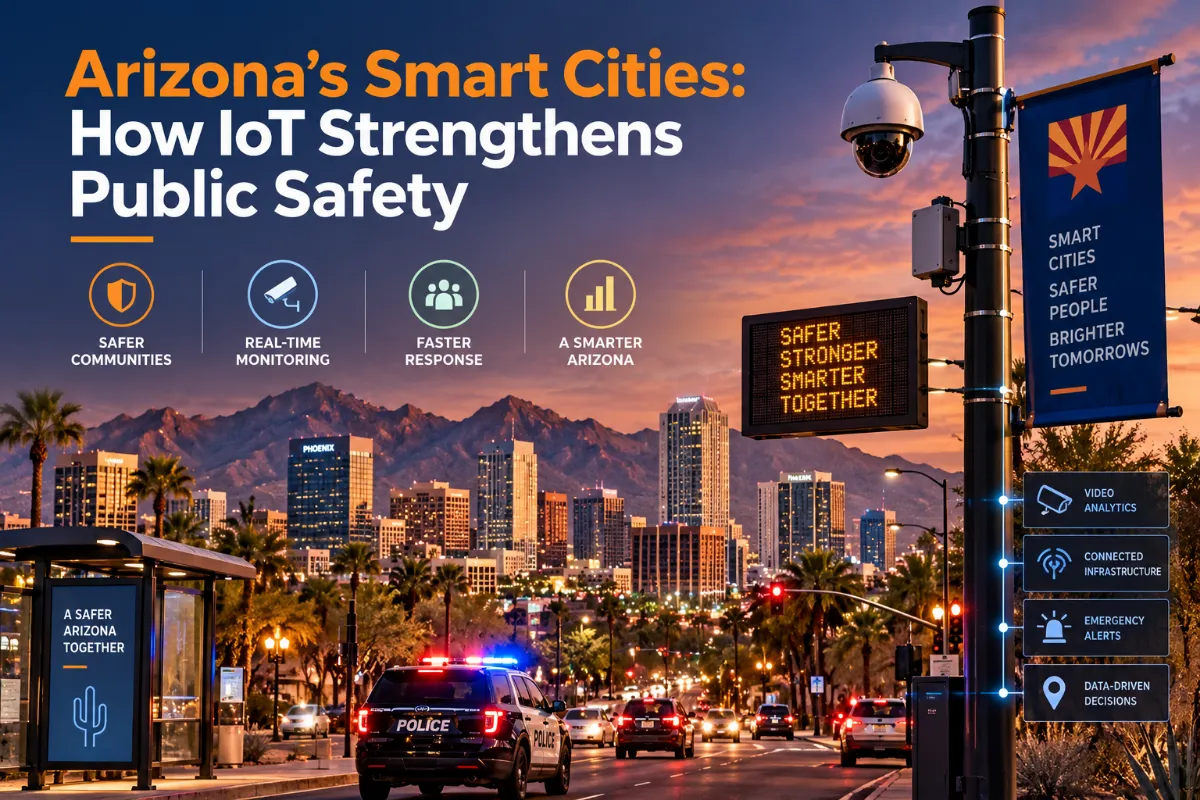
Gunshot detection is most useful when connected to a broader public safety system. In Arizona, that may include connected cameras, smart streetlights, emergency call centers, traffic management, and city operations centers.
Related infrastructure includes:
| City |
Possible Public Safety Use Case |
Internal Link |
| Phoenix |
Downtown corridors, event districts, traffic visibility, emergency response coordination |
Public Safety in Phoenix |
| Tucson |
Urban safety corridors, campus-area response, traffic and neighborhood monitoring |
Public Safety in Tucson |
| Glendale |
Sports districts, event areas, entertainment zones, parking and traffic support |
Public Safety in Glendale |
| Tempe |
Campus-adjacent areas, nightlife corridors, pedestrian-heavy zones |
Public Safety in Tempe |
| Mesa |
Growth corridors, municipal response, school and commercial zone visibility |
Public Safety in Mesa |
| Chandler |
Industrial corridors, commercial districts, emergency visibility near major employers |
Public Safety in Chandler |
| Scottsdale |
Entertainment districts, resort areas, commercial property safety |
Public Safety in Scottsdale |
| Goodyear |
Logistics corridors, industrial growth, road and facility monitoring |
Public Safety in Goodyear |
| Gilbert |
Residential growth, schools, municipal infrastructure, public space visibility |
Public Safety in Gilbert |
Because gunshot detection is expensive and controversial, Arizona communities should evaluate it with clear public metrics. A pilot program should not be judged only by the number of alerts generated. More alerts do not automatically mean better public safety.
- Confirmed gunfire rate
- False positive rate
- False negative estimate
- Average response time compared with 911-only reports
- Number of incidents where medical aid arrived faster
- Number of firearms recovered directly because of alerts
- Number of arrests directly connected to verified alerts
- Community complaints or concerns
- Cost per confirmed incident
- Geographic equity of deployment
Public safety technology must be governed carefully. Residents may reasonably ask whether sensors record conversations, how long audio is stored, who can access data, whether alerts are shared with other agencies, and whether the system expands into broader surveillance.
Critics, including civil liberties organizations, have raised concerns about transparency, reliability, and the potential for biased deployment in some communities. :contentReference[oaicite:1]{index=1}
Arizona communities considering gunshot detection should publish clear policies about:
- What audio is captured
- Whether conversations are recorded
- How long data is retained
- Who can access alert data
- How false alerts are reviewed
- How the public can see performance reports
- How deployment locations are chosen
- How the system is audited
Some cities pair acoustic alerts with nearby cameras to verify whether an incident occurred. This can improve situational awareness, but it also increases privacy concerns. Camera integration should be limited, documented, and governed by clear access policies.
For Arizona agencies, the best approach is not “more surveillance everywhere.” It is targeted, accountable technology that solves specific public safety problems.
Related reading: Smart Cameras in Arizona
Streetlights are often discussed as possible mounting locations for sensors, cameras, and communications hardware. In smart city planning, connected streetlights can become infrastructure for lighting, traffic, environmental sensors, public Wi-Fi, and emergency devices.
However, when streetlights become sensor platforms, cities must be transparent about what is installed and why.
Related reading: Connected Street Lighting Systems
Gunshot detection depends on microphones, sensors, edge computing, AI classification, communications networks, cloud platforms, and emergency workflow software. Arizona’s broader technology ecosystem includes companies connected to public safety, sensors, semiconductors, and connected infrastructure.
These companies do not all provide gunshot detection systems directly, but they represent the broader ecosystem of connected devices, semiconductors, sensing, automation, and public safety technology that supports modern smart infrastructure.
- What specific public safety problem are we trying to solve?
- Why is gunshot detection better than alternative investments?
- How will alerts be verified?
- What is the expected false positive rate?
- How will response-time improvements be measured?
- What happens when the alert is wrong?
- Will deployment affect some neighborhoods more than others?
- How will public performance reports be published?
- How will privacy be protected?
- What is the total cost over five years?
- Treating alerts as confirmed gunfire: Acoustic alerts should be verified, not assumed perfect.
- Ignoring community trust: Public safety tools need public legitimacy.
- Skipping transparency reports: Cities should publish performance data.
- Measuring only response time: Faster response matters, but outcomes matter too.
- Deploying without privacy policies: Audio and camera systems must have clear governance.
- Buying technology without staffing: Alerts need trained people and defined response workflows.
The future of gunshot detection will likely depend less on the sensor itself and more on accountability. Communities will want proof that systems improve response, reduce harm, and operate fairly. Vendors will need to provide clearer accuracy data. Cities will need to publish results. Residents will expect privacy protections.
For Arizona, gunshot detection may become one part of a broader public safety IoT strategy, but it should not be treated as a standalone answer to violence. Technology can support response, but prevention also depends on community programs, emergency medical readiness, lighting, environmental design, youth services, and trust between residents and public agencies.
Gunshot detection in Arizona is a serious public safety topic, not just a smart city trend. Acoustic sensors, AI alerts, cameras, and dispatch integrations may help some communities respond faster to possible gunfire. But the technology also raises legitimate questions about accuracy, cost, privacy, equity, and public trust.
The best approach is careful, transparent, measurable deployment. Arizona communities should evaluate gunshot detection as part of a complete public safety workflow, with clear goals, independent review, public reporting, and strong governance.
Frequently asked questions
Gunshot detection technology uses acoustic sensors and software to detect sounds that may be gunfire and send alerts to public safety teams.
Multiple sensors listen for loud impulsive sounds. Software classifies the sound and estimates the location based on readings from different sensors.
No. Gunshot detection systems can produce false positives and false negatives. Communities should track confirmed alert rates and publish performance data.
Arizona cities may consider it to improve incident awareness, support faster response, and connect public safety alerts with broader smart city systems.
Main concerns include false alerts, cost, privacy, over-policing, lack of transparency, cybersecurity, and whether the system improves real public safety outcomes.
Cities should measure confirmed gunfire rates, false positives, response time changes, medical aid outcomes, costs, community feedback, and deployment equity.
Related articles

 Public Safety