Arizona is in the middle of one of the largest factory-building waves in the country. TSMC's north Phoenix campus, Amkor's $7 billion packaging and test facility in Peoria, LG Energy Solution's $5.5 billion battery complex in Queen Creek and dozens of supplier plants are rising across the Valley and beyond. Most of these facilities are being designed as smart factories from the first drawing, not retrofitted later.
That raises a practical question for every company planning or expanding a plant in Arizona, whether a 500,000 square foot campus or a 40,000 square foot supplier facility: what should a smart factory built for the desert include? This guide focuses on design decisions that are cheap to make before construction and expensive to fix afterward. For a broader maturity framework, see our smart manufacturing roadmap.
Standard smart factory checklists focus on machines and software. In Arizona, four site conditions deserve equal weight from the start:
- Water is constrained by the new Colorado River guidelines, groundwater rules and local large-water-user ordinances.
- Heat stresses equipment, materials, buildings and workers for months each year.
- Power comes from a grid that set new peak records in July 2026, with rising demand charges and growing pressure on large loads.
- Labor is competitive, so plants need to make skilled people as productive as possible.
A smart factory designed around these conditions measures and manages them as carefully as it manages production.
Installing meters during construction costs a fraction of retrofitting them later. Plan electrical submetering by production line and major equipment, water metering by process and building system, and compressed air, chilled water and natural gas metering where they matter. This creates the data needed for cost allocation, efficiency projects, sustainability reporting and compliance with local water rules.
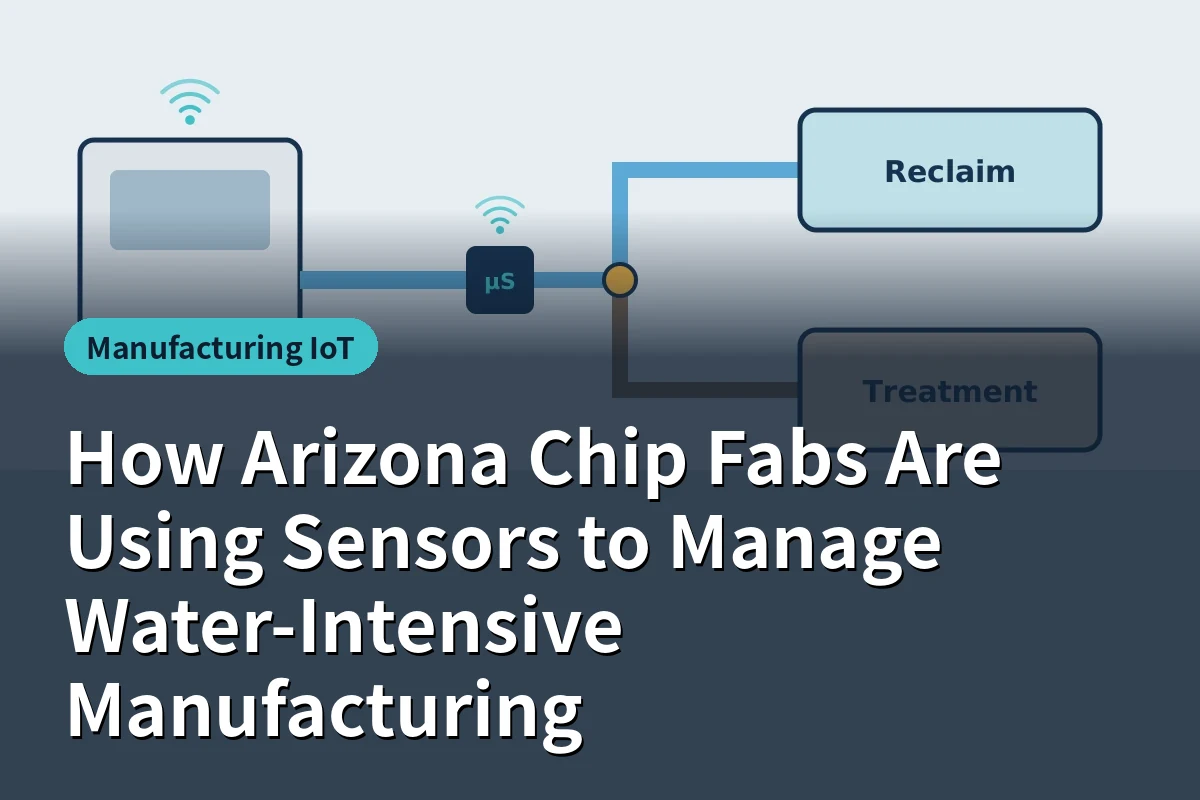
TSMC's approach to water shows how seriously large manufacturers take this. Its Phoenix site already recycles about 65 percent of its water through an in-house water resource center, and a 15-acre reclamation plant under construction is designed to reach about 85 percent at start-up, with a goal of 90 percent or better by its 2028 completion. Reuse at that level depends on detailed measurement of every stream. Smaller plants can apply the same principle at their own scale.
Many factories end up with a tangle of networks added piece by piece. A smart factory plans its operational technology network as core infrastructure: structured cabling and industrial Wi-Fi throughout production areas, separate network zones for machines, building systems, security devices and business IT, and a single controlled path for vendor remote access. Consider whether private LTE or 5G makes sense for large outdoor yards or mobile equipment; our private 5G guide explains the trade-offs.
| System | Heat Risk | Smart Design Response |
|---|
| Electrical rooms and drive cabinets | Derating and failures in hot rooms | Dedicated cooling, temperature sensors and alarms |
| Compressors and chillers | Lower efficiency and more breakdowns in summer | Ventilated rooms, condition monitoring, sequencing controls |
| Raw material storage | Degradation of resins, adhesives, chemicals and electronics | Climate-controlled zones with continuous temperature logging |
| Production floors | Worker heat stress and thermal drift in precision processes | Zoned cooling, environmental sensors, heat safety integration |
| Rooftop and outdoor equipment | Sun-loaded enclosures, dust and monsoon lightning | Shaded, sealed and grounded installations with health monitoring |
Plants that can shift energy use away from summer afternoon peaks save money and support the grid. Design options include thermal storage for cooling, battery storage, onsite solar, controls that stagger large motor starts and scheduling systems aware of utility rate windows. Monitoring is what makes these options work. Our peak demand guide explains how demand charges shape the business case.
Specify machine connectivity in equipment purchase orders: support for open standards such as OPC UA or MTConnect, documented data points and secure remote access methods. Require vendors to deliver equipment ready to connect, rather than adding adapters later. For semiconductor and electronics suppliers, also consider equipment security requirements such as SEMI E187.
Building information models created during design and construction can become the foundation of a facility digital twin. When sensors, meters and equipment are mapped to the model from the start, maintenance teams know exactly where every device sits, and engineers can simulate changes before making them. Even a simple version, an accurate digital map of assets and sensors, saves time for years.
Smart factories still depend on technicians, operators and engineers. Plan for operator-friendly displays at machines, mobile access to work instructions and maintenance data, training spaces and remote support capabilities. Integrate heat safety monitoring for areas that are not fully air conditioned. Good tools make jobs more attractive in a tight labor market, an advantage when competing for talent with the largest employers in the Valley.
Every connected device is a potential entry point. Require unique credentials, firmware update support and vulnerability disclosure from equipment and sensor vendors. Segment networks, log remote access and plan incident response before production starts. Our IoT security guide and PLC security checklist cover the essentials.
A 40,000 square foot supplier facility in Goodyear or Mesa does not need every feature of a fab. A practical minimum includes:
- Electrical submeters on major loads and a main water meter with leak alerts.
- A segmented network with separate zones for machines, building systems and office IT.
- Machine connectivity on bottleneck equipment from installation day.
- Temperature monitoring in storage, electrical rooms and production areas.
- Condition monitoring on compressors and chillers.
- A documented asset and sensor inventory tied to the building layout.
These steps add modest cost during construction and avoid expensive retrofits later.
Few manufacturers have every skill needed in-house. Successful projects typically combine an architect and engineering firm familiar with industrial design, a systems integrator with OT network and controls experience, and equipment vendors willing to follow the plant's connectivity and security standards. Ask partners for references from Arizona projects, since local experience with heat, dust, monsoon storms and utility requirements avoids many surprises. Define responsibilities clearly in contracts so that no system falls between vendors.
- Treating technology as a late-stage add-on. Network and metering decisions should be made with electrical and mechanical design, not after.
- Letting each equipment vendor install its own network and remote access. This creates security gaps and integration headaches.
- Underestimating summer conditions. Designs based on national averages can leave rooms, equipment and workers overheated.
- Skipping data ownership terms. Contracts should guarantee access to equipment and system data.
- Ignoring commissioning of sensors. Sensors that are installed but never calibrated or verified produce misleading data from day one.
The months between construction completion and full production decide whether smart factory features deliver on their promise. Commissioning should verify not just that equipment runs, but that every sensor, meter and data connection works correctly. That means calibrating sensors, confirming that each meter reports to the right system with the right units, testing alarms end to end and checking that network segmentation and remote access controls behave as designed.
Many plants skip this step in the rush to start production, then spend years distrusting their own data. A better approach assigns a data commissioning lead who works alongside mechanical and electrical commissioning teams, maintains a checklist of every data point and signs off only when readings match reference measurements. In Arizona, schedule at least part of commissioning to cover hot-weather operation, since cooling, compressed air and electrical systems often behave differently in July than in March.
Finally, capture a baseline during the first stable months of production. Energy use, water consumption, equipment performance and environmental conditions recorded then become the reference point for every future improvement project.
Smart factory features built in during construction pay off through lower energy and water costs, fewer heat-related failures, faster startup, easier compliance with customer and regulatory requirements and better use of skilled labor. They also improve a plant's resilience to the conditions that define Arizona: water limits, heat waves and grid stress.
The factories being built in Arizona today will operate for decades. Those designed with measurement, flexibility and security at their core will adapt more easily to new products, new regulations and a changing climate. For companies planning their next facility, the most important smart factory decision may be the earliest one: involving operations, IT, OT and facilities teams together before the first wall goes up.
Our guide to how semiconductor manufacturing uses IoT shows how far these principles can go, and our practical guide to IoT in Arizona manufacturing covers upgrades for existing plants. Find automation and smart factory partners in the IoT Arizona company directory, including manufacturing IoT providers in Goodyear. Browse more of our Manufacturing IoT coverage.
Frequently asked questions
It must manage water limits, extreme heat, grid peaks and labor competition as carefully as production, measuring and controlling those conditions from day one.
Submetering power, water, compressed air and chilled water during construction costs far less than retrofitting and provides data for cost control, efficiency and compliance.
Plan the OT network as core infrastructure, with separate zones for machines, building systems, security devices and business IT, plus one controlled path for vendor remote access.
Yes, at smaller scale: submeter major loads, segment the network, connect bottleneck machines, monitor temperatures and key equipment and keep a documented sensor inventory.
Verifying during startup that every sensor, meter and data connection is calibrated, reports correctly and triggers the right alarms, before teams rely on the data.
Adding technology late, letting vendors install their own networks, underestimating summer heat, skipping data ownership terms and failing to commission sensors.
Related articles


 Manufacturing IoT