 Manufacturing IoT

Predictive Maintenance in Arizona Manufacturing: A Heat-Season Playbook for Motors, Compressors and Chillers
Manufacturing IoT
Published by IOT Arizona Research & Editorial Team
- What Heat Does to Plant Equipment
- Matching Monitoring Techniques to Failure Modes
- The Threshold Problem: Why Summer Floods Alarms
- Ranking Assets by Criticality
- The P-F Interval: Buying Time to Plan
- A Program a Mid-Sized Plant Can Run
- An Illustrative Example: A West Valley Molder's Summer
- Making the Business Case
- Common Pitfalls
- Where Predictive Maintenance Is Heading
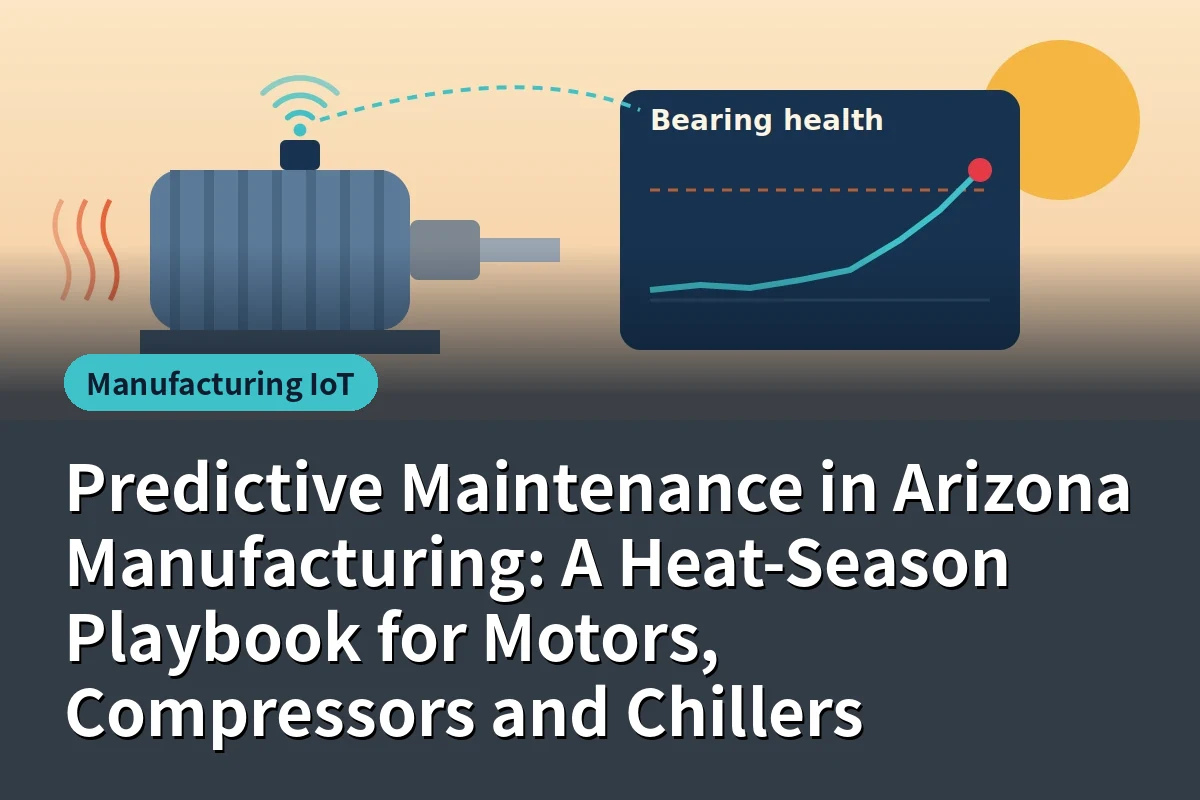
Most predictive maintenance guides are written for factories in mild climates. In Arizona, the calendar itself is a failure mode. Motors, compressors, chillers, drives and bearings that run comfortably from October through April start failing in clusters once shop and rooftop temperatures climb in June. Monsoon storms then add voltage sags, dust and lightning. A predictive maintenance program built without accounting for that seasonal pattern will either miss failures or bury technicians in false alarms.
This guide approaches predictive maintenance for Arizona factories from that angle: which failure modes heat accelerates, which monitoring techniques catch them, how to set alarm thresholds that respect the seasons, and how to build a program a mid-sized plant can actually run.
What Heat Does to Plant Equipment
Several well-established engineering rules of thumb explain why summer is so hard on equipment. They are approximations rather than precise laws, but they point maintenance teams in the right direction.
- Motor insulation. A widely used rule holds that insulation life roughly halves for every 10 degrees Celsius a motor runs above its rated temperature. Motors in hot, poorly ventilated rooms age far faster than their nameplate suggests.
- Bearing lubrication. Grease oxidizes and thins faster at higher temperatures, shortening relubrication intervals. A schedule set in winter may leave bearings underlubricated by August.
- Drives and electronics. Variable frequency drives and control electronics must be derated at high ambient temperatures, and clogged cabinet filters make the problem worse.
- Compressors and chillers. Air compressors and process chillers work harder as intake air and condenser temperatures rise, driving up discharge temperatures, runtime and wear.
- Belts, hoses and seals. Elastomers degrade faster with heat and UV exposure, especially on rooftop and outdoor equipment.
Add monsoon season, with power quality disturbances and wind-driven dust, and it becomes clear why many Arizona plants see their worst unplanned downtime between June and September.
Matching Monitoring Techniques to Failure Modes
| Technique | What It Detects | Best Arizona Applications | Typical Approach |
|---|---|---|---|
| Vibration analysis | Imbalance, misalignment, looseness, bearing defects | Motors, pumps, fans, gearboxes, spindles | Wireless triaxial sensors with periodic spectrum uploads |
| Temperature monitoring | Overheating bearings, windings, connections and enclosures | Motors, electrical cabinets, compressors | Surface sensors plus ambient reference readings |
| Motor current analysis | Electrical faults, rotor issues, load changes, mechanical binding | Critical motors where sensors are hard to mount | Current transformers at the motor control center |
| Infrared thermography | Hot spots in electrical panels and connections | Switchgear, disconnects, drive cabinets before summer | Scheduled surveys, or fixed thermal sensors on critical panels |
| Ultrasonic detection | Early bearing wear, compressed air leaks, electrical arcing | Compressed air systems, slow-speed bearings | Route-based surveys or permanent sensors |
| Oil analysis | Contamination, wear metals, lubricant breakdown | Gearboxes, hydraulics, large compressors | Scheduled sampling with lab analysis |
Most plants do not need every technique. Continuous wireless vibration and temperature monitoring on critical rotating equipment, plus a pre-summer thermography survey of electrical systems, covers the majority of heat-related risk for a typical Arizona manufacturer.
The Threshold Problem: Why Summer Floods Alarms
Here is a mistake that sinks many first-year programs. A plant installs temperature sensors in March, lets the software learn "normal" behavior during mild weather, and sets alarm limits accordingly. In June, every motor runs hotter because the room is hotter, and the system fires hundreds of alerts. Technicians start ignoring them, and the one alert that mattered gets lost.
Three practices prevent this:
- Measure ambient alongside equipment. Track the temperature rise of a bearing or winding above the surrounding air, not just its absolute temperature. A rise that stays constant is normal summer behavior. A rise that grows is a developing problem.
- Build a full-year baseline. Where possible, let models learn across at least one complete summer before relying on automated anomaly detection.
- Use seasonal limits for absolute alarms. Keep hard safety limits fixed, but adjust warning thresholds between cool and hot seasons so alerts reflect real risk.
Vibration monitoring is less affected by ambient temperature, which is one reason it is often the most reliable early indicator in Arizona conditions.
Ranking Assets by Criticality
Instrumenting everything is expensive and overwhelming. A simple criticality ranking focuses investment where failures hurt most. Score each asset on a few questions:
- If it fails, does production stop, slow or continue?
- Is there a spare or redundant unit?
- How long would repair take, including parts lead time?
- Does failure create a safety, environmental or quality risk?
- Has it failed in past summers?
Assets with high scores, such as a single air compressor feeding the whole plant, a process chiller for injection molding, or the spindle on a bottleneck machining center, get continuous monitoring first. Lower-priority assets can remain on route-based inspections.
The P-F Interval: Buying Time to Plan
Reliability engineers talk about the P-F interval, the time between when a developing failure becomes detectable and when the equipment actually fails. Predictive maintenance is valuable only if the interval is long enough to plan a repair: order parts, schedule downtime and assign staff.
Vibration and ultrasonic techniques often detect bearing problems weeks ahead of failure, while temperature rises may appear only days before. That difference matters in Arizona, where parts shortages and contractor backlogs peak in summer. Detecting a problem in April, not July, can be the difference between a planned weekend repair and an emergency shutdown during the busiest production month.
A Program a Mid-Sized Plant Can Run
- Complete a pre-summer audit in spring. Thermography on electrical panels, cleaning of cabinet filters and condenser coils, and a review of lubrication schedules.
- Instrument the top ten critical assets. Wireless vibration and temperature sensors, plus ambient sensors in the same rooms.
- Connect alerts to the maintenance system. Alerts should create work orders in the CMMS automatically, with clear ownership.
- Hold a weekly review. Maintenance and production leads look at trends, open issues and upcoming planned repairs.
- Close the loop after every failure. When something breaks, check whether sensors showed warning signs. Adjust thresholds and coverage accordingly.
- Expand after one full year. Use results from a complete seasonal cycle to decide which assets to add next.
An Illustrative Example: A West Valley Molder's Summer
Consider a plastics injection molder in Glendale running 20 presses, with two process chillers and three air compressors in a hot mechanical room. For years, the plant has lost several production days each summer to chiller trips and compressor failures, usually during the hottest weeks of July.
In spring, the maintenance team installs vibration and temperature sensors on the chillers, compressors and the hydraulic pumps on its four most critical presses, along with ambient sensors in the mechanical room. Within weeks, the data shows that one chiller's condenser fan motor is running with rising vibration, and the mechanical room reaches much higher temperatures in the afternoon than anyone realized because an exhaust fan has failed.
The team replaces the fan motor during a planned weekend shutdown in May and repairs the exhaust fan. In July, the sensors flag a bearing problem on a compressor two weeks before it would likely have failed, and the repair is scheduled for a Sunday. The plant does not avoid every problem, but it moves most of its summer repairs from emergencies to planned work.
The details are hypothetical, but the pattern is common: much of the early value comes from seeing conditions nobody had measured before.
Making the Business Case
Predictive maintenance pays through avoided downtime, lower repair costs, longer equipment life and fewer emergency service premiums. For many Arizona plants, a single avoided summer failure of a critical compressor or chiller covers the cost of monitoring a dozen assets for a year. Calculate your own numbers from last summer's downtime logs, emergency invoices and overtime records.
There are softer benefits too. Technicians spend less time on routine rounds in hot areas and more time on planned work. Energy consumption often drops as misaligned, unbalanced or poorly lubricated equipment is corrected. And demand charges can fall when compressors and chillers run efficiently during peak hours, which our guide to cutting peak electricity demand covers in more detail.
Common Pitfalls
- Buying sensors without a response plan. Alerts need owners and work order integration.
- Ignoring sensor health. Batteries and mounts fail too, especially in hot, vibrating environments. Monitor device status alongside equipment status.
- Trusting vendor models blindly. Machine learning tools help, but experienced technicians should validate what the models flag.
- Skipping the basics. Monitoring does not replace clean filters, proper lubrication and alignment. It tells you when those basics are slipping.
Where Predictive Maintenance Is Heading
Sensor prices keep falling, battery life keeps improving and more analysis happens on the device itself through edge computing. Maintenance platforms increasingly combine sensor data with work order history, spare parts inventory and production schedules to recommend not just what to fix, but when. For Arizona manufacturers, the most important advance may be simpler: models and dashboards that understand the desert's seasons as well as the technicians who have worked through them.
Our guide to industrial IoT sensors in Arizona covers how to choose hardware that survives the heat, and our practical guide to IoT in Arizona manufacturing shows where predictive maintenance fits among other first projects. Manufacturers looking for local partners can browse the IoT Arizona company directory or explore manufacturing IoT providers in Phoenix. Browse more of our Manufacturing IoT coverage.
Tags:
Related articles
Manufacturing IoT
 Manufacturing IoT
Arizona Advanced Manufacturing Growth: Companies and IoT Technologies to Watch
 Manufacturing IoT
Intel's Arizona Manufacturing Operations: Where Smart Factory Technology Fits as 18A Ramps in Chandler
 Manufacturing IoT