On October 15, 2026, TSMC Chairman and CEO C.C. Wei told analysts that construction of the company's second Arizona fab was complete and that tool move-in and installation were underway, with volume production now expected in the third quarter of 2027, slightly ahead of the previous schedule. Construction of the third fab is underway, preparatory work has started on a fourth fab and the site's first advanced packaging facility, and the City of Phoenix says that once announced projects are complete, Arizona will host about 30 percent of TSMC's 2nm-and-beyond capacity.
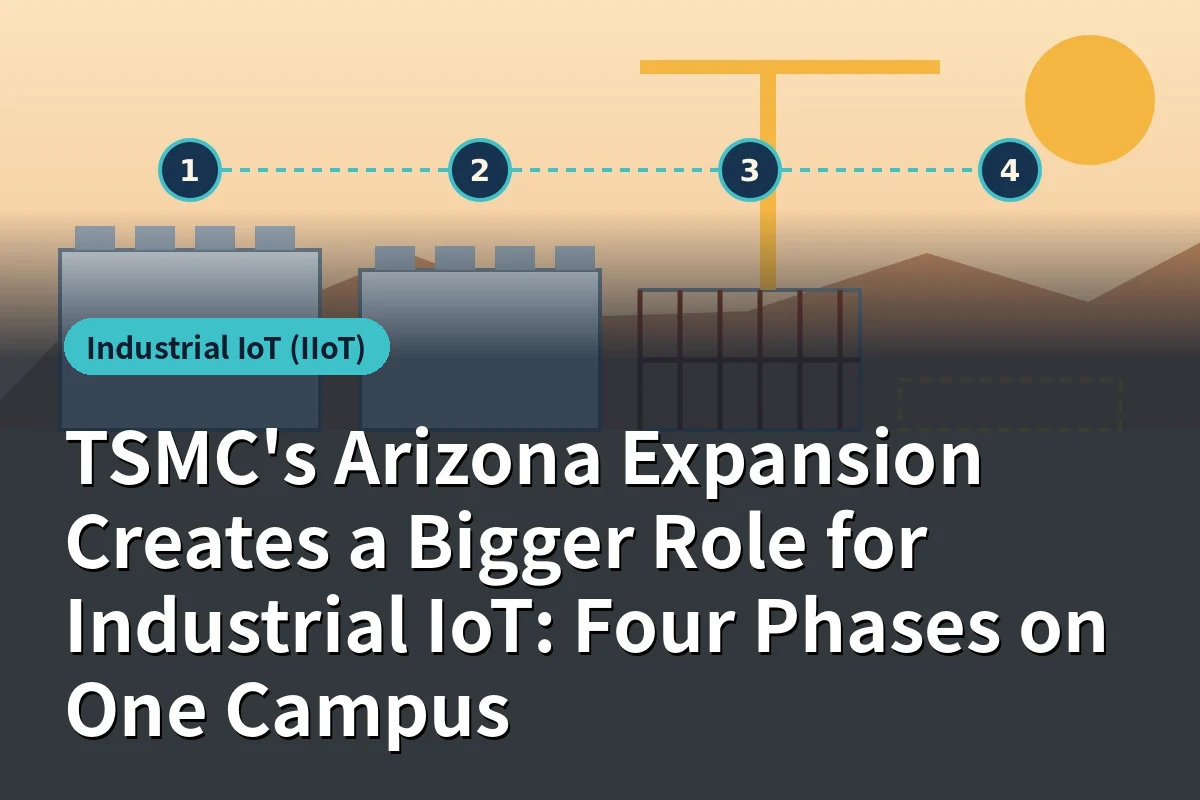
Most coverage treats those milestones as a story about chips. For industrial IoT, the more useful way to read them is as a story about phases. A fab campus that is simultaneously running one fab, installing tools in a second, building a third and preparing a fourth has every stage of the industrial lifecycle happening at once on the same site. Each stage needs a different kind of connected sensing, and the handoffs between them are where the biggest risks and opportunities sit.
| Phase | TSMC Arizona Status | Industrial IoT Role | Who Supplies It |
|---|
| Construction | Third fab underway; fourth fab and packaging site in preparation | Jobsite heat and safety monitoring, equipment tracking, concrete curing sensors, progress verification | Contractors, construction technology firms, safety specialists |
| Tool installation and commissioning | Second fab moving in and installing tools | Utility hookup verification, vibration and cleanliness monitoring, sensor calibration, data commissioning | Tool vendors, facility integrators, instrumentation and calibration services |
| Qualification and ramp | Second fab targeting volume production in 3Q 2027 | Process data collection, fault detection, environmental stability, yield learning | Fab engineering teams, analytics and automation providers |
| Volume operations | First fab producing N4 chips since late 2024 | Predictive maintenance, utility monitoring, water reclamation, energy management, security | Facility operations, maintenance contractors, OT security providers |
The lesson for Arizona's IoT community is that "the TSMC opportunity" is not one market. A construction safety firm, a calibration lab and an OT security provider all serve the same campus, at different moments, with different customers inside it.
Industry executives have told Nikkei Asia that once equipment is installed, it can take up to a year to qualify production lines and ramp output, and that advanced production involves thousands of steps that must be transferred and verified. Much of that work depends on data. Every utility connection to every tool, including ultrapure water, specialty gases, chemicals, exhaust and power, has to be verified. Every environmental sensor in the cleanroom has to be calibrated and confirmed to report correctly. Every alarm has to be tested.
That is a quieter but very real demand for industrial IoT skills: people and systems that can verify thousands of data points against specifications, document results and hand over clean data to operations. For a second fab moving toward a 2027 ramp, and a third and fourth following, commissioning is a recurring need rather than a one-time event. Our guide to smart factory design in Arizona explains why data commissioning decides whether a new plant can trust its own sensors.
In mid-September 2025, a power fault at an industrial gas facility operated by Linde, which supplies TSMC's Arizona site, interrupted the flow of gases the fab needs. Reports said production stopped for several hours. TSMC confirmed to Tom's Hardware that a power outage occurred at a supplier but did not confirm whether wafers were lost, though the Culpium newsletter reported that wafers were scrapped. The fab itself has backup generation; the vulnerability was upstream.
One detail matters for industrial IoT. In Taiwan, TSMC manages much of its own gas infrastructure, but in Arizona it outsources that function. That means the fab's resilience depends partly on systems it does not own. Visibility across that boundary, including power quality at supplier plants, gas pressure and purity at the point of handoff, and early warnings shared between companies, becomes part of fab reliability.
For suppliers and integrators, the takeaway is practical: monitoring that stops at the fab fence leaves a gap. As the campus grows to multiple fabs and packaging plants, the supporting network of gas, chemical, water and power suppliers grows with it, and so does the value of shared, trustworthy operational data.
Semiconductor fabs are unusually sensitive to power disturbances. Even brief voltage sags can trip tools and ruin wafers in process. As TSMC adds fabs in north Phoenix, utilities and the company both depend on detailed power quality monitoring, from substations to the tool level. Arizona's grid set new peak records in July 2026, and the state's broader debate over large loads, including data centers, adds pressure to understand exactly how large industrial customers draw and respond. Our article on energy monitoring for large loads covers the metering principles involved.
TSMC is building a 15-acre Industrial Reclamation Water Plant on its Phoenix campus, designed to recycle about 85 percent of water at start-up with a goal of 90 percent or better. Each new fab adds water streams that must be measured, separated and treated. Our companion article on how Arizona chip fabs use sensors to manage water explains how that works in detail.
The Greater Phoenix Economic Council has estimated that about 12,000 construction trade workers could be needed to build out the fabs. TSMC's chief financial officer has said U.S. fab construction costs run roughly four to five times higher than in Taiwan. In that environment, anything that reduces rework, delays or safety incidents has direct financial value. Connected jobsite monitoring, from heat stress sensors to equipment tracking, is part of the answer. Ironworkers reported heat illnesses on the campus in summer 2026, a reminder covered in our jobsite heat sensor guide.
A campus with multiple fabs, a packaging facility, a reclamation plant and dozens of supplier connections presents a large and complex operational technology footprint. The industry's SEMI E187 specification addresses equipment cybersecurity, but the wider campus, including building systems, utility interfaces and supplier links, also needs segmentation, controlled remote access and monitoring. Our PLC security checklist outlines the basics that apply across industrial sites.
Picture a week inside a fab during tool installation. Rigging crews move a lithography system into place while vibration sensors on the floor confirm that nearby construction work is not shaking the building beyond limits. Facility technicians connect ultrapure water, nitrogen and exhaust to a newly placed etch tool, and each connection is checked against flow, pressure and purity specifications before the tool vendor begins its own startup. Particle counters in the new bay show elevated readings after a ceiling panel is opened, triggering a cleaning cycle before the area is released for the next installation.
Meanwhile, next door, the first fab is in volume production. Its maintenance team watches pump and chiller condition data more closely than usual, because shared utilities across the campus are being extended and tied in. A temporary power configuration during a utility tie-in is monitored second by second. None of these tasks is glamorous, but each depends on reliable sensors, clear data and people who know what the readings mean. The details here are illustrative, but the pattern is typical of any fab campus growing while operating.
- Construction phase: safety monitoring, heat stress, equipment tracking and progress documentation for contractors.
- Commissioning phase: instrumentation installation, calibration services, data verification and documentation.
- Operations phase: maintenance monitoring, utility metering, power quality, water analytics and OT security.
- Supplier network: monitoring at gas, chemical and water suppliers, and secure data sharing with the fab.
Most local firms will work through general contractors, tool vendors, facility integrators or suppliers rather than directly with TSMC. Our supplier readiness guide explains the documentation and quality culture involved.
- Second fab tool installation and qualification through 2026 and 2027, leading to volume production targeted for the third quarter of 2027.
- Third fab construction for N2 and A16 technologies.
- Fourth fab and first advanced packaging facility preparation.
- Reclamation plant completion, scheduled for 2028.
- Possible expansion beyond Arizona, as TSMC has said it is evaluating Texas, which could shape supplier and workforce competition.
TSMC's Arizona expansion is often described in dollars and nanometers. For industrial IoT, it is better described as a campus where construction, commissioning, ramp and operations will overlap for years. Each phase needs connected sensing, and the boundaries between phases and between companies are where monitoring adds the most value. Firms that understand those handoffs will find work long after any single fab is complete.
Our article on Arizona's new semiconductor industrial IoT ecosystem maps the suppliers forming around the fabs. Learn more about TSMC Arizona and find industrial IoT partners in the IoT Arizona company directory, including industrial IoT providers in Phoenix. Browse more of our Industrial IoT coverage.
Frequently asked questions
The first fab has produced N4 chips since late 2024. In October 2026 TSMC said the second fab's construction was complete, tool installation was underway and volume production is expected in the third quarter of 2027.
It supports construction safety, tool installation and commissioning, process ramp and volume operations, with different sensors and data needs in each phase.
Every utility connection, cleanroom sensor and alarm must be verified before production. Industry executives say qualifying lines after tool installation can take up to a year.
In mid-September 2025, a power fault at a Linde gas facility serving the fab interrupted gas supply and reportedly stopped production for several hours. TSMC confirmed a supplier outage but not wafer losses.
Most work through contractors, tool vendors, facility integrators or suppliers, providing safety monitoring, calibration, commissioning support, maintenance monitoring and OT security.
Second fab ramp to volume production in 3Q 2027, third fab construction for N2 and A16, preparation of the fourth fab and packaging facility and completion of the water reclamation plant in 2028.
Related articles

 Industrial IoT (IIoT)