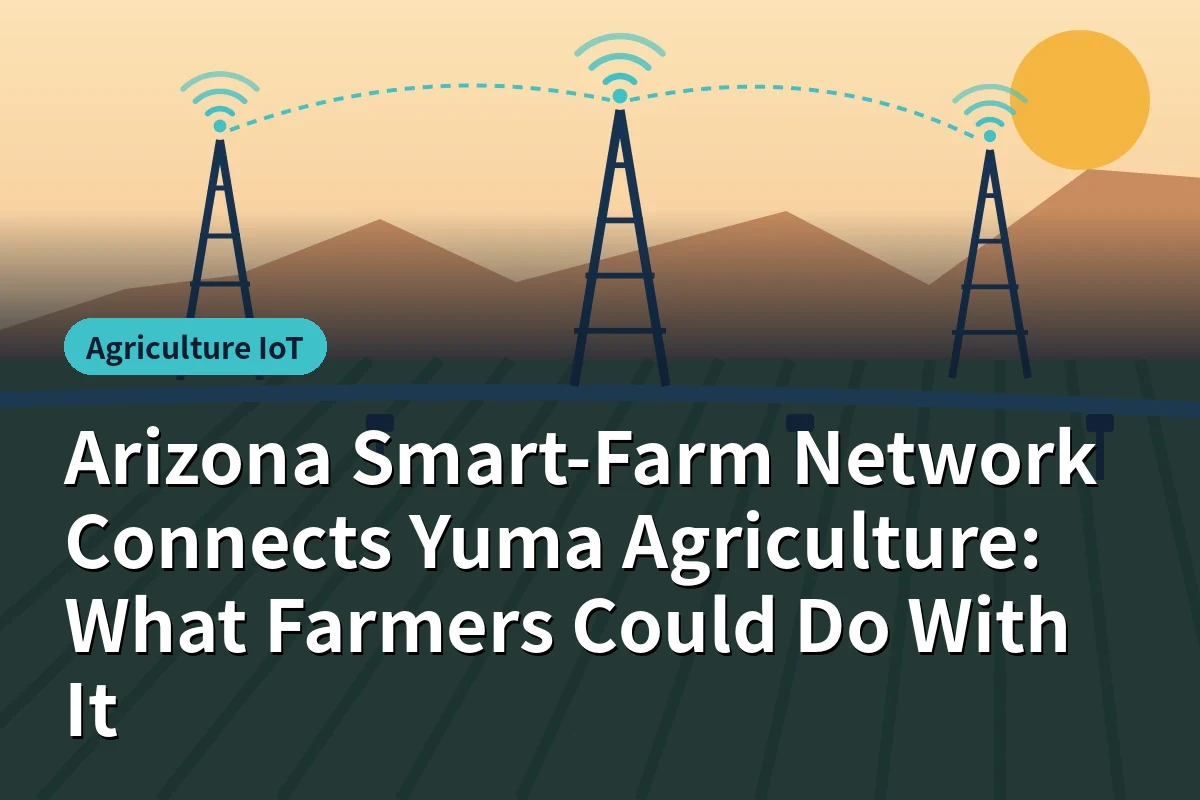
Yuma County is building something few agricultural regions anywhere have: a wireless network designed specifically for farms. The project broke ground on November 12, 2025, with Governor Katie Hobbs attending, funded by a $6 million American Rescue Plan Act grant awarded to the county and built by eX² Technology, a Vivacity company. Initial plans called for 27 tower structures; a July 2026 report described 34 towers being built across roughly 180,000 acres of farmland, with completion targeted for the end of August and wireless service to follow in a later phase. A test tower operates at the University of Arizona Yuma Agricultural Center.
At the groundbreaking, the governor also signed two related bills: one recognizing autonomous farm vehicles as instruments of husbandry, and another creating a Broadband Service District Authority to oversee the agriculture-focused system. The center's director, Samuel Discua, told reporters he believes no one else in the world has built something like it.
Coverage of the project has focused on the towers. The more useful question for growers is practical: once the network is live, what could they actually do with it, and in what order? This article ranks the likely uses by readiness and value, and flags what the network will not solve.
Yuma County has nearly 190,000 acres under cultivation, about 94 percent irrigated, and agriculture contributes about $3.2 billion a year, according to project announcements. Farms in all six of the county's irrigation districts are intended to gain field-level access. Yet cellular coverage across fields has long been patchy, which limits sensors, cameras and connected machinery. Many agtech tools that work in demonstrations struggle in practice when data cannot leave the field reliably.
Water adds urgency. Yuma's senior Colorado River rights have shielded it from the cuts central Arizona farmers have absorbed, but the 2027 and 2028 guidelines and ongoing litigation keep every irrigated acre under scrutiny. The ability to document and optimize water use is becoming a business necessity.
| Use Case | Readiness | Value for Yuma Growers | Network Need |
|---|
| Soil moisture and weather monitoring | Ready now | Better irrigation timing and documented water use | Low data, many devices |
| Flow meters and pump telemetry | Ready now | Water accounting, pump health, fewer field trips | Low data, reliable delivery |
| Remote irrigation control | Ready, needs care | Faster response, labor savings at night | Reliable, secure connections |
| Camera-based insect monitoring | Emerging | Earlier pest detection; the project highlights AI for insect tracking | Images, moderate bandwidth |
| Drone and machine imagery upload | Emerging | Faster crop scouting and mapping | High bandwidth bursts |
| Autonomous and assisted machinery | Early | Labor relief in a tight market; supported by new state law | Low latency, wide coverage |
| Harvest crew safety and logistics | Ready now | Heat monitoring, crew coordination, cold chain handoff | Coverage where crews work |
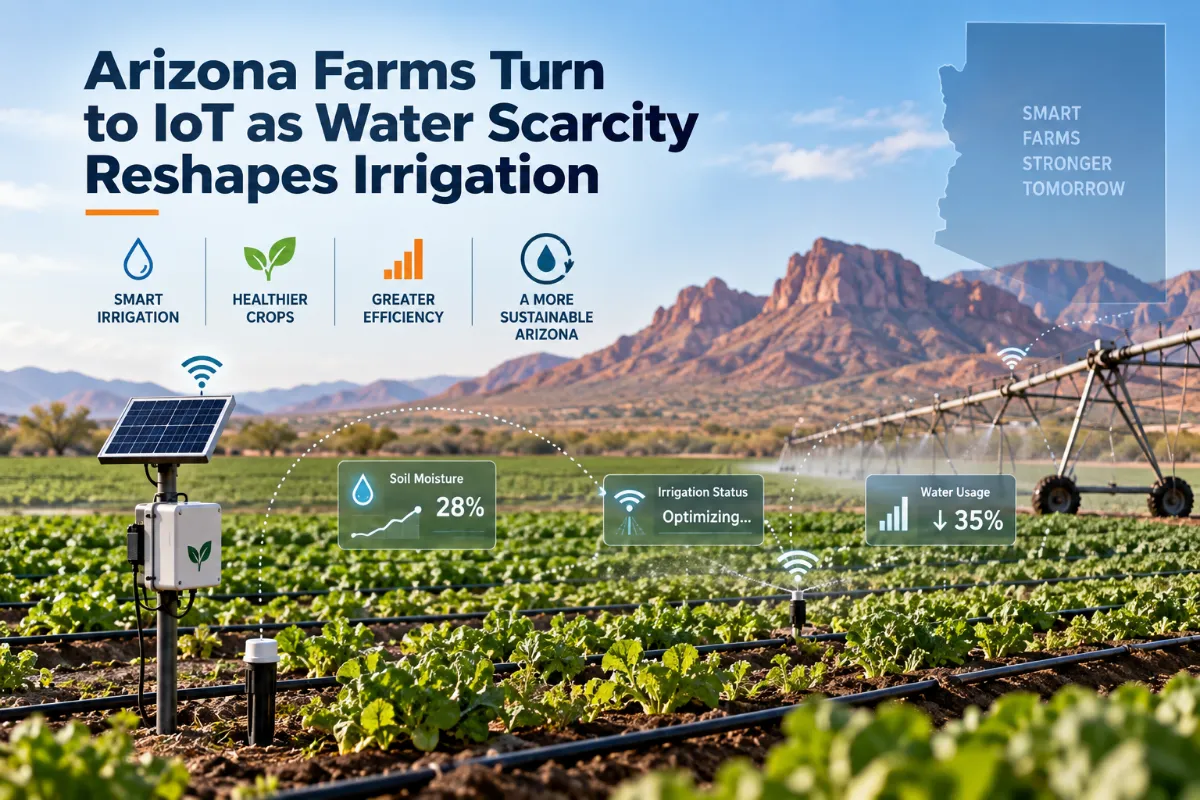
The fastest return for most growers will come from the simplest devices. University of Arizona research at the Yuma Agricultural Center found sensor-based irrigation scheduling reduced applied water by roughly 10 percent compared with a traditional schedule in a lettuce trial, while researchers cautioned that results vary by field and management. Soil probes, weather stations and flow meters need very little bandwidth, but they need coverage everywhere, which is exactly what a dedicated network can provide.
Water records also have value beyond irrigation. Documented applied water supports conservation programs, buyer sustainability requirements and conversations with irrigation districts. Our farm water verification guide explains how to build a credible record.
Yuma's winter vegetables, especially leafy greens, are highly sensitive to pests and quality defects. The project's backers have highlighted connected sensors using AI and machine learning to track insect populations and their movement. Camera traps that photograph and count insects, uploading images for automated identification, could give pest control advisers earlier warnings and help target treatments. This is promising but still developing, so growers should pilot it alongside traditional scouting rather than replacing scouts.
The bill recognizing autonomous farm vehicles as instruments of husbandry clarifies how such equipment is treated under state law, which matters for growers considering autonomous tractors or sprayers. Labor shortages and heat make automation attractive. But autonomous machinery needs reliable connectivity, careful safety planning and operators who understand the systems. Expect early adopters to start with supervised, partially automated tasks rather than fully driverless fleets.
- Devices and software. The network carries data; growers still need sensors, platforms and people to use them.
- Data quality. Poorly placed or uncalibrated sensors produce misleading information regardless of connectivity.
- Integration. Different vendors' systems may not talk to each other without effort.
- Costs. Service fees, device costs and maintenance still need budgets. Details of service terms and pricing had not been widely published as of this writing.
- Security. Connected pumps and controls must be protected. Our IoT security guide covers the basics.
Connected farms need people who can install sensors, interpret data and troubleshoot equipment in the field. The University of Arizona's Yuma Center of Excellence for Desert Agriculture and local colleges are natural partners for training. Growers who invest in staff skills alongside devices tend to get more from the technology, because problems are caught and fixed during the season rather than discovered after harvest.
A shared network creates an opportunity that individual farms rarely have: pooled data. Aggregated, anonymized information on soil moisture, weather, pest pressure and water use across many fields could improve regional forecasts, help irrigation districts plan deliveries and give researchers better insight into desert agriculture. Pest monitoring in particular benefits from scale, because insects move between fields. Any sharing arrangement should be voluntary, clearly governed and protective of individual growers' business information. The Broadband Service District Authority, irrigation districts and the University of Arizona could all play roles in setting those rules.
Field devices in Yuma face intense summer heat, dust and occasional monsoon storms. Sensors and gateways should be rated for high temperatures, shaded where possible and protected against lightning. Battery-powered devices last longer when they report only as often as decisions require. Our sensor buyer's guide covers hardware choices for desert conditions, and the same principles apply in the field as in industrial sites.
- When will service reach my fields, and how strong will coverage be at my sensor locations?
- What will connection or service fees cost, and who manages the network day to day?
- Which devices and platforms are compatible, and can I keep my existing equipment?
- Who owns the data my sensors produce, and who can see it?
- How is the network secured, and what happens if it goes down during an irrigation event?
- Is technical support available locally during harvest?
- Pick two or three fields with typical soils and high-value crops.
- Install flow meters and soil moisture stations and confirm they report reliably over the network.
- Run a side-by-side comparison with a field on your usual schedule.
- Add one emerging tool, such as an insect camera trap, on a trial basis.
- Review results with your irrigation district and advisers before expanding.
At the groundbreaking, the governor said the towers and a Yuma County middle-mile backbone were expected to be fully operational within the following year. The middle mile matters because towers need high-capacity links back to the internet. The new Broadband Service District Authority is intended to oversee the system, which raises practical questions growers will want answered: how decisions about pricing, upgrades and priorities are made, and how farmers can give input.
Yuma's produce moves quickly from field to cooler to truck. Connectivity in fields and around packing and cooling facilities could support temperature logging from harvest onward, crew coordination and better scheduling of trucks. Linking field data with cold chain records strengthens traceability for buyers, as our produce cold chain article explains for the Nogales corridor.
Supervisor Jonathan Lines has described the goal as turning Yuma County into a living laboratory of innovation. The network, the University of Arizona's research presence and new state laws on autonomy and broadband governance together create conditions few farming regions have. Whether that potential is realized depends on growers adopting tools that pay off, vendors building compatible products and the network proving reliable through the heat of harvest. The towers are the beginning, not the result.
Our LoRaWAN guide explains how low-power sensor networks work on farms, and our article on Colorado River cuts and smart water monitoring covers the water context. Find agtech partners in the IoT Arizona company directory, including agriculture IoT providers in Tucson. Browse more of our Agriculture IoT coverage.
Frequently asked questions
An agriculture-dedicated wireless tower network funded by a $6 million ARPA grant to Yuma County and built by eX² Technology, with groundbreaking on November 12, 2025.
Initial plans called for 27 tower structures. A July 2026 report described 34 towers across roughly 180,000 acres, with wireless service to follow the tower build.
Soil moisture and weather monitoring, flow meters and pump telemetry, and crew safety tools are ready now and deliver the quickest returns.
Governor Hobbs signed bills recognizing autonomous farm vehicles as instruments of husbandry and creating a Broadband Service District Authority to oversee the system.
Growers still need sensors, software, integration, budgets for service and devices, calibrated data and cybersecurity for connected pumps and controls.
Coverage at their fields, service fees and management, compatible devices, data ownership and access, network security and outage handling, and local technical support.
Related articles

 Agriculture IoT