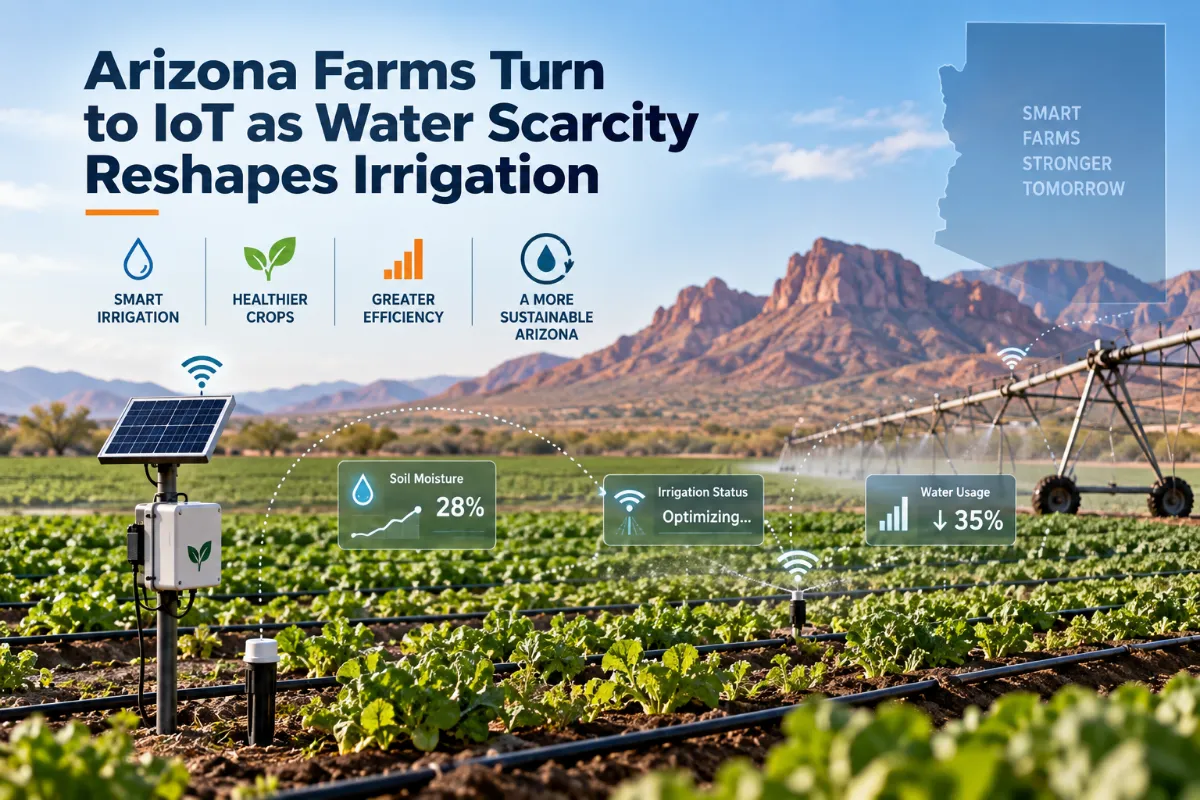
Arizona farmers have always worked with less water than they'd like. But the last few years have turned a chronic problem into an operational emergency. Colorado River shortages, tightening groundwater rules in Active Management Areas, and back-to-back dry winters have pushed growers from Yuma to Pinal County to rethink how every gallon gets used. Increasingly, the answer isn't a new canal or a deeper well. It's a network of sensors, valves, and software that tells a farmer exactly when and where water is needed, down to the acre.
This shift toward connected, data-driven irrigation is part of a broader wave of agriculture technology adoption, but in Arizona it carries a sharper edge. Here, precision farming isn't a productivity upgrade so much as a survival strategy. Understanding how these systems work, what they cost, and where they tend to stumble is useful for anyone farming, investing in, or servicing agricultural land in the state.
Arizona's agricultural regions sit at the intersection of two pressures. First, the state supplies a disproportionate share of the country's winter lettuce, leafy greens, and durum wheat, crops that depend on reliable, timed irrigation rather than rainfall. Second, its main water sources, the Colorado River and deep aquifers in central Arizona, are both under legal and physical strain. Tiered shortage declarations on the river have already cut allocations to agricultural users in Pinal County, and groundwater pumping in several Active Management Areas now faces new reporting and conservation requirements.
That combination means Arizona growers can't simply absorb inefficiency the way farms in wetter states sometimes can. A field that's over-irrigated by even ten percent isn't just wasting money on pumping costs, it's using water that may not be available next season at all. This is the backdrop that makes sensor-driven irrigation and precision farming tools less of a novelty and more of a baseline requirement for staying in business.
The term "agriculture IoT" covers a fairly wide toolkit, but on Arizona farms it usually shows up as a few connected pieces working together.
Small solar-powered probes placed at different depths and locations across a field measure moisture, salinity, and sometimes temperature. Instead of irrigating on a fixed calendar, a grower can see that the root zone in the north corner of a field is still saturated while the south end has dried out, and adjust accordingly.
Center pivots, drip lines, and surface irrigation gates can now be fitted with controllers that open and close automatically based on sensor readings, weather forecasts, and crop growth stage. Some systems apply water at different rates across a single field, matching output to soil type and slope rather than treating the whole plot as uniform.
All of that sensor data feeds into a dashboard, often accessible from a phone, that lets a farm manager check field conditions without driving out to every parcel. For an operation spread across several thousand acres, this alone can save hours of labor a week.
Combined with ground sensors, satellite or drone imagery helps spot stressed areas of a field before they're visible to the naked eye, often by tracking subtle changes in plant reflectance tied to water or nutrient stress.
Growers rarely adopt this technology because it sounds modern. They adopt it because the numbers work, and in Arizona the numbers are especially visible given how much irrigation costs in both water fees and pumping energy.
- Reduced water use per acre, which matters directly under Colorado River allocation limits and groundwater pumping caps.
- Lower energy costs, since well pumps and pressurized drip systems run less when irrigation is precisely timed.
- Higher yield consistency, because crops stressed by uneven watering tend to produce lower and less uniform yields, which affects pricing for produce sold on quality grades.
- Fewer labor hours spent on manual field checks and irrigation scheduling, which is significant given ongoing agricultural labor shortages in the state.
Cotton and alfalfa growers in Pinal County have used variable-rate systems to trim water applications while maintaining yield, a balance that matters more each year as allocations shrink. In Yuma's winter vegetable belt, where lettuce and leafy greens are grown on tight harvest schedules, soil moisture sensors help avoid both under-watering, which stresses plants near harvest, and over-watering, which can promote disease in dense plantings.
Farms that succeed with this technology tend to avoid trying to instrument an entire operation on day one. A more workable path usually looks like this:
- Start with a single field or crop type that has clear, measurable water costs, often the one with the highest pumping expense or the tightest quality requirements.
- Install a modest sensor network, enough to capture variation across the field rather than a single average reading.
- Pair sensors with a controller that a farm manager actually trusts, sometimes starting in an advisory mode where the system recommends irrigation timing but a human still approves it.
- Track water use and yield against the previous season to build an internal case before expanding to more acreage.
- Scale gradually, adding fields once the team is comfortable interpreting the data and troubleshooting connectivity or sensor issues.
This staged approach matters because the return on investment is easiest to defend when it's backed by a full season of comparable data rather than a vendor's projected savings.
The technology itself is fairly mature at this point, but the conditions it has to operate in create some recurring headaches.
Many of Arizona's most productive agricultural areas sit well outside reliable cellular coverage. Sensors that rely on cellular data can end up with spotty reporting, which pushes some operations toward long-range, low-power wireless networks instead, though these require their own base station infrastructure.
Sensor electronics and solar panels in the field face extreme summer temperatures and blowing dust, both of which shorten equipment life and increase maintenance calls compared to the same technology used in milder climates.
A dashboard full of soil moisture readings isn't useful if no one on the farm has time or training to act on it daily. Some operations end up paying for sensor networks that quietly go unused after the first season because the data never got built into daily irrigation decisions.
Smaller family farms often find the per-acre cost of a full sensor and controller network harder to justify than large operations do, even though water savings matter just as much to them. Cost-sharing programs and cooperative extension pilot projects have helped bridge this gap in some counties, but access varies.
A few trends are shaping how Arizona agriculture IoT will look over the next few growing seasons.
Irrigation scheduling is moving from reactive to predictive. Rather than responding to current soil moisture readings, newer systems combine sensor data with short-term weather forecasts and crop growth models to schedule irrigation a day or two ahead, smoothing out water use rather than reacting after stress has already begun.
Water accounting is becoming as automated as water application. With regulatory reporting requirements tightening in several Active Management Areas, farms are looking for systems that can log and report actual water use automatically, rather than relying on manual meter readings and paperwork.
Shared infrastructure is starting to make sense for smaller growers. Rather than each farm building its own private wireless network, some regions are seeing shared connectivity infrastructure emerge, spreading the cost of rural coverage across multiple operations.
Crop-specific tuning is replacing one-size-fits-all sensor placement. Lettuce, cotton, alfalfa, and citrus all respond to water stress differently, and vendors are increasingly offering configuration presets tuned to specific Arizona crop rotations rather than generic agricultural defaults.
For an Arizona operation weighing whether to invest in agriculture IoT tools, the most useful first question isn't which brand of sensor to buy. It's which field or crop currently has the clearest, most measurable water problem. Starting there, with a small deployment and a full season of side-by-side comparison, tends to produce a far more convincing business case than trying to modernize an entire operation at once. Given how tightly water allocations are likely to keep shrinking across the state, the farms that build this data habit early will have a real head start when the next shortage tier hits.
Frequently asked questions
Arizona's water supply is under direct legal and physical pressure from Colorado River shortage tiers and groundwater pumping restrictions, which makes precise water use a financial necessity rather than an optional efficiency upgrade.
Costs vary widely by acreage and sensor density, but many growers start with a limited deployment on one high-value field before expanding, which keeps initial investment manageable while data proves out the savings.
Cellular-dependent sensors can struggle in remote Arizona farmland, which is why many operations use long-range, low-power wireless networks paired with an on-site base station instead.
Water-sensitive, high-value crops like leafy greens and lettuce in the Yuma area see clear benefits, along with cotton and alfalfa in central Arizona where water allocations have already been reduced.
Most growers need at least one full growing season of comparable data against prior years to fairly evaluate water and yield savings before deciding to expand the system to more acreage.
The most common issue isn't hardware failure but underuse, where sensor data is collected but never actively built into daily irrigation decisions by farm staff.
Related articles

 Agriculture IoT