Arizona farmers have always done more with less. Between shrinking Colorado River allocations, triple-digit summer heat, and soil that dries out within hours of a rain event, growing anything here has never been forgiving. That's exactly why the state has quietly become one of the more interesting proving grounds for connected agriculture technology, even though most national coverage of the sector focuses on the Midwest corn belt or California's Central Valley.
The broader numbers help explain why. The global market for internet-connected farming tools was valued at roughly $17.78 billion in 2025 and is expected to climb to about $19.47 billion in 2026. That growth is coming from a handful of specific technologies: soil and weather sensors tied to automated irrigation, AI-driven analytics that turn raw field data into planting and watering decisions, and wireless monitoring systems for cattle and dairy herds. None of those categories are theoretical in Arizona. They're already running in cotton fields near Casa Grande, lettuce rows outside Yuma, and cattle operations scattered across the high desert near Sonoita and Willcox.
Most agriculture technology was originally built for places with predictable rainfall and moderate temperature swings. Arizona offers neither. Growers here are managing crops in conditions where evapotranspiration rates spike fast, where a single missed irrigation cycle can cost a field within a day or two, and where water rights are increasingly tied to strict usage limits rather than simple habit.
That pressure changes how connected farming tools get used. In wetter regions, sensor networks are often treated as an efficiency upgrade, something that trims costs at the margins. In Arizona, soil moisture probes and flow meters function closer to a survival tool. A grower in Pinal County isn't just trying to save a few dollars on a water bill; they're trying to stay within an allocation that may not stretch through the full growing season.
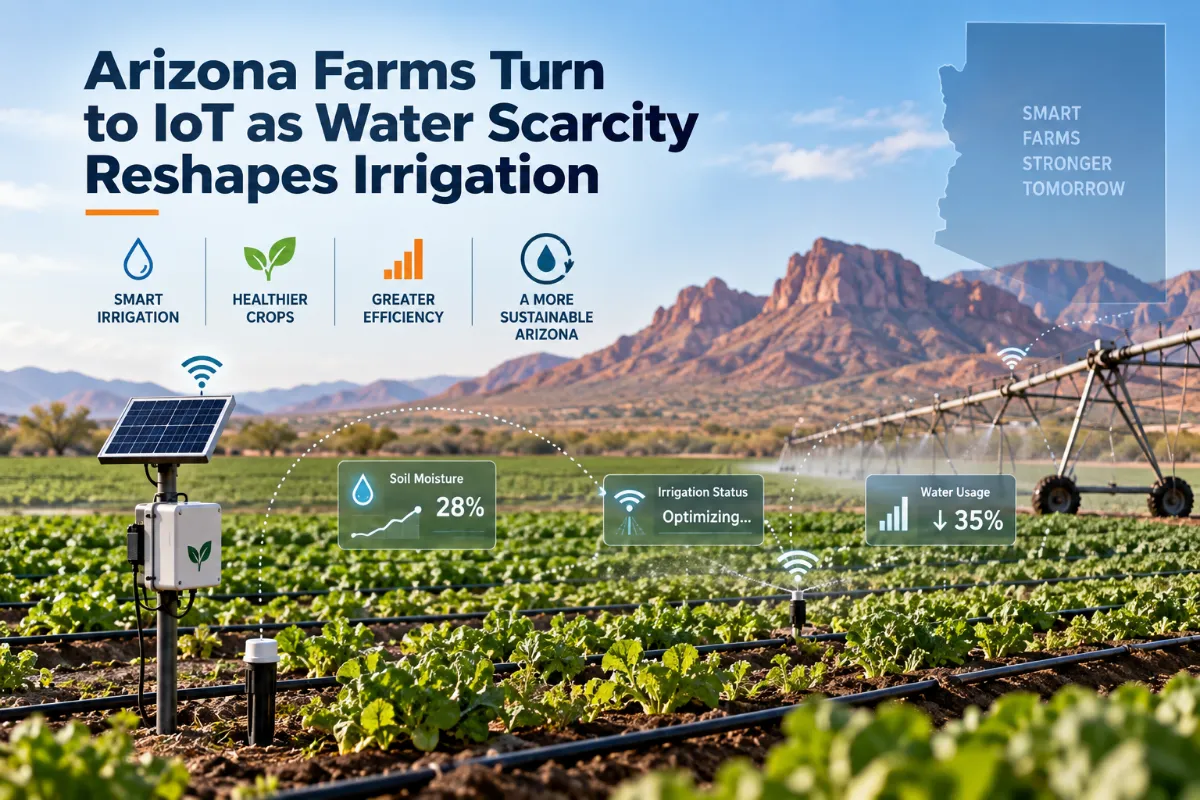
Yuma County, which supplies a large share of the country's winter leafy greens, has become a natural fit for soil moisture sensing paired with automated drip and pivot systems. Sensors buried at different root depths feed data back to a controller that adjusts watering schedules in near real time, rather than relying on a fixed calendar set weeks in advance. When a cooler week rolls through or humidity ticks up even slightly, the system can hold back water instead of running a preset cycle that would otherwise waste it.
Cotton growers further east have taken a similar approach, combining soil sensors with weather station feeds to time irrigation around actual crop stress rather than guesswork. Since cotton is particularly sensitive to both under and overwatering during boll development, this kind of tight feedback loop has a direct effect on yield quality, not just water savings.
The Salt River Project and Central Arizona Project canal systems add another layer. Farms that receive water through scheduled deliveries benefit from monitoring tools that track exactly when water arrives at the head gate and how quickly it moves through a field, helping avoid the kind of over-ordering that used to be common when growers erred on the side of requesting more than they needed.
- Soil moisture and temperature probes placed at two or three depths per representative zone
- A local weather station or regional data feed for evapotranspiration estimates
- A controller or valve automation system that can act on sensor thresholds without manual intervention
- A dashboard or mobile app that lets a farm manager review and override decisions remotely
None of this requires a full-scale robotics investment. Many Arizona operations start with a handful of sensors on their highest-value or most water-stressed acreage, then expand once the return on the first zone is proven out.
Cattle ranching across Arizona's high desert regions faces its own version of the water problem, along with a heat stress issue that can be just as costly. Herds spread across large grazing allotments are hard to check on daily, and heat stress in cattle can escalate from mild to dangerous within a matter of hours during summer months.
Wearable and ear-tag sensors that track movement, temperature, and rumination patterns give ranch managers an early warning system that doesn't depend on a physical ride out to check every animal. A drop in rumination combined with reduced movement is often a signal of heat stress or illness well before visual symptoms show up. Some operations have paired this with automated water trough sensors, since a broken float valve or a dry tank in July can put an entire group of animals at risk within a single day.
Smaller ranches in areas like Sonoita have adopted scaled-down versions of these systems, often starting with GPS collars on a portion of the herd to track grazing patterns and water access rather than instrumenting every animal at once. The data helps with rotational grazing decisions too, since ranchers can see which paddocks are being overgrazed near water sources versus which pasture areas are being underused.
Arizona growers and ranchers tend to ask a fairly direct question before adopting any of this: does it pay for itself within a season or two? The honest answer depends heavily on crop value and water cost exposure, but a few patterns show up consistently.
| Investment Area | Typical Payback Driver |
|---|
| Soil moisture sensors and irrigation automation | Reduced water use and fewer yield losses from under or overwatering |
| Livestock wearables and trough monitoring | Lower death loss and earlier illness detection, reduced labor for manual checks |
| Weather station networks | Better timing of planting, spraying, and harvest windows |
| AI-based yield and stress analytics | Improved input planning across multiple fields or pastures at once |
Labor savings matter as much as water savings in many cases. A ranch manager who no longer needs to physically drive out to check trough levels twice a day frees up hours that can go toward other operational work, which matters more in a region where finding reliable seasonal labor has gotten harder every year.
Growers who've had success with these systems tend to follow a similar sequence rather than trying to instrument an entire operation at once.
- Start with the highest-value or highest-risk zone, whether that's a water-stressed field or a herd segment prone to heat issues
- Choose hardware rated for extreme heat and dust exposure, since consumer-grade sensors often fail faster in desert conditions than their spec sheets suggest
- Confirm connectivity before buying equipment, not after, since cellular and satellite coverage varies significantly across rural Arizona counties
- Bring in a local agronomist or extension office contact who understands both the technology and the specific soil and crop conditions on that land
- Set a clear review point, usually after one full irrigation season or one full grazing cycle, to decide whether to expand the system
Dust is a bigger problem than most first-time adopters expect. Sensor housings and solar panels on remote units need regular cleaning, and equipment not rated for fine desert dust can develop connection issues within months rather than years. Heat is a second recurring issue, since battery life and electronics both degrade faster once ambient temperatures push past 110 degrees for extended stretches during summer.
Connectivity gaps remain a real constraint outside the Phoenix and Tucson metro corridors. Some ranches and remote fields rely on satellite-based data transmission or mesh networks that hop data between multiple field units before reaching a cellular tower, which adds cost and complexity compared to areas with dense rural broadband.
Cost remains the most cited barrier among smaller operations, particularly family-run farms and ranches operating on tighter margins than large commercial growers. Many have found that phased adoption, starting with a single field or herd segment, makes the upfront cost more manageable while still generating usable data to justify further investment.
The next phase of adoption in Arizona looks likely to center on combining ground-level sensor data with satellite and drone imagery, giving growers a way to spot irrigation problems or crop stress across large acreage without walking every row. AI-driven analytics platforms are also becoming more accessible to mid-sized operations rather than remaining tools built primarily for large agribusiness, which matters in a state where family-owned farms and ranches still make up a significant share of total agricultural land.
Autonomous and semi-autonomous equipment is starting to show up in pilot programs as well, particularly for tasks like weeding and spot-spraying that are labor-intensive and time-sensitive during Arizona's compressed growing windows. None of these tools solve the underlying water scarcity issue on their own, but they do give operations a better shot at making every acre-foot count, which in Arizona's current climate may end up being the difference between staying in production and not.
Frequently asked questions
Arizona's combination of strict water allocations, extreme heat, and reliance on irrigated desert farming makes real-time monitoring tools more of a necessity than a convenience, since small inefficiencies have a bigger impact on both yield and water access.
Most small operations begin with a limited number of soil moisture sensors placed in their highest-value or most water-stressed field zone, then expand coverage once they've confirmed water savings and yield benefits.
Consumer-grade equipment often struggles once temperatures pass 110 degrees for extended periods, so operations in the state generally need hardware specifically rated for high heat and dust exposure to avoid frequent failures.
Wearable sensors that track movement and rumination patterns can flag early signs of heat stress or illness in cattle before visible symptoms appear, giving ranch managers time to intervene before conditions become dangerous.
Yes, in many areas outside Phoenix and Tucson, cellular coverage is inconsistent, which is why some ranches and remote fields rely on satellite connections or mesh networks to transmit sensor data reliably.
Payback timelines vary by crop value and water costs, but many operations start seeing measurable water or labor savings within one to two growing seasons after installing a targeted, smaller-scale system.
Related articles


 Agriculture IoT