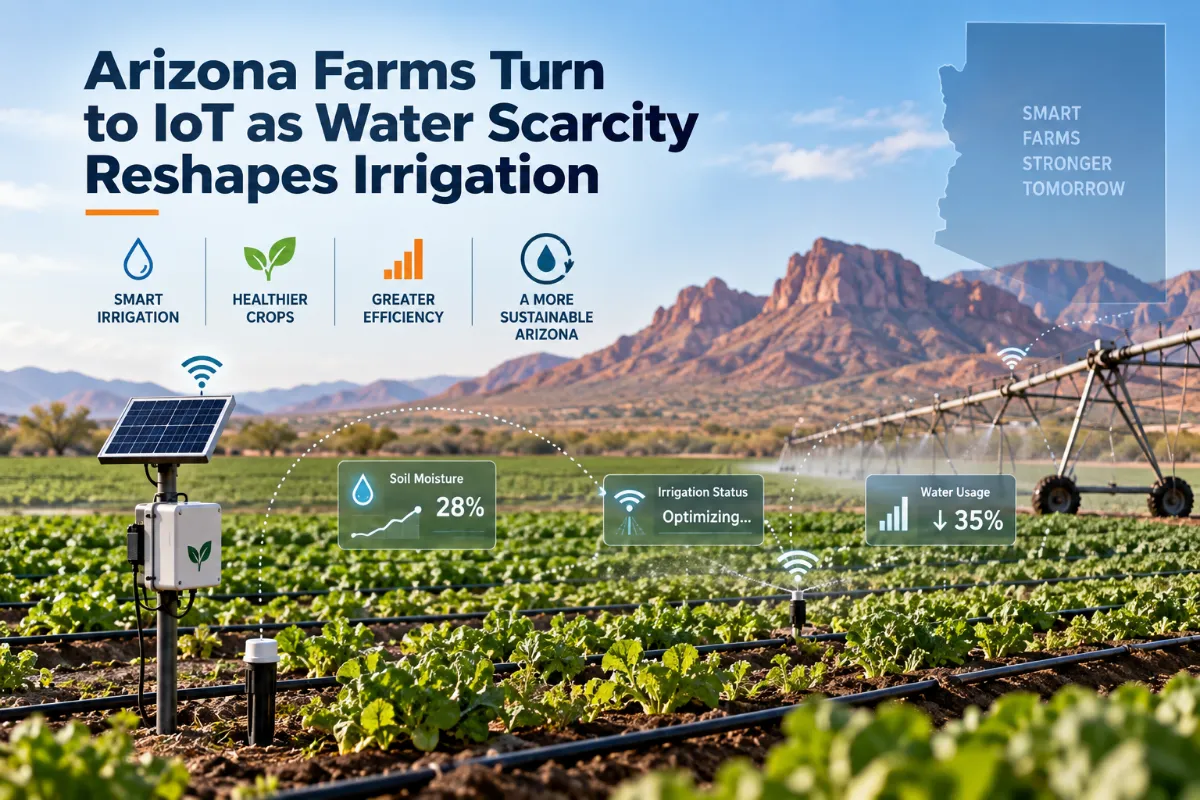
Ask most people what smart irrigation looks like and they picture drip lines and sensors in neat rows. In parts of Pinal County, that picture runs into a practical problem. As farmer Nancy Caywood explained in a March 2026 interview, flood irrigation remains common there partly because water from local districts carries silt that makes drip and sprinkler systems unusable. Her farm focuses instead on controlling flow through ditches, leveling fields and even running a sand-filled tire implement down furrows to pack soil so water moves sideways into crop beds rather than sinking below the roots.
That detail captures something important about how smart irrigation is actually moving deeper into Arizona agriculture. It is not one technology replacing another everywhere. It is a set of tools matched to water quality, crops, soils, irrigation districts and budgets. As Colorado River cuts take effect on January 1, 2027, and as earlier cuts continue to reshape central Arizona farming, the growers who save the most water will be those who choose the right kind of "smart" for their fields.
| Irrigation Method | Where It Fits in Arizona | Smart Technology That Helps | Key Constraint |
|---|
| Surface flood and furrow | Fields with silty district water, crops and soils suited to gravity systems | Turnout flow meters, automated gates, advance sensors in furrows, precision leveling | Uniformity depends on leveling and timing |
| Center pivot | Large, regular fields of forage and grains | Remote control and telemetry, variable rate irrigation, pressure and flow monitoring | Field shape and upfront cost |
| Drip and subsurface drip | High-value crops with clean or well-filtered water | Pressure, flow and filter monitoring, soil moisture probes, automated valves | Silt and salinity clog emitters without strong filtration |
| Solid-set sprinklers | Vegetable fields, especially for germination in winter | Valve automation, weather-based scheduling | Evaporation and wind in hot months |
Arizona's Water Irrigation Efficiency Program, run with University of Arizona Cooperative Extension, offered a large-scale test of these trade-offs. In its first year, the $45 million state program approved more than 70 grants, with applicants required to show at least 20 percent water savings, and more than 18,000 acres in 11 counties were moving away from flood irrigation, with projected savings of more than 36,000 acre-feet a year. By 2024, program staff reported more than 60 farmers in 11 of Arizona's 15 counties participating and nearly 36,500 acre-feet saved. Pivot grants of $1,500 per acre helped some growers switch, and an irrigation specialist noted past drip experience suggesting savings around 35 percent with similar yields.
The program also surfaced limits. A Yuma-area grower using solid-set sprinklers found they suited winter crops but not summer crops that still needed flood irrigation. Research at the Maricopa Agricultural Center has studied crops under reduced water, salt movement and soil amendments, because water savings mean little if salts build up in the root zone.
Because surface irrigation will remain common in parts of Arizona, improving it may deliver some of the largest water savings. Practical tools include:
- Turnout and field flow meters that measure exactly how much water each field receives.
- Advance sensors placed along furrows or borders that signal when water reaches the end of a field, so irrigators can cut off flow rather than overwatering the tail.
- Automated or remotely controlled gates that open and close on schedule or in response to sensors, reducing night trips and timing errors.
- Precision leveling, as Caywood emphasized, so high spots and low spots do not cause uneven watering.
- Soil moisture probes that show whether water reached the root zone and when the next irrigation is needed.
These technologies need connectivity in fields, which is why projects like Yuma County's agriculture-dedicated wireless network, covered in our article on the Yuma smart-farm network, matter for surface irrigation as well as drip.
Where drip fits, it can save substantial water, but only with careful management. Filtration must handle sediment, and chemical treatment may be needed to prevent clogging from minerals common in Arizona water. Monitoring pressure across filters and along laterals shows when cleaning is needed and catches clogged or broken lines before crops suffer. Salinity management matters too: without periodic leaching, salts can accumulate in the root zone under drip. Soil salinity sensors help growers decide when to apply extra water to flush salts.
Center pivots are often the most practical upgrade for large forage and grain fields. A Pinal County farmer who received pivot grants said the systems require little maintenance and expected savings of at least 30 percent. Modern pivots add remote control, telemetry and, in some cases, variable rate irrigation that applies different amounts to different parts of a field. Pressure and flow monitoring confirms they are delivering water as intended.
Whatever the delivery method, deciding when and how much to irrigate is where sensors earn their keep. University of Arizona research at the Yuma Agricultural Center found sensor-based scheduling reduced applied water by roughly 10 percent compared with a traditional schedule in a lettuce trial, with researchers cautioning that results vary. Combining soil moisture data with weather stations and crop growth stage gives irrigators more confidence to stretch intervals without risking yield. Our farm water verification guide explains how to document the results.
Sensors and gates are only useful if their data reaches the grower. Low-power wide-area networks such as LoRaWAN suit soil probes and gate sensors spread across large fields, while cellular works near towns and highways. Solar panels power most field devices, but they need cleaning after dust storms and batteries rated for heat. Our LoRaWAN guide covers network design for farms.
The right upgrade depends on crop value, water cost, field size, water quality and available grants. High-value vegetables may justify drip with strong filtration. Forage fields may favor pivots. Fields with silty district water may gain most from leveling, flow measurement and automated gates. A useful rule is to measure first: install flow meters and a few soil probes, establish a baseline for a season and then decide which investment will save the most water per dollar.
Many Arizona farms receive water through irrigation districts that schedule deliveries and maintain canals. District rules, delivery schedules and water quality shape what technology makes sense on the farm. Some districts are adding their own telemetry on canals and turnouts, which can be shared with growers to coordinate orders and confirm deliveries. Talking with the district early, before buying equipment, helps avoid mismatches such as installing drip where district water cannot be filtered economically.
- Installing drip without filtration designed for the actual water source.
- Ignoring salinity when reducing applied water.
- Placing soil probes in unrepresentative spots, such as field edges.
- Automating gates or valves before measurement is reliable.
- Choosing technology without considering how labor and management will change.
Irrigation technology changes how work is done. Automated gates and remote pivots reduce night trips, while drip systems require filter maintenance and leak checks. Training irrigators to use data, and involving them in choosing equipment, makes adoption smoother and helps catch problems early.
Consider a 1,200-acre farm in Pinal County growing alfalfa, cotton and small grains, irrigated with a mix of district water and pumped groundwater. The district water is silty, ruling out drip on most fields. In year one, the farm installs flow meters at every turnout and well, plus soil moisture probes in four representative fields. Data shows some fields receive far more water than others because of uneven leveling and long irrigation sets at night. In year two, the farm laser-levels the worst fields, adds advance sensors and remotely controlled gates on two furrow fields and applies for a pivot grant for its largest regular field. By year three, water applied per ton of crop has fallen, and records support conversations with the irrigation district. The scenario is illustrative, but it shows how smart irrigation often begins with measurement rather than new hardware.
Grant programs, irrigation districts and university extension staff can all help growers test options on a few fields before committing across the farm.
Smart irrigation in Arizona will keep spreading, but in many forms: smarter flood systems, pivots with telemetry, drip with serious filtration and sensor-based scheduling across all of them. As water supplies tighten and records matter more, the most successful growers will be those who match technology to their water, soils and crops rather than chasing a single solution.
Our earlier introduction to smart irrigation systems in Arizona covers the basics, and our article on University of Arizona IoT research looks at where new tools are tested. Find agtech partners in the IoT Arizona company directory, including agriculture IoT providers in Mesa. Browse more of our Agriculture IoT coverage.
Frequently asked questions
In parts of Pinal County, district water carries silt that clogs drip and sprinkler systems, so flood irrigation remains common and must be made more efficient.
With turnout flow meters, advance sensors that signal when water reaches the field end, automated gates, precision leveling and soil moisture probes.
A state program run with U of A Extension. In its first year it had $45 million, required 20 percent water savings and moved more than 18,000 acres in 11 counties away from flood irrigation.
An irrigation specialist cited about 35 percent savings from past drip experience, and a Pinal grower expected at least 30 percent with pivots, though results vary by farm.
Salts can build up in the root zone, especially under drip, so salinity monitoring and periodic leaching are important.
Measure first with flow meters and a few soil probes for a season, then choose the upgrade that saves the most water per dollar.
Related articles

 Agriculture IoT