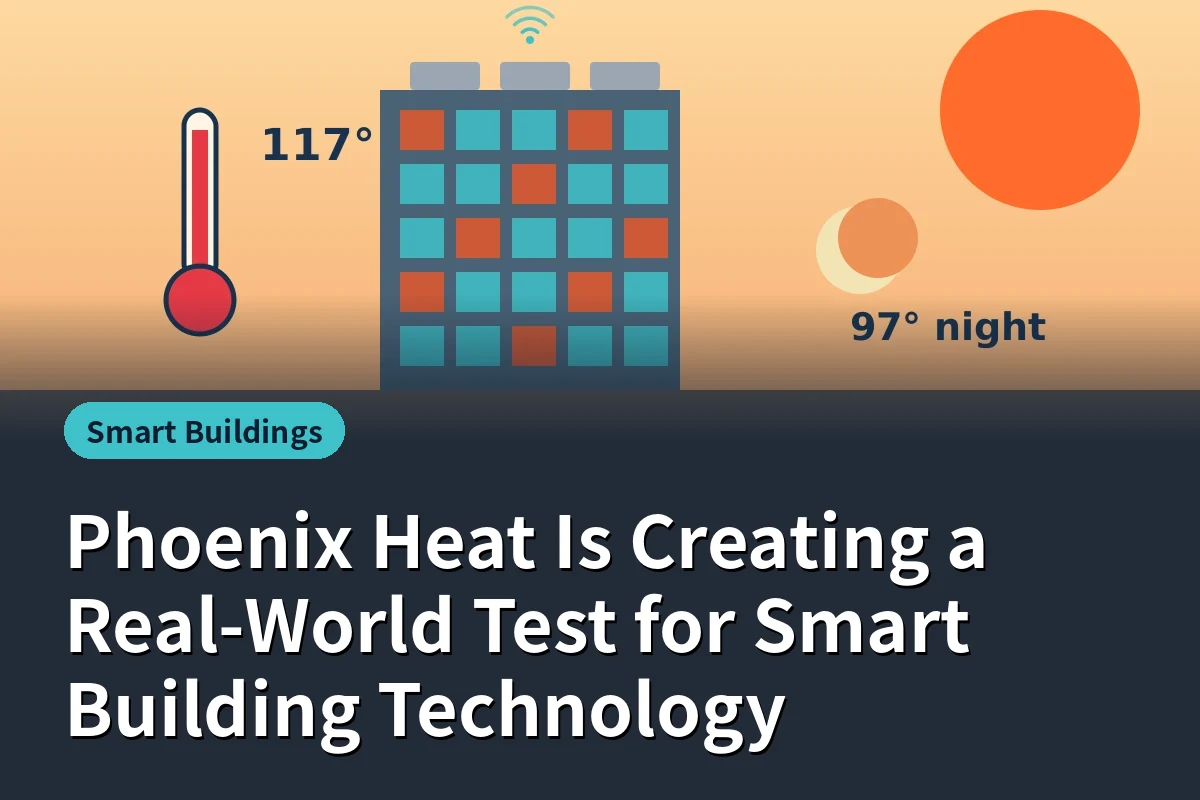
Most writing about smart buildings focuses on comfort, energy savings and tenant experience. In Arizona, there is a more basic job that connected building technology can do: help keep people alive when the cooling stops.
Investigations of heat deaths in Maricopa County have repeatedly found that many indoor victims had air conditioning that was present but not working. Phoenix and Tucson require rental units cooled by air conditioning to stay no warmer than 82 degrees in habitable rooms, or 86 degrees with evaporative cooling. Under state law, landlords generally have five days after written notice to fix broken cooling when outdoor temperatures exceed 100 degrees. In February 2026, state lawmakers introduced SB 1608, which would make the 82 degree standard statewide and shorten the time before tenants could end a lease over failed cooling. The City of Phoenix investigated around 200 complaints of broken air conditioning in 2024 alone.
This article looks at smart buildings in Arizona through that lens: how connected sensors and controls can detect cooling failures early, document compliance and protect vulnerable occupants, while still delivering the efficiency and comfort benefits owners expect.
| Building Type | Heat Risk | Smart Building Priority |
|---|
| Multifamily rentals | Cooling failures in occupied units; legal temperature limits in Phoenix and Tucson | Unit temperature monitoring and fast maintenance dispatch |
| Senior and assisted living | Residents highly vulnerable to heat illness | Room-level monitoring, backup power and escalation plans |
| Schools | Classrooms and gyms overheat at the start and end of the school year | Classroom sensors and scheduled pre-cooling |
| Hospitals and clinics | Patients and temperature-sensitive medications | Critical zone monitoring and redundant cooling |
| Warehouses | Workers in partially cooled spaces | Zone heat sensing tied to heat safety plans |
| Offices | Tenant comfort and productivity during heat waves | HVAC fault detection and zone sensing |
In many buildings, a cooling failure is discovered when a resident calls, often after hours of rising indoor temperatures. Smart building technology can change that sequence:
- Sensors detect rising temperatures in units or zones before occupants notice severe discomfort.
- Equipment monitoring spots the cause, such as a compressor that stopped running or a refrigerant problem, often identifying the issue remotely.
- Alerts reach maintenance teams with location and likely cause, so technicians arrive with the right parts.
- Occupants receive updates about expected repair times and temporary cooling options.
- Records document response, showing when the problem started, when it was reported and when it was fixed.
That last step matters legally and ethically. Documentation helps responsible owners demonstrate compliance and helps cities and tenants hold neglectful owners accountable.
Apartment communities are where indoor heat risk and smart building technology meet most directly. Many Valley properties already use smart thermostats, locks and leak sensors, often through platforms developed by Arizona companies such as Scottsdale-based SmartRent. Building on that infrastructure, owners can monitor unit temperatures for cooling failures, flag units where equipment is running constantly without reaching setpoint and prioritize maintenance during heat waves.
Privacy deserves careful attention. Residents may be uneasy about owners monitoring conditions in their homes. Clear policies that limit monitoring to building systems and safety thresholds, rather than detailed occupancy patterns, and that explain how data is used, help build trust.
A building's cooling depends on electricity. Heat-driven grid stress, storms and planned shutoffs in wildfire-prone northern Arizona can all cut power. Smart buildings can improve resilience by monitoring indoor temperatures during outages, prioritizing backup power for critical spaces, pre-cooling buildings before expected grid stress and providing cooling refuges inside large buildings. For senior living and healthcare facilities, these capabilities can be lifesaving.
Heat safety and energy efficiency are not in conflict. The same sensors that detect cooling failures also reveal waste: units running against open windows, oversized equipment short cycling, poorly balanced air distribution and equipment schedules that ignore actual occupancy. Arizona's grid set new peak records in July 2026, and many commercial customers face demand charges based on summer afternoon peaks. Our guide to cutting peak demand explains how connected controls lower those costs.
- HVAC monitoring and controls. The core of both comfort and heat safety. Our IoT HVAC monitoring guide covers what to measure.
- Zone and unit temperature sensors. The simplest and most valuable safety layer.
- Electrical submetering. Shows where energy goes and supports tenant billing.
- Water leak detection. Arizona's water constraints make leaks costly, and slab leaks can go unnoticed for long periods.
- Access control and cameras. Security systems that must be protected from cyber threats, as our commercial real estate security article explains.
- Indoor air quality. Dust storms and wildfire smoke make particulate monitoring and filtration important.
Consider a 1990s apartment community in west Phoenix with 240 units, each with its own split system. Before monitoring, the property learned about cooling failures only when residents called the office or emergency maintenance line, sometimes after a night of rising temperatures.
The owner installs wireless temperature sensors in each unit's living area and current sensors on each outdoor condenser. The system flags units where indoor temperatures rise above 80 degrees while the condenser is not running, or where the condenser runs constantly without bringing the temperature down. During a July heat wave, it flags 11 units over five days. Several are repaired before residents report problems, and the maintenance team uses data to prioritize a unit occupied by an elderly resident. The property also discovers that a handful of units account for most service calls, guiding replacement decisions for the following spring.
The example is illustrative, but it reflects how monitoring can move cooling failures from emergencies to managed events, with better outcomes for residents and clearer records for owners.
Smart building programs work best when occupants understand and trust them. Explain what is monitored, why and how data is protected. Offer residents a simple way to report problems and see repair status. In commercial buildings, share comfort and air quality data with tenants. Transparency turns monitoring from something done to occupants into something done for them.
Most Arizona buildings that will exist in 2040 already stand today. Wireless sensors, retrofit controllers on rooftop units and cloud-based analytics make it possible to add smart capabilities without major construction. For office owners, our Class B office retrofit guide covers the commercial side. For apartment and senior living operators, starting with unit temperature monitoring and HVAC fault detection delivers the most immediate safety benefit.
Smart building systems must be reliable and secure, because failures can directly affect safety. Segment building networks from tenant and business systems, control vendor remote access and choose devices with ongoing security updates. Ensure that local controls keep cooling running even if cloud connections fail. Our IoT security guide covers the essentials.
Arizona schools often start classes in early August, when outdoor temperatures can still exceed 110 degrees. Classroom temperature sensors, combined with HVAC fault detection, help facilities teams find failing units in the first days of the school year rather than after complaints from teachers and parents. Pre-cooling schedules and portable units can be deployed where data shows rooms running hot.
Senior living and assisted living facilities carry even higher stakes. Residents may not recognize or report overheating, and some take medications that make heat more dangerous. Room-level monitoring, backup power for cooling in common areas, clear escalation plans and regular drills for cooling failures are sensible safeguards. Coordinating with local emergency managers ahead of summer helps ensure transportation and alternative cooling are available if a building cannot be cooled.
For heat safety, useful metrics include the number of cooling failures detected before occupant complaints, average time from detection to repair, hours units spent above legal or target temperatures and repeat failures by building or equipment type. For efficiency, track energy use, peak demand and maintenance costs. Reviewing both sets of metrics after each summer guides the next round of improvements.
Rules on indoor cooling are evolving. Phoenix and Tucson already have cooling requirements for rentals, and the Attorney General's office has warned landlords about obligations under the state landlord-tenant law. Proposals such as SB 1608 show that statewide standards remain under discussion. Building owners who monitor and document indoor conditions will be ready whatever form future rules take.
Arizona's summers are getting hotter and its population older. Smart buildings that combine efficiency, comfort and heat safety will be increasingly valuable to owners, tenants and communities. The most important feature of a smart building in the desert may simply be this: it knows when the cooling stops, and it tells someone who can fix it.
Our heat-season remote patient monitoring guide shows how healthcare providers approach the same risk. Find building technology partners in the IoT Arizona company directory, including smart building providers in Scottsdale. Browse more of our Smart Buildings coverage.
Frequently asked questions
Phoenix and Tucson require air-conditioned rental units to stay no warmer than 82 degrees in habitable rooms, or 86 degrees with evaporative cooling. State law generally requires repairs within five days of notice above 100 degrees.
Not yet. SB 1608, introduced in February 2026, proposed making the 82 degree standard statewide and shortening the notice period before tenants could end a lease.
Temperature sensors and equipment monitoring detect cooling failures early, alert maintenance with likely causes, update occupants and document response times.
Multifamily rentals, senior and assisted living, schools, hospitals and clinics, warehouses with partial cooling and offices during heat waves.
Limit monitoring to building systems and safety thresholds rather than detailed occupancy, explain how data is used and give residents clear ways to report problems.
No. The same sensors that detect cooling failures also reveal waste such as short cycling, poor scheduling and unbalanced airflow, lowering energy and demand costs.
Related articles


 Smart Buildings