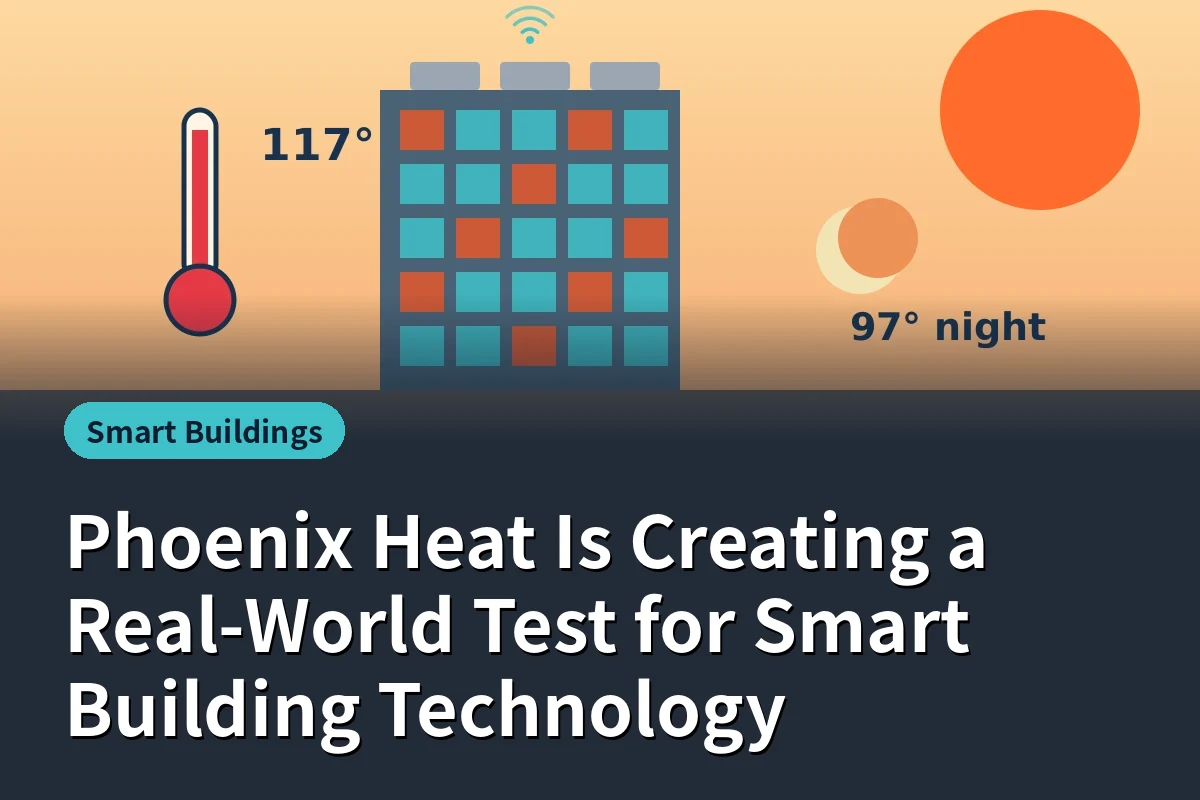
Most building equipment sold in the United States is rated under conditions that Phoenix routinely blows past. Standard capacity ratings for many residential and light commercial air conditioners are measured at an outdoor temperature of 95 degrees Fahrenheit. In summer 2026, Phoenix Sky Harbor recorded 89 of 92 days at or above 100 degrees, 39 days at or above 110, highs of 117 on three separate days and an overnight low of 97 degrees on July 24. Statewide, it was the hottest summer on record; for Phoenix, the second hottest.
That gap between test conditions and real conditions is what makes Phoenix a genuine stress test for smart building technology. Strategies that work in milder climates, such as night flushing, generous setbacks and economizer cooling, can fail when nights stay in the 90s. Equipment that meets its nameplate in a lab may struggle on a 117 degree rooftop. And building data reveals all of it. This article looks at what Phoenix summers expose about smart building technology, and how owners can use that evidence.
| Condition | Phoenix Summer 2026 | Why It Matters for Buildings |
|---|
| Days at or above 100 degrees | 89 of 92 days from June through August | Cooling ran almost continuously for three months |
| Days at or above 110 degrees | 39 | Equipment operated far above typical rating conditions |
| Hottest high | 117 degrees, on three days | Rooftop units and condensers at their limits |
| Warmest overnight low | 97 degrees on July 24 | No nighttime relief to cool building mass |
| Grid conditions | Utility reserve margins near 10 percent at peaks | Demand response and peak management mattered more |
Air conditioning capacity falls as outdoor temperature rises, and efficiency drops with it. A rooftop unit sized correctly at standard rating conditions may deliver noticeably less cooling on a 115 degree afternoon, especially if its condenser coil is dirty or its refrigerant charge is low. Monitoring supply air temperature, run time and power shows when equipment is running flat out and still losing ground, the clearest sign of undersizing or degradation.
Many energy strategies rely on cool nights: flushing buildings with outdoor air, letting temperatures float overnight and recovering in the morning. When overnight lows stay in the 90s, outdoor air cannot cool anything, economizers should stay closed and buildings start each day already warm. Smart controls must recognize these conditions and switch strategies. Data from 2026 shows exactly how often that happened.
Pre-cooling a building before afternoon peak pricing can cut demand charges, as our peak demand guide explains. But on the hottest days, there may be little spare capacity to pre-cool, and stored cooling drains quickly through hot roofs and sunlit glass. Zone temperature data shows how long each area coasts before comfort suffers, letting owners tune strategies to real conditions rather than assumptions.
A stuck economizer damper, a failing condenser fan or a slow refrigerant leak may barely matter in April. In July, the same fault can push a unit over the edge. Our HVAC monitoring guide explains which measurements catch these faults early.
Rooftop controllers, wireless gateways and outdoor sensors sit in the same sun as the equipment they manage. Enclosures can run much hotter than the air. Smart building hardware must be rated, shaded and monitored for its own health, or the system meant to protect the building fails when it is needed most. Our sensor buyer's guide covers heat-rated hardware.
Together, these lessons explain why Phoenix data is so valuable: it shows where standard assumptions break, which is exactly what owners in other hot cities will need to know as their summers intensify.
Owners who capture that evidence now will enter next summer with sharper sequences, better maintenance priorities and fewer comfort complaints.
Every connected building in Phoenix now holds a record of how it performed in one of the hottest summers ever measured. That record is valuable. A structured post-summer review can turn it into decisions:
- Find the zones that lost control. Identify where temperatures exceeded setpoints and for how long.
- Match zones to equipment. Determine whether problems came from undersized units, faults or envelope issues such as west-facing glass.
- Compare equipment under identical weather. Units serving similar spaces should perform similarly; outliers point to faults.
- Review peak demand. See which days and hours set demand charges and which loads drove them.
- Check control logic. Confirm economizers, setbacks and pre-cooling behaved sensibly on hot nights.
- Prioritize repairs and replacements before next spring, using evidence rather than age alone.
In homes and rental properties, cooling failures are a safety issue. Phoenix and Tucson require air-conditioned rentals to stay no warmer than 82 degrees in habitable rooms. Maricopa County had confirmed 230 heat-related deaths by late September 2026. Smart building monitoring that detects cooling failures quickly, especially for older or vulnerable residents, is one of the most valuable uses of the technology. Our smart buildings article covers heat safety in detail.
Heat does not enter only through equipment limits. Roofs, walls and windows let heat in, and Phoenix's sun makes envelope performance obvious in data. Zones on top floors and west sides often show the largest afternoon temperature rise. Surface temperature sensors on roofs, glass and walls, combined with zone data, help owners decide whether cool roofs, window film, shading or insulation would reduce cooling load more cost-effectively than larger equipment.
Arizona utilities saw reserve margins fall to about 10 percent during summer 2026 peaks. Buildings that can reduce load on request, through controlled setpoint changes, staggered compressor operation or battery dispatch, help the grid and may earn incentives. But demand response in Phoenix heat must protect occupants: limits on how far temperatures can drift and exemptions for vulnerable spaces are essential.
Heat is not Phoenix's only stressor. Monsoon storms bring humidity spikes, dust storms and power disturbances. Humidity reduces evaporative cooler effectiveness and raises latent cooling loads, dust clogs filters and coils within hours and brief power interruptions can leave controllers in unexpected states. Smart building systems should log power events, confirm equipment restarts correctly after outages and alert staff when filter pressure drops spike after a haboob. Reviewing monsoon events alongside heat data gives a fuller picture of how a building performed.
Homes face the same physics at smaller scale. A smart thermostat that shows a home's air conditioner running all afternoon without reaching setpoint is often the first sign of a failing system. Homeowners and landlords who review summer data can schedule maintenance before the next heat season rather than during a July emergency, when contractors are overwhelmed.
- Test and publish equipment performance at Phoenix-like conditions, not just standard ratings.
- Build control strategies that adapt automatically to hot nights.
- Rate controllers and gateways for rooftop enclosure temperatures.
- Provide clear fault diagnostics that facility teams can act on quickly.
- Design demand response features with occupant safety limits.
Consider a three-story office in central Phoenix with eight rooftop units. Its post-summer review shows two third-floor west zones exceeded 80 degrees on 24 afternoons. Data reveals both are served by the same older unit, which ran continuously from noon to 7 p.m. on hot days with a shrinking supply air temperature difference, consistent with low refrigerant charge and a fouled condenser. Meanwhile, the economizer on another unit opened during several hot nights because its logic used a fixed schedule rather than outdoor temperature. The owner schedules refrigerant repair and coil cleaning in spring, fixes the economizer logic, adds window film to the west facade and budgets for replacing the oldest unit. The example is illustrative, but it shows how one hot summer's data can produce a clear, prioritized plan.
- Hours each zone spent above setpoint during the summer.
- Number of cooling faults detected before occupants complained.
- Peak demand on the hottest days compared with the previous year.
- Energy use normalized for weather.
- Equipment that ran continuously without meeting load.
Comparing these figures year over year shows whether repairs, controls changes and envelope upgrades are working.
Phoenix summers are likely to keep testing buildings harder than design assumptions anticipate. That makes the city one of the best places in the country to learn which smart building technologies actually work in extreme heat. Owners who treat each summer's data as a performance review, and vendors who design for Phoenix conditions rather than standard ones, will turn a punishing climate into a source of practical knowledge.
Our guide to building energy management in Arizona covers verification and savings. Find smart building partners in the IoT Arizona company directory, including smart building providers in Phoenix. Browse more of our Smart Buildings coverage.
Frequently asked questions
Sky Harbor recorded 89 of 92 days at or above 100 degrees, 39 days at or above 110, highs of 117 on three days and an overnight low of 97 on July 24.
Many air conditioners are rated at 95 degrees outdoors, but Phoenix spends long stretches far hotter, reducing capacity and efficiency.
Strategies such as night flushing and overnight setbacks rely on cooler nights. When lows stay in the 90s, outdoor air cannot cool buildings.
It can reduce peak demand, but on the hottest days spare capacity is limited and stored cooling drains quickly, so zone data should guide strategy.
Find zones that lost control, link them to equipment or envelope causes, compare similar units, review peak demand and check control logic before spring.
Publish performance at Phoenix-like conditions, adapt controls to hot nights, rate hardware for rooftop heat and design demand response with occupant safety limits.
Related articles

 Smart Buildings