 Construction & Real Estate
A Walk Through Downtown Arizona Where Buildings Quietly Resp...
Published On 21-06-2026

Published by IOT Arizona Research & Editorial Team
The lobby quiets down. Parking lots empty. Cleaning crews arrive. Vendors enter side doors. HVAC systems shift into after-hours mode. A few employees stay late. Delivery trucks pull up near service entrances. Security guards may cover several buildings at once.
This is where IoT security systems are beginning to change commercial real estate in Arizona.
Not by turning every building into a high-tech fortress, but by helping property owners understand what is happening across doors, cameras, sensors, parking areas, tenant spaces, mechanical rooms, and shared corridors in real time.
For years, commercial security was built around separate systems.
One system controlled access cards. Another handled cameras. Another tracked alarms. Visitor logs sat at the front desk. Maintenance teams had their own process. Property managers often reviewed problems after something already happened.
IoT changes that model.
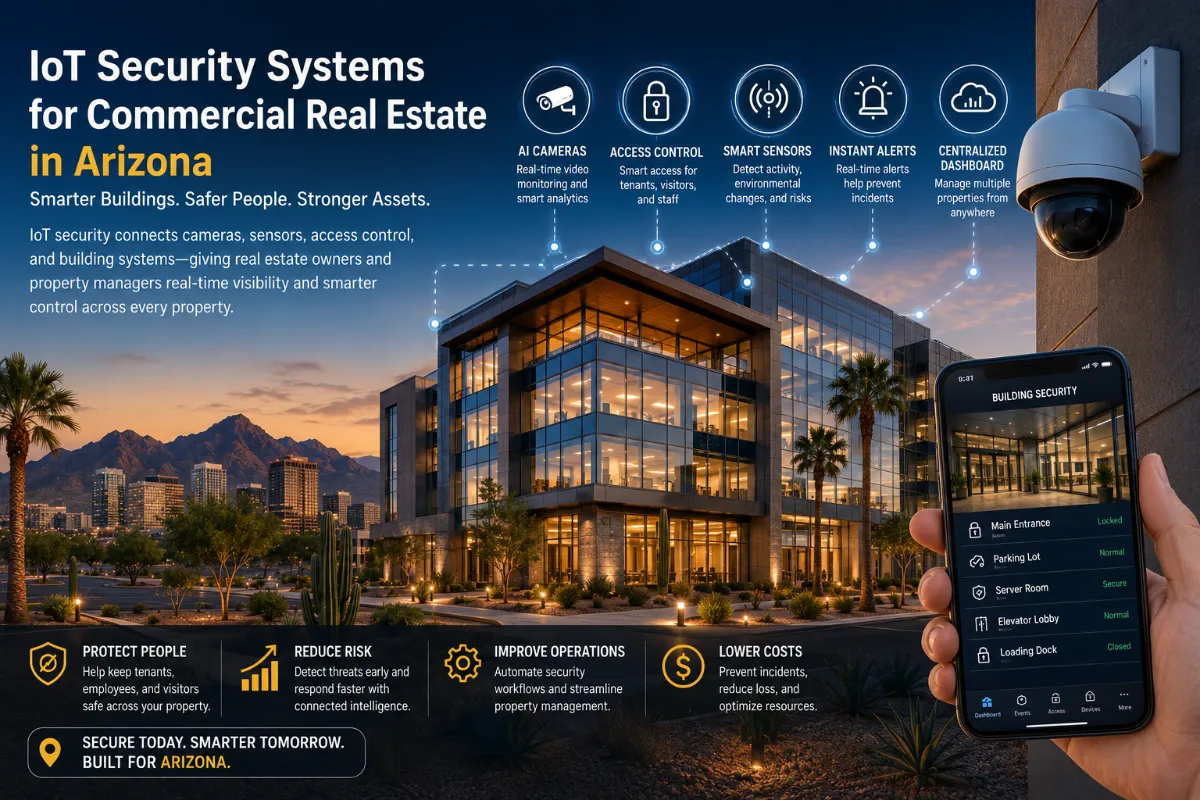
Connected security systems turn a building into a network of signals. A door forced open, a camera motion alert, an unusual after-hours entry, a package-room event, or a sensor warning can all become part of one larger building story.
That is why this article is not just about security devices. It is about how Arizona commercial buildings are becoming more aware of themselves.
Arizona commercial real estate is expanding across office parks, medical buildings, industrial properties, retail centers, mixed-use developments, warehouses, and multi-tenant spaces.
Many of these properties are spread across large sites, hot parking lots, outdoor walkways, loading areas, and mechanical spaces that are difficult to monitor manually all day.
Arizona’s climate adds another layer. Heat affects equipment. Dust affects cameras and sensors. Large properties require wider coverage. Tenants expect safer, more convenient access. Owners want better visibility without adding unnecessary labor costs.
IoT security systems help connect those gaps.
The future of commercial building security is not simply more cameras or more guards.
It is better signals.
An IoT-enabled building can notice small changes that humans may miss:
Individually, these events may seem minor. Together, they help property teams understand building risk before it becomes a larger issue.
Walk through a modern Arizona commercial building and the security network may be almost invisible.
At the entrance, mobile credentials may replace traditional keys. In the lobby, visitor management software may log guests. In elevators, access permissions may limit floors. In parking areas, connected cameras may monitor movement. At loading docks, sensors may track door activity. In tenant areas, smart locks may record entry events.
The building is not just locked. It is listening for operational signals.
IoT security systems often connect multiple building technologies into one environment.
The value comes from connection. A camera alone records. A connected camera linked with access control, door sensors, and alerts helps explain what happened.
Employees enter using cards, phones, or assigned credentials. The system logs access automatically. If a tenant recently changed staff, permissions can be updated without replacing physical keys.
Guests are registered through a visitor platform. Temporary access can be limited to specific floors, rooms, or times.
A vendor receives controlled access to a mechanical area. The system records entry and exit activity, creating accountability without requiring constant supervision.
Access rules change. Fewer doors remain active. Cameras and sensors become more important. Alerts become more sensitive.
A side door sensor detects that the door has remained open longer than expected. The property manager receives an alert before the issue turns into a security risk.
The system flags a camera outage. Instead of discovering the issue days later, the team knows immediately.
For owners and property managers, IoT security is not only about crime prevention. It is also about operations, tenant trust, liability, and asset protection.
A safer building is easier to lease. A more visible building is easier to manage. A building with better access control can support more flexible tenants, shared spaces, medical offices, coworking areas, and multi-use properties.
The strongest security systems do not just record incidents. They help property teams understand patterns before incidents happen.
This article follows Google’s AI optimization guidance by avoiding generic “benefits of IoT security” content. Google explains that generative AI features use retrieval-augmented generation and rely on strong SEO fundamentals, helpful content, and unique non-commodity perspectives. It specifically recommends content that is useful, reliable, people-first, and built from a unique point of view.
Instead of explaining security systems in a general way, this article connects IoT security to Arizona commercial real estate, building operations, tenant access, after-hours activity, environmental conditions, and property management decisions.
Choosing an IoT security system is not about buying the most devices. It is about building a connected security environment that fits the property.
Connected security systems protect physical spaces, but they also create digital responsibility.
Property owners should protect access-control platforms, cameras, cloud dashboards, and connected devices with secure passwords, role-based permissions, multi-factor authentication, encryption, software updates, and vendor security reviews.
A smart building should not create a new security weakness while trying to solve an old one.
Tenants may not care about the technical details of IoT security, but they will notice the experience.
They may notice easier mobile access. Faster guest check-ins. Better lighting in parking areas. Fewer unresolved door issues. More confidence in shared spaces. More flexible access for hybrid teams and after-hours work.
The best IoT security systems become part of the building experience without making the building feel difficult to use.
Over the next few years, Arizona commercial real estate will likely move toward more integrated building security. Access control, cameras, parking systems, lighting, HVAC alerts, visitor systems, and property management dashboards will become more connected.
This will matter most for multi-tenant office buildings, medical buildings, industrial parks, retail centers, warehouses, mixed-use developments, and large commercial campuses.
The commercial buildings that win will not simply be the most secure. They will be the easiest to manage, easiest to access, and easiest to trust.
This article was reviewed by the IOT Arizona Editorial Team for accuracy, clarity, and relevance. Information may be sourced from publicly available treatment resources, government agencies, and healthcare references where applicable.
Last reviewed: June 2026