 Smart Cities & Government
Connected Street Lighting Systems: How Smart Lighting Is Bec...
Published On 21-06-2026

Published by IOT Arizona Research & Editorial Team
For decades, public safety has been largely reactive.
An incident occurs, emergency responders are dispatched, and teams work to restore safety.
In 2026, cities are beginning to operate differently.
Instead of asking, "How quickly can we respond?" municipalities are asking, "How can we predict problems before they happen?"
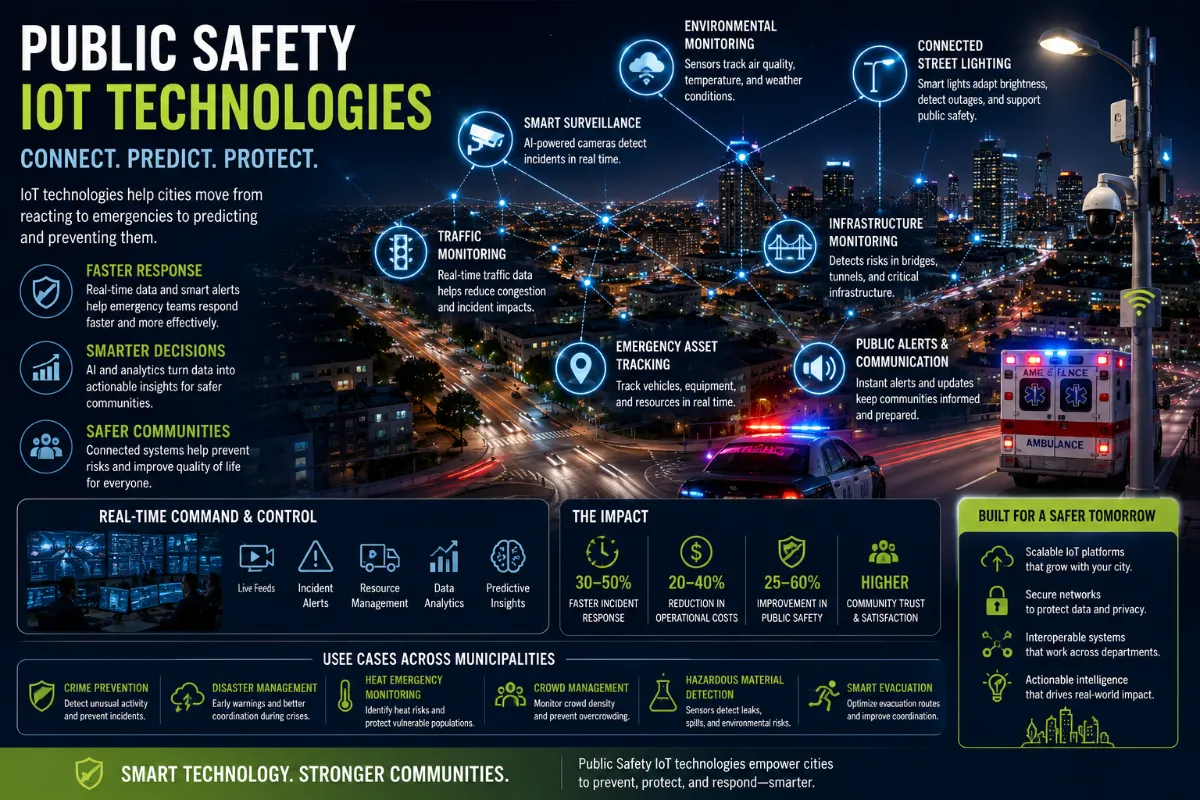
Public Safety IoT technologies are enabling this transformation by connecting infrastructure, sensors, analytics, and communication systems into one intelligent ecosystem.
The goal is no longer faster emergency response alone. The goal is preventing emergencies whenever possible.
Cities are becoming more complex every year.
Municipalities face growing challenges such as:
Traditional systems often rely heavily on manual reporting and delayed information.
Public Safety IoT provides real-time visibility.
Public Safety IoT technologies use connected devices, sensors, cloud platforms, artificial intelligence, and data analytics to monitor public environments continuously.
These systems collect information and help emergency teams make faster and better decisions.
The objective is to detect abnormalities before they become emergencies.
| Generation | Primary Approach |
|---|---|
| Reactive | Respond after incidents occur |
| Preventive | Reduce risks through planning |
| Predictive | Identify risks before incidents occur |
| Autonomous | Systems automatically coordinate responses |
Connected traffic systems monitor:
Emergency vehicles can receive optimized routes during incidents.
Environmental sensors monitor:
Cities can issue alerts before environmental conditions become dangerous.
Modern surveillance systems use AI to detect unusual activity.
Examples include:
These systems are designed to assist personnel rather than replace them.
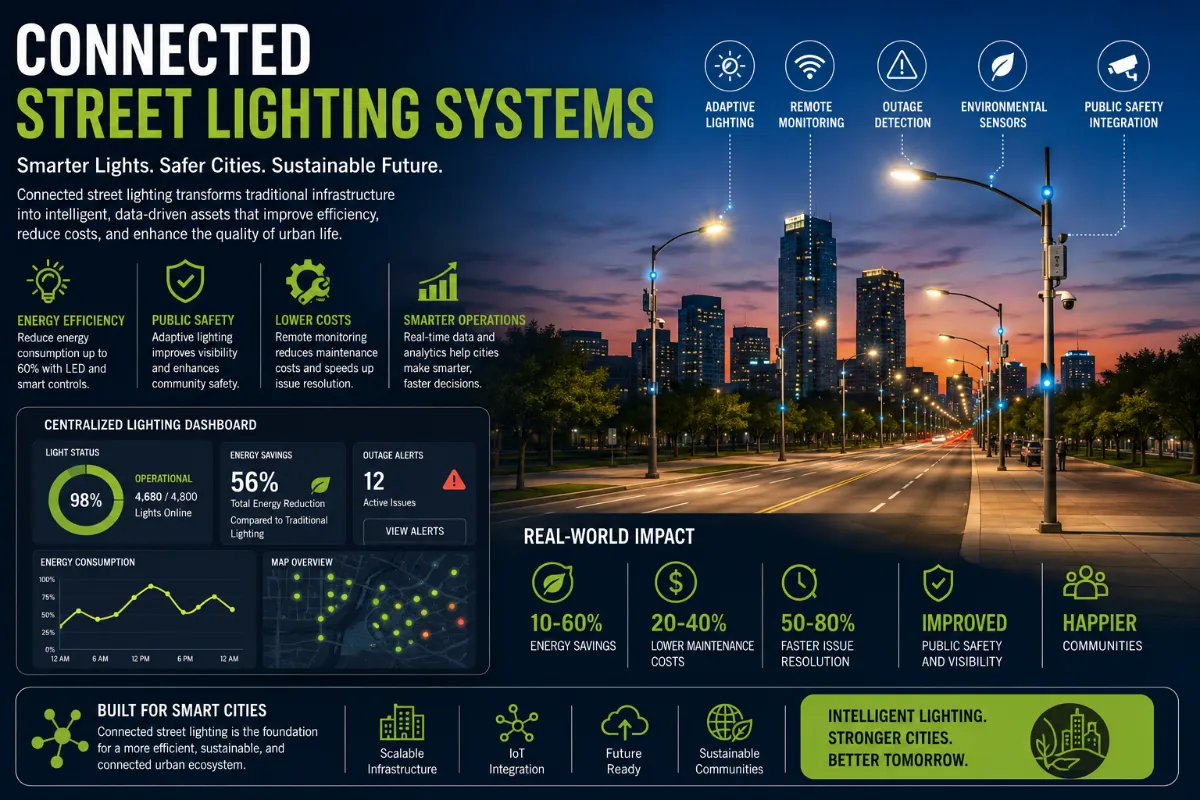
Smart streetlights can:
Extreme heat is becoming a growing public safety issue.
IoT sensors can identify:
Connected sensors monitor:
Potential failures can be detected earlier.
IoT systems can monitor:
This improves resource allocation.
Connected platforms can distribute alerts through:
| Layer | Purpose |
|---|---|
| Sensors | Collect information |
| Networks | Transmit data |
| Cloud Platforms | Centralize operations |
| AI Systems | Analyze patterns |
| Operations Centers | Coordinate responses |
| Field Teams | Execute actions |
| Area | Benefit |
|---|---|
| Response Time | Faster emergency deployment |
| Resource Management | Better allocation |
| Infrastructure Reliability | Reduced failures |
| Environmental Safety | Earlier warnings |
| Operational Costs | Improved efficiency |
| Community Trust | Improved public services |
Connected infrastructure must be secured against attacks.
Public trust requires responsible data governance.
Systems from different vendors must work together.
Projects must demonstrate measurable ROI.
Teams need training to operate smart infrastructure.
Future cities may operate differently.
Systems could:
Public safety is evolving from reaction to prediction.
Public Safety IoT technologies are not simply adding sensors to cities.
They are creating intelligent environments that help communities anticipate risks, allocate resources efficiently, and protect citizens more effectively.
The cities that adopt these systems today will be better prepared for tomorrow's challenges.
This article was reviewed by the IOT Arizona Editorial Team for accuracy, clarity, and relevance. Information may be sourced from publicly available treatment resources, government agencies, and healthcare references where applicable.
Last reviewed: June 2026
Smart Cities & Government
 Smart Cities & Government
 Smart Cities & Government
 Smart Cities & Government