 Smart Building & Commercial IoT
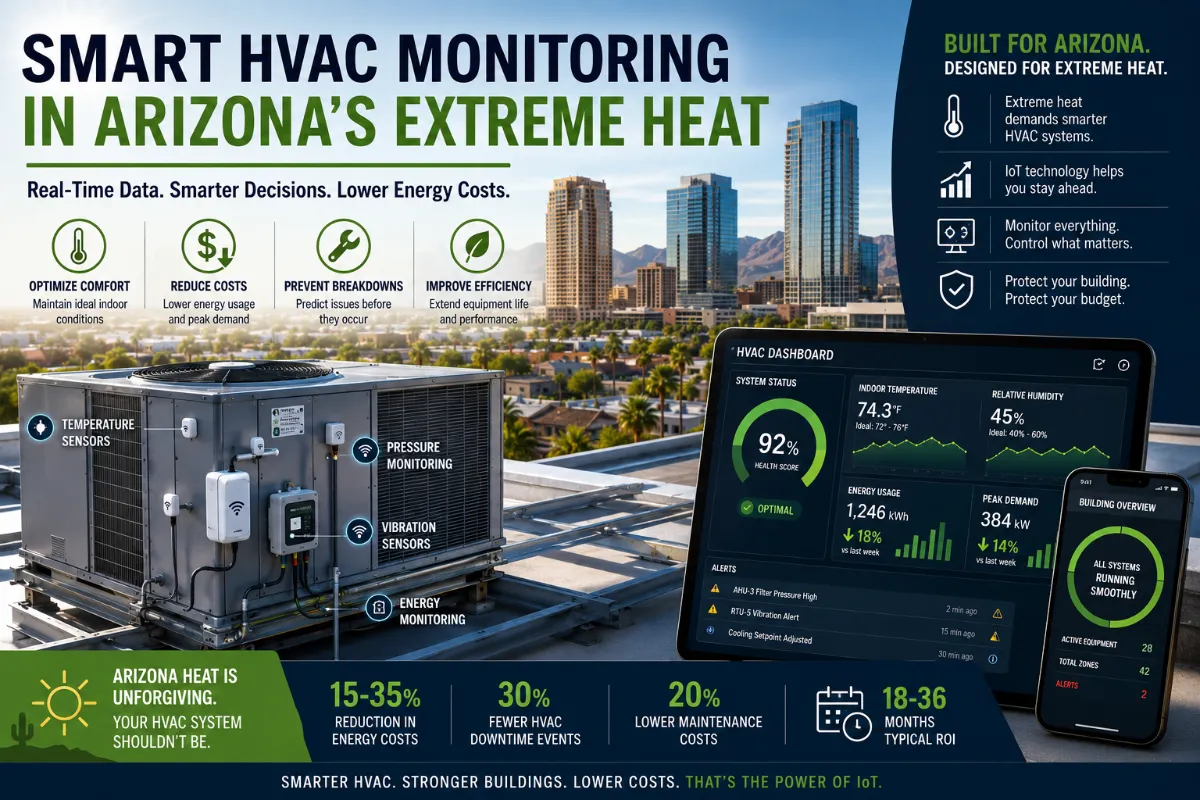
Smart HVAC Monitoring in Arizona's Extreme Heat: Why Commerc...
Published On 21-06-2026

Published by IOT Arizona Research & Editorial Team
Commercial properties in Arizona are under constant pressure. Extreme heat, rising energy costs, aging infrastructure, and increasing tenant expectations are forcing property owners to rethink how buildings are maintained.
For decades, maintenance followed two approaches.
In 2026, a third approach is becoming the new standard.
Predictive maintenance.
Instead of waiting for equipment to fail or performing unnecessary maintenance, Arizona commercial buildings are using real-time data to predict problems before they happen.
This shift is transforming how offices, retail centers, warehouses, schools, hospitals, hotels, and industrial facilities operate.
Arizona buildings operate differently from buildings in cooler climates.
Commercial properties face unique environmental challenges such as:
These factors accelerate equipment wear and increase the risk of costly failures.
Traditional maintenance schedules often miss these environmental variables.
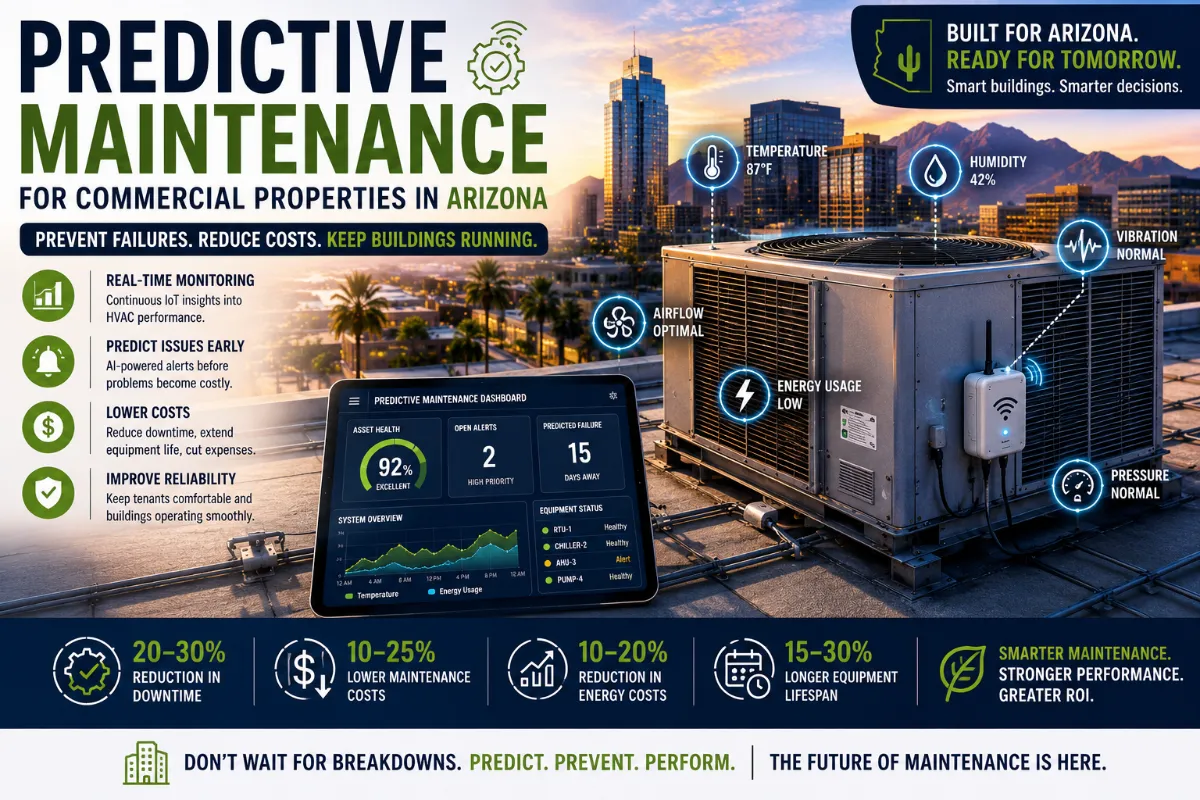
Predictive maintenance uses IoT sensors, artificial intelligence, machine learning, cloud platforms, and building analytics to monitor equipment continuously.
The system analyzes equipment performance and alerts maintenance teams before failures occur.
Instead of asking:
"What broke?"
Businesses begin asking:
"What will break next week?"
Many commercial properties unknowingly lose thousands of dollars every year due to reactive maintenance.
Common hidden expenses include:
Arizona's extreme heat amplifies these costs because equipment is already operating under stress.
| Building System | What Gets Monitored |
|---|---|
| HVAC Systems | Temperature, airflow, vibration, runtime |
| Rooftop Units | Motor health, refrigerant pressure |
| Chillers | Energy efficiency, temperature changes |
| Pumps | Pressure, vibration, flow rates |
| Elevators | Motor performance and usage |
| Electrical Panels | Heat signatures and load monitoring |
| Water Systems | Leaks and abnormal consumption |
| Backup Generators | Battery health and runtime |
Sudden temperature increases may indicate equipment stress or cooling inefficiencies.
Equipment operating longer than expected may indicate hidden issues.
Abnormal vibration often appears weeks before a mechanical failure.
Pressure changes can indicate clogged filters, airflow problems, or system degradation.
Unexpected energy increases may signal equipment inefficiencies.
Monitor HVAC performance, occupancy patterns, and energy usage to reduce operational costs.
Optimize cooling systems, parking lot lighting, and refrigeration equipment.
Monitor ventilation systems, dock equipment, and environmental conditions.
Protect critical equipment and maintain indoor environmental quality.
Reduce guest comfort complaints and prevent unexpected system failures.
Optimize energy usage and maintain comfortable learning environments.
Equipment that is failing often consumes more energy.
Examples include:
Early detection allows teams to correct these issues before utility costs increase.
| Performance Area | Potential Improvement |
|---|---|
| Equipment Downtime | 20% to 30% reduction |
| Maintenance Costs | 10% to 25% reduction |
| Energy Costs | 10% to 20% reduction |
| Equipment Lifespan | 15% to 30% increase |
| Emergency Repairs | Significant reduction |
Prioritize systems that have the greatest impact on operations.
Examples include:
Deploy sensors that monitor:
All information should feed into one dashboard.
Configure automated alerts for abnormal behavior.
Building usage patterns change throughout the year.
Continuous optimization is necessary.
Connected equipment must be protected.
Building owners should implement:
The future of predictive maintenance is autonomous operations.
Buildings will eventually:
Commercial properties are evolving from passive structures into intelligent assets.
Predictive maintenance is no longer an advanced technology reserved for large corporations.
It is becoming essential infrastructure for Arizona commercial properties.
Buildings that adopt predictive maintenance today will reduce costs, improve reliability, extend equipment lifespan, and create better experiences for occupants.
This article was reviewed by the IOT Arizona Editorial Team for accuracy, clarity, and relevance. Information may be sourced from publicly available treatment resources, government agencies, and healthcare references where applicable.
Last reviewed: June 2026
Smart Building & Commercial IoT
 Smart Building & Commercial IoT
 Smart Building & Commercial IoT
 Smart Building & Commercial IoT