 Smart Building & Commercial IoT
Predictive Maintenance for Commercial Properties in Arizona:...
Published On 21-06-2026

Published by IOT Arizona Research & Editorial Team
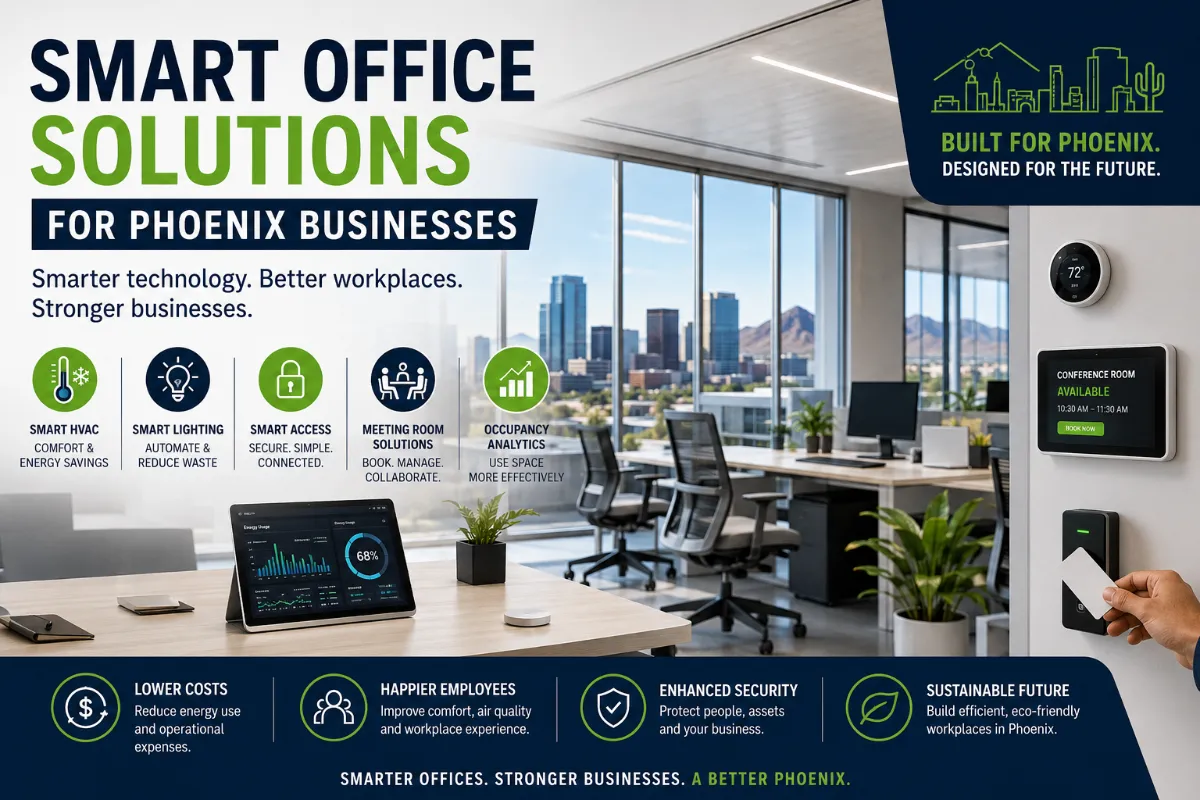
Smart office solutions for Phoenix businesses are no longer about adding trendy gadgets to a workplace. In 2026, they are becoming practical tools for solving real Phoenix office challenges: extreme heat, high cooling demand, rising operating costs, employee comfort, water conservation, security, hybrid work, and energy efficiency.
For office buildings in Phoenix, Scottsdale, Tempe, Chandler, Mesa, Glendale, and nearby Arizona business districts, smart office technology works best when it is designed around the local environment. A smart office in Phoenix should not be copied from a mild-weather city. It should be built around desert heat, long cooling seasons, workplace flexibility, and the need to operate more efficiently with better data.
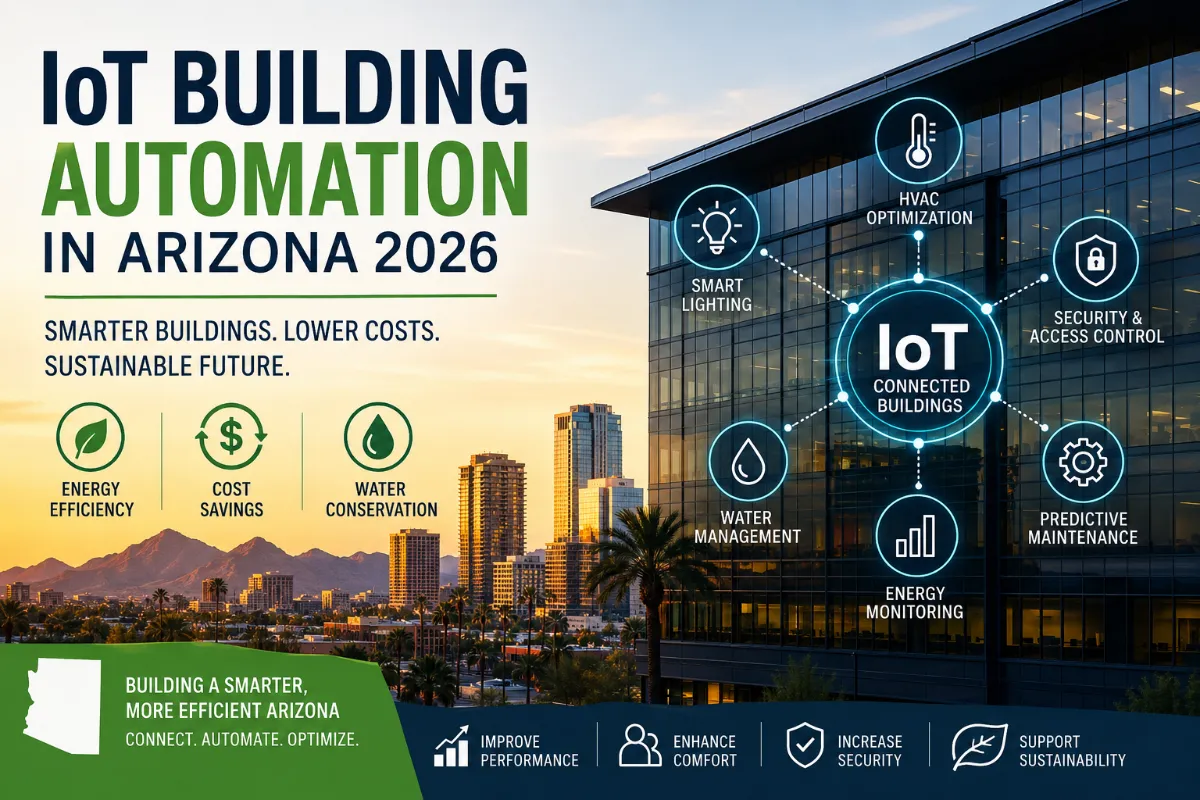
Smart office solutions are connected technologies that help businesses manage workplace systems more efficiently. These systems use sensors, automation, software, cloud platforms, and real-time data to improve comfort, security, productivity, and building performance.
Common smart office systems include HVAC automation, lighting control, smart access, occupancy sensors, indoor air quality monitoring, meeting room technology, energy dashboards, leak detection, visitor management, and connected security systems.
Phoenix businesses face different workplace challenges than companies in cooler markets. The most important smart office decisions are often connected to cooling, comfort, energy use, and operational resilience.
In Phoenix, indoor comfort is a business issue. If an office is too hot, unevenly cooled, or slow to respond to temperature changes, employees and visitors notice quickly. Smart HVAC systems help businesses monitor temperature by zone, adjust cooling based on occupancy, and reduce energy waste during low-use periods.
Many Phoenix offices are no longer full five days per week. Smart occupancy sensors can show which conference rooms, desks, floors, and collaboration areas are actually being used. This helps companies avoid wasting money on unused space while improving the areas employees use most.
Smart energy monitoring gives businesses visibility into when and where power is being used. Instead of waiting for a utility bill, owners and managers can identify inefficient equipment, peak usage patterns, and opportunities to reduce waste.
Modern offices need more flexible access control. Smart access systems allow businesses to manage employee entry, visitor access, vendor access, after-hours permissions, and activity logs from a centralized system.
Smart HVAC automation is one of the highest-value upgrades for Phoenix offices. Connected thermostats, zone sensors, occupancy sensors, and building automation software can help maintain comfort while reducing unnecessary cooling.
For Phoenix businesses, the goal is not simply to make the office colder. The goal is to cool the right areas at the right time based on occupancy, sunlight exposure, room use, and business hours.
Smart lighting systems use sensors and schedules to turn lights on, dim them, or shut them off based on activity. This is especially useful for conference rooms, private offices, restrooms, hallways, storage areas, and shared workspaces.
Lighting automation can also improve employee experience by adjusting brightness throughout the day and reducing energy waste in unused spaces.
Smart access control replaces or improves traditional keys and manual entry systems. Businesses can use mobile credentials, access cards, temporary visitor codes, and role-based permissions.
This is useful for offices with hybrid employees, vendors, cleaning crews, delivery access, coworking areas, or multiple tenant spaces.
Smart meeting room systems help employees find, reserve, and use meeting spaces more efficiently. These systems can include room booking screens, occupancy detection, video conferencing equipment, automated lighting, and climate control.
For Phoenix businesses with hybrid teams, meeting room automation can reduce scheduling confusion and improve collaboration between in-office and remote employees.
Indoor air quality sensors can track temperature, humidity, CO2 levels, ventilation performance, and particulates. This helps businesses create healthier and more comfortable office environments.
Air quality monitoring is especially useful for offices with high occupancy, enclosed meeting rooms, healthcare-related spaces, education offices, and buildings where employee wellness is a priority.
Energy dashboards show real-time usage across office systems. Business owners and facility managers can see whether HVAC, lighting, appliances, server rooms, or equipment are using more energy than expected.
This makes energy management more proactive instead of reactive.
Water leak sensors can detect moisture near restrooms, break rooms, mechanical rooms, kitchens, irrigation systems, and plumbing areas. In Phoenix, where water conservation is important, leak detection can help prevent waste and property damage.
Smart camera systems allow businesses to monitor entrances, parking areas, reception areas, storage rooms, and common areas. These systems can include motion alerts, cloud storage, mobile access, and integration with access control.
| Business Type | Most Useful Smart Office Solutions |
|---|---|
| Professional Offices | Smart HVAC, access control, meeting room automation, lighting control |
| Medical Offices | Indoor air quality monitoring, smart security, access control, energy monitoring |
| Law Firms | Secure access, visitor management, conference room automation, smart lighting |
| Coworking Spaces | Mobile access, occupancy tracking, room booking, security cameras |
| Tech Companies | Occupancy analytics, smart meeting rooms, energy dashboards, connected security |
| Retail Offices | Smart lighting, security cameras, HVAC scheduling, leak detection |
The cost of smart office technology depends on office size, system complexity, number of connected devices, software needs, installation requirements, and whether the office is new construction or a retrofit.
| Office Size | Estimated Smart Office Investment |
|---|---|
| Small Office | $5,000 to $20,000 |
| Mid-Size Office | $20,000 to $75,000 |
| Large Office | $75,000 to $250,000+ |
| Multi-Tenant Office Building | Custom pricing based on integrations and building systems |
Many Phoenix businesses start with one or two high-impact systems, such as smart HVAC and access control, before expanding into lighting, occupancy analytics, energy dashboards, and air quality monitoring.
The strongest return on investment often comes from reducing energy waste, improving employee comfort, lowering maintenance issues, and making better use of office space.
| Smart Office Area | Business Value |
|---|---|
| Smart HVAC | Lower cooling waste and improved comfort |
| Occupancy Sensors | Better space planning and hybrid work decisions |
| Smart Lighting | Reduced electricity use in unused spaces |
| Access Control | Better security and easier employee management |
| Energy Dashboards | Improved visibility into utility usage |
| Leak Detection | Reduced water waste and property damage risk |
Do not start by buying devices. Start by identifying the most expensive or frustrating workplace problems. Common Phoenix office problems include uneven cooling, high utility bills, unused meeting rooms, security gaps, and poor visibility into building performance.
For many Phoenix offices, the best starting points are HVAC automation, smart lighting, access control, and energy monitoring. These systems usually solve practical problems quickly.
A smart office should not become a collection of disconnected apps. Choose systems that can integrate with building management platforms, access control systems, energy dashboards, and future upgrades.
Every connected office device adds a cybersecurity responsibility. Businesses should use secure networks, strong passwords, software updates, role-based access, and vendor security reviews.
Smart office systems work better when people understand how to use them. Employees should know how to book rooms, use access systems, report comfort issues, and follow security procedures.
Track utility usage, comfort complaints, space utilization, maintenance tickets, security incidents, and employee feedback before and after installation.
Smart devices are only useful when they solve a clear problem. Businesses should avoid installing technology simply because it is popular.
In Phoenix, HVAC performance is central to office comfort. A smart office plan that ignores cooling zones, sun exposure, and occupancy patterns may miss the biggest savings opportunity.
If every system has its own dashboard, login, and reporting process, the office becomes harder to manage. Integration should be part of the plan from the beginning.
Smart cameras, access systems, thermostats, and sensors should be treated as part of the business technology environment. They need security controls, updates, and monitoring.
A Phoenix smart office should be designed around heat, comfort, water awareness, energy visibility, hybrid work, and security. The best systems help businesses operate better in the desert environment instead of copying a generic smart office model from another region.
The most valuable smart office strategy is one that connects workplace comfort with operational performance. When HVAC, lighting, access, occupancy, air quality, and energy systems work together, the office becomes easier to manage and more responsive to daily business needs.
Smart offices in Phoenix will continue moving toward automation, AI-assisted building management, predictive maintenance, energy optimization, solar integration, EV charging coordination, and more advanced workplace analytics.
As Phoenix continues to grow, businesses that invest in smart office systems will be better positioned to control costs, improve employee experience, and operate more resilient workplaces.
Smart office solutions for Phoenix businesses should focus on practical outcomes: cooler workspaces, lower waste, better security, improved employee experience, smarter space planning, and more efficient operations.
The best smart office is not the one with the most devices. It is the one that uses connected technology to solve real Phoenix business problems.
This article was reviewed by the IOT Arizona Editorial Team for accuracy, clarity, and relevance. Information may be sourced from publicly available treatment resources, government agencies, and healthcare references where applicable.
Last reviewed: June 2026
Smart Building & Commercial IoT
 Smart Building & Commercial IoT
 Smart Building & Commercial IoT
 Smart Building & Commercial IoT