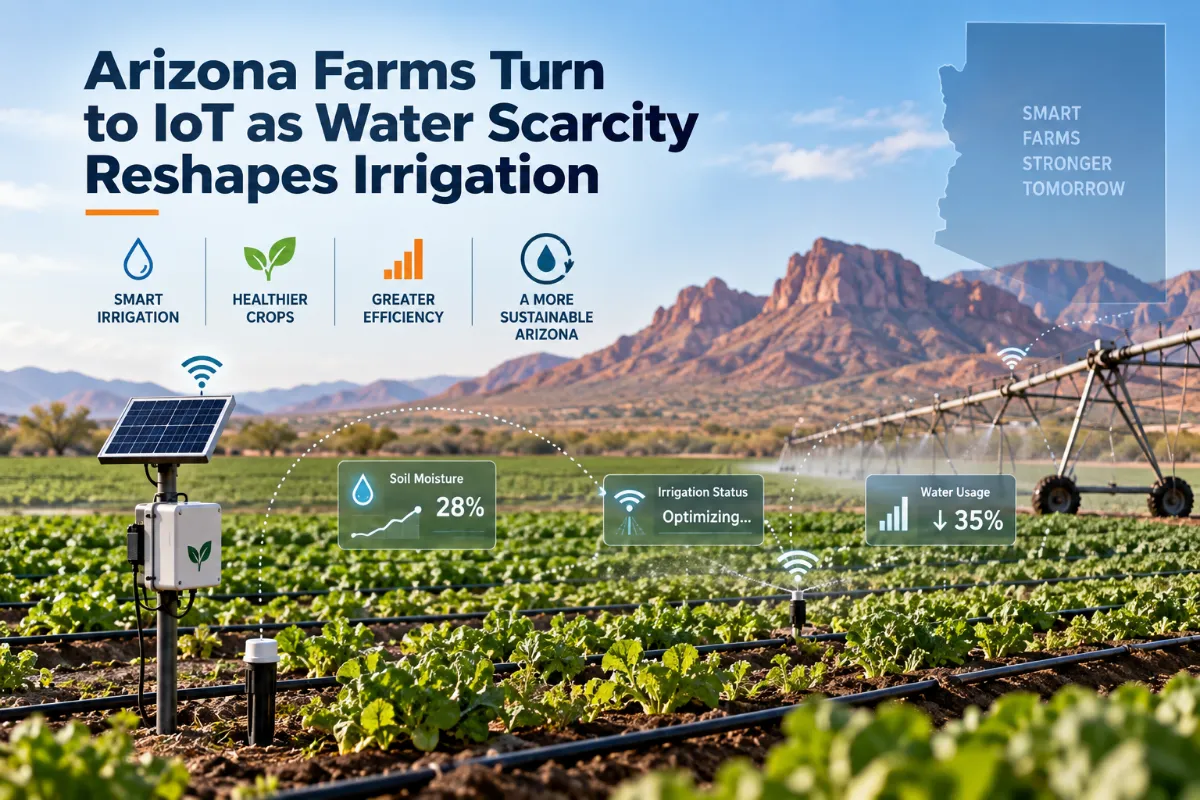
Water has always been one of Arizona's most valuable resources. With a dry climate, unpredictable rainfall, growing population, and increasing pressure on agricultural water supplies, farmers are continually looking for ways to produce healthy crops while using every gallon of water more efficiently.
Smart irrigation systems are helping make that possible. By combining Internet of Things (IoT) technology with connected sensors, weather forecasting, automated irrigation equipment, and real-time analytics, Arizona farms can make more informed irrigation decisions while reducing waste and improving crop performance.
Many people think smart irrigation simply means watering crops automatically.
Modern irrigation systems are far more intelligent.
Instead of watering fields on fixed schedules, connected irrigation systems collect information from multiple sources before deciding when, where, and how much water should be applied.
These systems can analyze:
- Soil moisture
- Weather forecasts
- Air temperature
- Humidity
- Solar radiation
- Wind speed
- Water pressure
- Crop growth stage
- Historical irrigation data
- Water consumption
The result is more efficient irrigation that supports healthier crops while conserving valuable water resources.
Agriculture plays an important role in Arizona's economy, but farming in the desert requires careful water management.
Farmers face several challenges including:
- Limited water availability
- High summer temperatures
- Rapid evaporation
- Variable soil conditions
- Increasing operating costs
- Growing sustainability expectations
- Changing weather patterns
Traditional irrigation schedules often rely on estimates. Smart irrigation uses real-time information to help farmers apply water only when crops actually need it.
A smart irrigation system combines connected sensors, IoT devices, cloud software, weather information, and automated irrigation equipment to improve watering efficiency.
| Traditional Irrigation |
Smart Irrigation |
| Fixed watering schedules |
Data-driven irrigation |
| Manual adjustments |
Automatic optimization |
| Limited visibility |
Real-time monitoring |
| Reactive maintenance |
Predictive maintenance |
| Watering by estimation |
Watering based on field conditions |
One of the most valuable components of a smart irrigation system is the soil moisture sensor.
Instead of guessing how much water remains in the soil, farmers receive accurate measurements from different depths across the field.
Benefits include:
- Preventing overwatering
- Reducing underwatering
- Improving root development
- Reducing runoff
- Lower pumping costs
- Better crop consistency
Weather conditions change rapidly across Arizona.
Smart irrigation systems can combine local weather forecasts with on-site environmental sensors to determine whether irrigation should continue, be delayed, or be adjusted.
Useful weather information includes:
- Rain forecasts
- Temperature
- Humidity
- Wind speed
- Solar radiation
- Evapotranspiration estimates
Using weather data helps reduce unnecessary irrigation while supporting healthier crops.
Water pumps are essential components of many irrigation systems.
IoT-enabled pumps can continuously monitor:
- Motor performance
- Power consumption
- Pressure
- Flow rates
- Pump temperature
- Operating hours
- Maintenance requirements
Instead of discovering failures after irrigation has stopped, connected systems can identify potential problems earlier.
Modern irrigation valves can be remotely controlled through cloud-based management platforms.
This allows farmers to:
- Open irrigation zones remotely
- Adjust watering schedules
- Respond to changing weather
- Reduce labor requirements
- Improve water distribution
- Monitor valve performance
Smart irrigation systems generate continuous operational data that helps farmers make informed decisions throughout the growing season.
Dashboards may display:
- Water usage
- Soil moisture trends
- Pump status
- Valve activity
- Weather conditions
- Historical irrigation performance
- Equipment alerts
Instead of relying on manual inspections, growers gain visibility across their entire irrigation system.
Many Arizona farms manage irrigation across multiple fields and large geographic areas.
Automation allows routine irrigation tasks to occur without constant manual intervention.
Examples include:
- Scheduled irrigation
- Automatic shutdown during rain
- Pressure-based valve control
- Remote equipment diagnostics
- Low-water alerts
- Equipment fault notifications
| Operation |
Smart Irrigation Benefit |
| Row Crops |
Consistent soil moisture management |
| Orchards |
Targeted irrigation around root zones |
| Vineyards |
Precision water scheduling |
| Greenhouses |
Automated climate and irrigation control |
| Nurseries |
Reduced water waste |
| Specialty Crops |
Improved crop quality |
Water conservation remains one of Arizona agriculture's highest priorities.
Smart irrigation supports sustainability by helping reduce:
- Excess irrigation
- Water runoff
- Groundwater demand
- Energy used for pumping
- Chemical runoff
- Operational waste
More efficient irrigation also contributes to long-term resource management for future agricultural production.
One of the greatest advantages of IoT is the ability to transform operational data into actionable insights.
Farm managers can answer questions such as:
- Which field requires irrigation first?
- Which irrigation zones consume the most water?
- Are pumps operating efficiently?
- How has water usage changed over time?
- Which equipment requires maintenance?
- How do weather conditions affect irrigation demand?
| Region |
Opportunity |
| Phoenix Metropolitan Area |
Urban agriculture and landscaping |
| Yuma |
Large-scale vegetable production |
| Pinal County |
Row crop irrigation optimization |
| Maricopa County |
Commercial agriculture and nurseries |
| Tucson |
Water-efficient agriculture |
| Cochise County |
Precision irrigation for specialty crops |
- Installing sensors without regular calibration.
- Using fixed irrigation schedules despite changing weather.
- Ignoring equipment maintenance alerts.
- Collecting data without reviewing reports.
- Overlooking cybersecurity for connected devices.
- Deploying technology without staff training.
Future irrigation systems will become even more intelligent by combining artificial intelligence, satellite imagery, drone mapping, computer vision, predictive analytics, and autonomous irrigation equipment.
Instead of responding to water needs after crops show stress, future systems will predict irrigation requirements before problems develop.
Smart irrigation systems are becoming an essential technology for Arizona agriculture. By combining IoT sensors, weather intelligence, automation, and real-time analytics, farmers can improve water efficiency, reduce operating costs, and support more sustainable farming practices.
As connected agriculture continues to evolve, intelligent irrigation will play an increasingly important role in helping Arizona produce more food while conserving one of its most valuable natural resources.
Frequently asked questions
A smart irrigation system uses connected sensors, weather information, automation, and analytics to optimize irrigation schedules and improve water efficiency.
Arizona's dry climate and limited water resources make efficient irrigation essential for sustainable agriculture.
They continuously measure water levels within the soil, helping farmers determine when irrigation is actually needed.
Yes. By applying water only when necessary, smart irrigation systems help reduce unnecessary water consumption.
Many systems use internet or wireless communications for remote monitoring, although some functions may also operate locally.
Vegetables, orchards, vineyards, nurseries, specialty crops, and greenhouse operations can all benefit from intelligent irrigation technologies.
Related articles


 Agriculture IoT