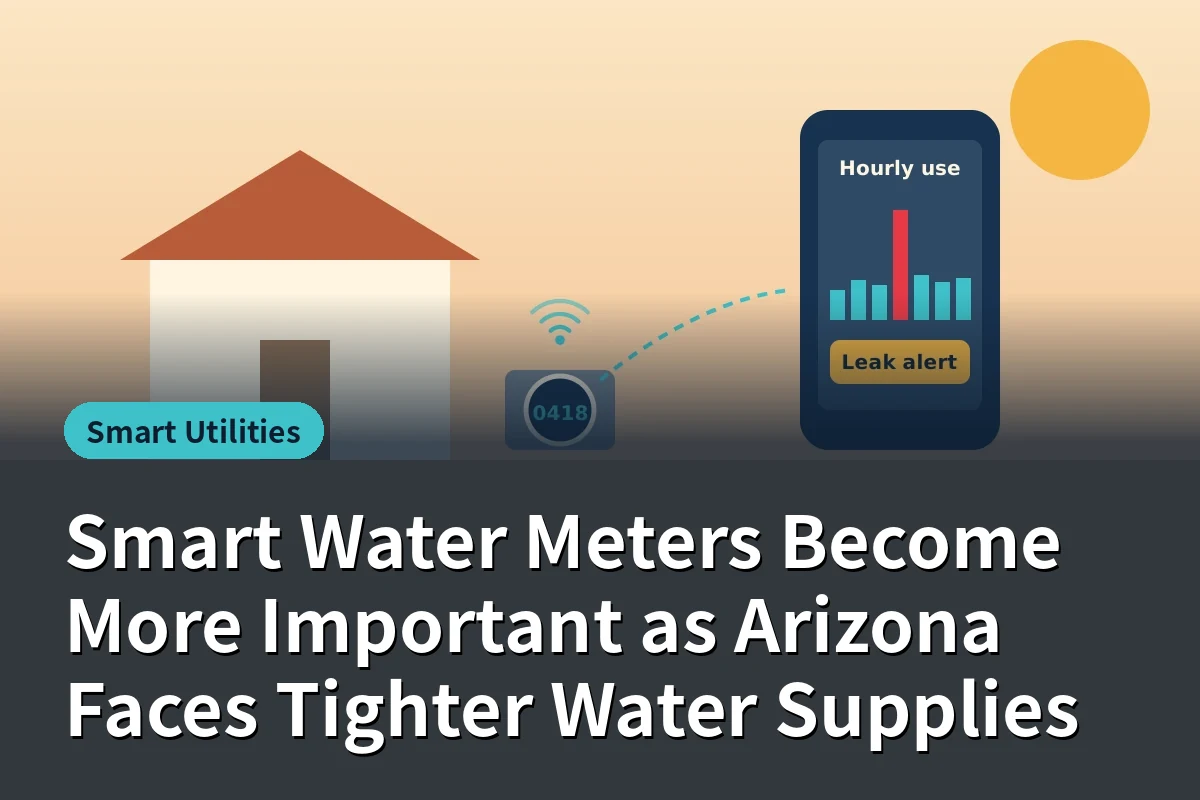
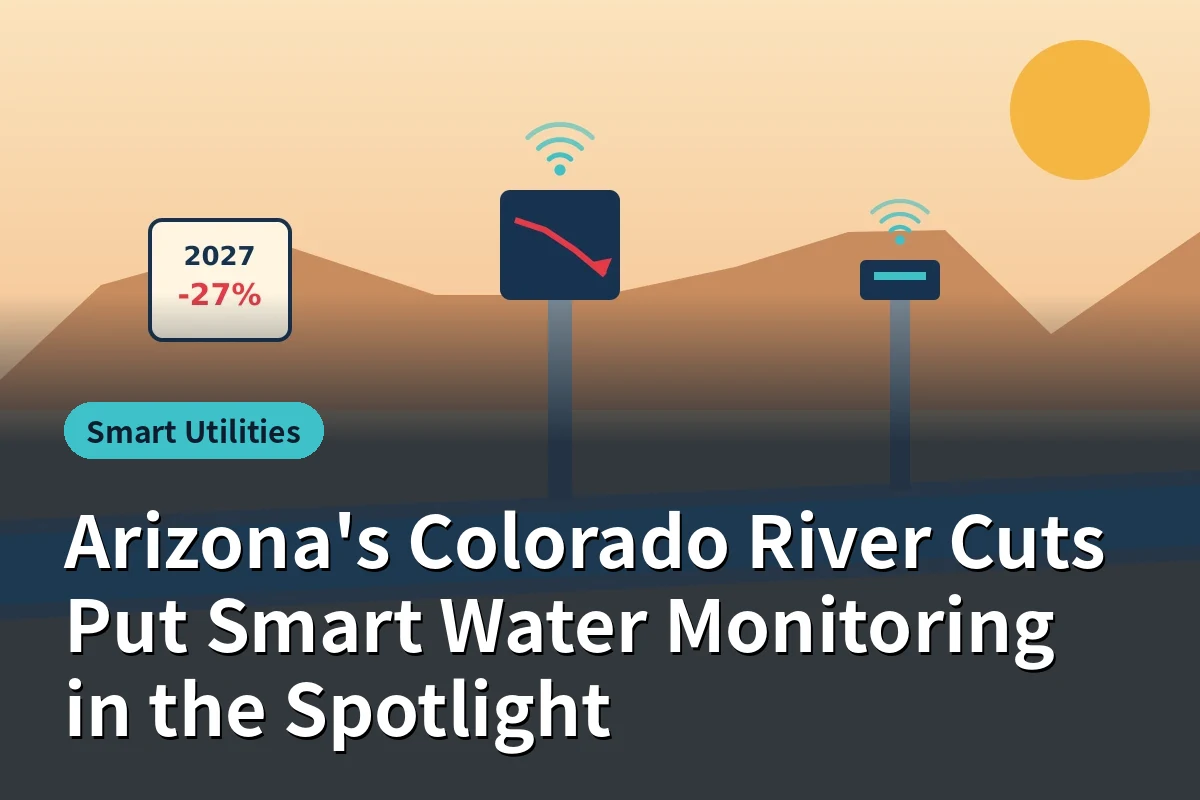
Arizona utilities face a problem most of the country doesn't: they have to stretch a shrinking water supply across a fast-growing population while also keeping the lights on through triple-digit summers. That combination has turned the state into an unlikely proving ground for connected sensors, smart meters, and predictive software that fall under the umbrella of smart utilities IoT. This isn't a futuristic concept anymore. It's showing up in municipal water departments in Yavapai County, in the distributor relationships that supply meters to Phoenix-area cities, and in the broader wave of technology upgrades happening at water and energy utilities across North America right now.
Every gallon lost to an undetected pipe leak in a desert state carries a different weight than it does in a region with abundant rainfall. That reality is pushing Arizona water providers toward the same category of technology that's reshaping utilities nationally: sensor networks, cloud dashboards, and automated alerts that catch problems before a crew ever gets dispatched.
A clear local example comes from Prescott Valley, where a municipal project built custom software called "Water Smart" to provide real-time leak alerts and connect water customers to their current and historic water use record and save an estimated 48 million gallons of water per year. That's not a pilot buried in a lab. It's a working deployment tied directly to a town's water budget, and it illustrates the kind of return Arizona communities can expect when they connect metering infrastructure to real-time software rather than relying on quarterly manual reads.
On the distribution side, the state's water utility supply chain has also been shifting. Master Meter announced a new partnership with PureOps to serve customers in the state of Arizona, an alliance meant to ensure continued support for existing clients while positioning the company for growth in the region. The company's regional presence isn't abstract either — its Arizona sales contact is based just outside of Phoenix in Gilbert, underscoring how metering vendors are building out local infrastructure to match rising demand from valley and rural utilities alike.
Arizona's local moves are happening against a backdrop of rapid national investment. Several major meter and analytics vendors have rolled out upgrades within the past year that are directly relevant to any utility manager evaluating a system refresh:
- Xylem expanded its smart water solutions portfolio by integrating advanced AI-driven analytics into its digital platform, enabling utilities to improve leak detection, predictive maintenance, and real-time grid optimization across municipal water networks.
- Itron announced enhancements to its smart water infrastructure platform, focusing on edge computing capabilities and IoT-enabled water meters to support utilities in reducing non-revenue water.
- Badger Meter introduced upgraded ultrasonic smart water meters with enhanced connectivity and cloud-based data analytics, helping utilities modernize aging infrastructure and strengthen smart grid integration.
- Sensus, a Xylem brand, deployed advanced smart water network solutions across multiple U.S. municipalities, focusing on digital twin technology and real-time pressure monitoring to improve operational efficiency.
These aren't isolated announcements. They reflect a market that's expanding quickly: the IoT water management market is projected to reach 13.45 billion dollars in 2026, and the IoT segment is expected to account for 41% of the global smart water management market share this year. For a state managing Colorado River allocations and groundwater restrictions, that scale of investment matters because it means the sensor hardware, cloud platforms, and analytics engines utilities need are becoming more mature, more interoperable, and less expensive to deploy than they were even three years ago.
Smart utilities in Arizona really break down into two connected but distinct use cases, and understanding the difference matters for anyone budgeting a project.
Sensors attached to a home's or building's water pipes can track water pressure and detect leaks, while temperature monitoring adds context for seasonal shifts or freeze risks. In a state where a single slab leak can waste tens of thousands of gallons before anyone notices a change in the water bill, that kind of pressure and flow monitoring turns a quarterly billing surprise into a same-day text alert. Smart meters provide advantages over traditional meters, including the ability to analyze consumption patterns for leaks or other inefficiencies that lead to cost and resource savings.
The second use case is less visible to most residents but arguably just as important during Arizona summers: grid-side sensors that help utilities balance load, spot equipment stress, and integrate solar and battery resources. As utilities modernize to meet rising energy demands, renewable energy and alternative distribution models are becoming central to long-term planning. Advanced metering infrastructure ties both worlds together, since the same communication backbone that reads a water meter can often support electric and gas metering on a shared network.
Non-revenue water — water that's produced but never billed because it leaked out somewhere along the way — is one of the biggest financial drains a utility can face. Rapid urbanization and climate change have increased water demands and placed greater pressure on utility networks, contributing to an estimated $40 billion in losses tied to non-revenue water globally. Arizona utilities, many of which operate aging pipe networks stretched across sprawling desert developments, have a direct financial incentive to close that gap.
| Traditional Approach | IoT-Enabled Approach |
|---|
| Manual quarterly meter reads | Continuous remote data collection |
| Leaks found after customer complaint or high bill | Automated pressure and flow alerts within hours |
| Reactive pipe repair after failure | Condition-based maintenance scheduling |
| Limited visibility into system-wide usage | Dashboard-level view across the entire network |
Applying AI and real-time IoT sensors for predictive maintenance and early leak detection replaces the old reactive cycle, where a pipe fails, a crew responds, and the utility absorbs both repair costs and the revenue lost from unmetered water, with a maintenance schedule driven by actual asset condition data. For a mid-sized Arizona municipal utility, that shift can mean the difference between an emergency line replacement budget and a planned capital improvement schedule that residents barely notice.
None of this is plug-and-play. A handful of recurring obstacles show up whenever a city or private water company starts evaluating a smart metering rollout:
- Legacy infrastructure. Many pipe networks and meter pits were installed decades before wireless connectivity was a consideration, which complicates sensor placement and retrofit costs.
- Connectivity gaps. Rural and exurban parts of Arizona don't always have the same cellular or fixed-network coverage that a dense metro area does, which affects which communication protocol makes sense for a given deployment.
- Cybersecurity requirements. Advanced metering infrastructure adoption is expanding across North America, with utilities deploying IoT sensor networks, cloud-based analytics platforms, and cybersecurity frameworks that meet FERC and DOE standards. Meeting those requirements takes dedicated IT expertise that smaller utilities may not have in-house.
- Data overload without action. Collecting readings every fifteen minutes across thousands of meters is only useful if staff have dashboards and alert thresholds set up to act on the data, not just store it.
- Budget justification. Capital committees and city councils often need a clear payback timeline before approving a system-wide rollout, which means utilities need pilot data before scaling.
Utilities and larger commercial property operators considering a smart metering or grid-sensor project can reduce risk by starting narrow. A pilot in one pressure zone or one commercial campus, similar in scope to the Prescott Valley leak-alert rollout, generates real usage and savings data before a city commits to a full-scale build-out. Choosing meter and sensor vendors that already support open communication standards also matters, since it keeps the door open to add electric or gas monitoring later without ripping out the water metering backbone.
It's also worth budgeting time, not just money, for staff training. A leak-alert dashboard only pays off if someone on staff is checking it daily and has a documented response process when a pressure anomaly appears at 2 a.m.
Digital twins are a major trend for 2026, particularly for improving reservoir management and distribution planning under variable demand conditions. For Arizona, where reservoir levels and Colorado River allocations are watched closely every year, a virtual model of the distribution network that can simulate different drought scenarios is a genuinely useful planning tool rather than a novelty. Expect more utilities in the state to pair sensor data with these simulation platforms over the next few years, especially as vendors continue folding AI-driven anomaly detection directly into their standard meter software rather than selling it as a separate add-on.
The bigger picture is that smart utilities technology in Arizona isn't a single product purchase. It's a layered system — meters, pressure sensors, communication networks, cloud analytics, and staff processes — that together turn a scarce resource problem into something a utility can actually see, measure, and manage in near real time.
Frequently asked questions
It generally refers to metering and sensor systems connected to a communication network and cloud dashboard, allowing utilities to monitor water pressure, flow, energy load, or leak conditions remotely instead of relying only on manual meter reads.
Results vary by system size, but the Prescott Valley 'Water Smart' program in Arizona was designed to save an estimated 48 million gallons of water per year through real-time leak alerts and usage tracking.
Usually not. Most upgrades happen at the utility's meter pit or main line, and residents typically gain access to a usage dashboard or app rather than needing to install anything themselves.
They can share underlying communication infrastructure, since the same wireless or cellular network used for water meter reads can often support electric or gas metering, but the sensors and data purposes differ between the two.
Reducing non-revenue water, meaning water that's produced but never billed due to undetected leaks, which industry estimates put at roughly $40 billion in losses globally each year.
Start with a limited pilot in one pressure zone or district to gather real savings and performance data, which helps justify a larger budget request to city councils or capital committees.
Related articles


 Smart Utilities