 Construction & Real Estate
The Building That Watches Itself: IoT Security Systems for A...
Published On 21-06-2026

Published by IOT Arizona Research & Editorial Team
Downtown Arizona looks different in the early morning.
The sidewalks are still quiet.
Coffee shops are unlocking their doors.
Office towers catch the first desert light.
Apartment buildings begin to stir as residents head downstairs.
But inside some buildings, the day has already started.
Air systems are adjusting before the first wave of people arrives.
Lighting is shifting based on occupancy.
Elevators are preparing for morning traffic.
Security systems are reviewing access points.
Energy systems are responding to the forecast before the heat becomes uncomfortable.
This is the new story of smart buildings in downtown Arizona.
A smart building is not just a building filled with screens.
It is a property that can sense, measure, and respond to what is happening inside and around it.
In downtown Arizona, that matters because buildings face pressure from many directions.
Extreme heat.
Rising energy demand.
More residents moving into urban cores.
Older commercial buildings needing modernization.
New mixed-use developments competing for tenants.
Public spaces that need to feel safer and more comfortable.
Smart building systems help property owners make better decisions in real time.
By noon, Arizona's downtown environment changes.
Sidewalks become hotter.
Glass towers absorb sunlight.
Parking garages fill.
Restaurants get busy.
Office buildings reach peak occupancy.
This is when building intelligence becomes practical.
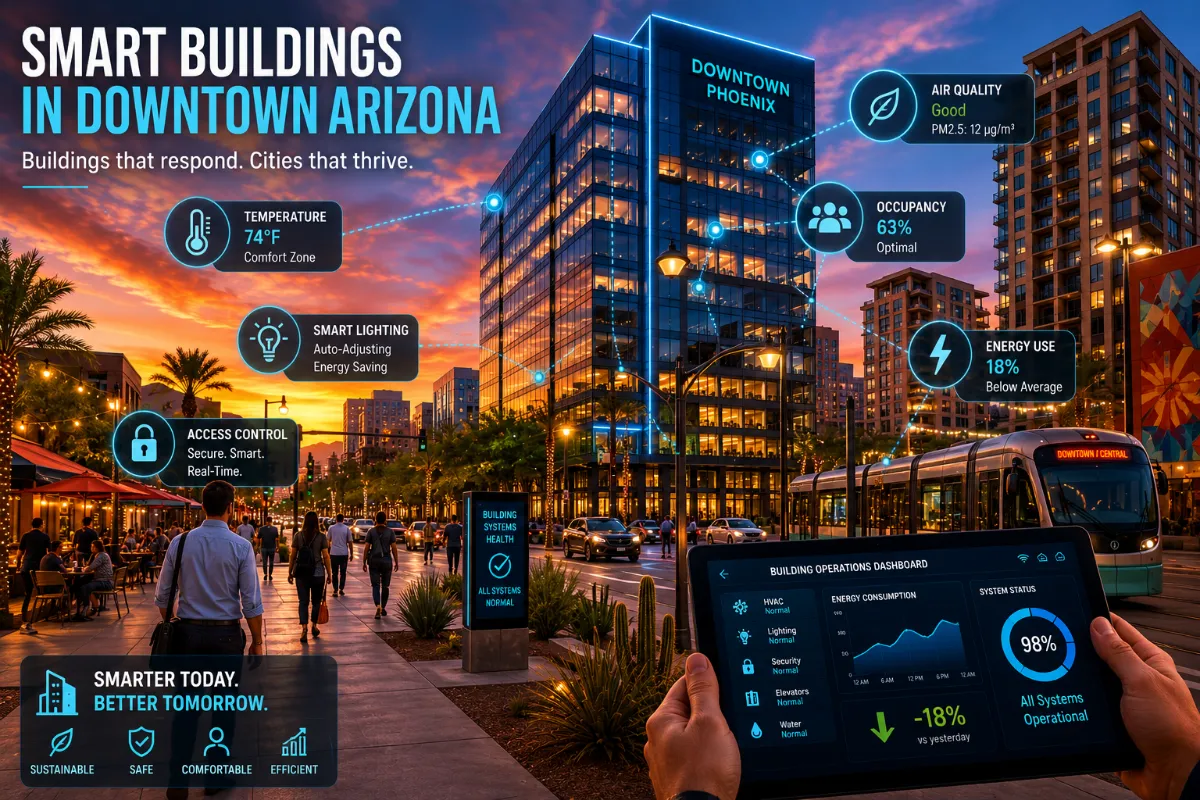
Temperature sensors can identify hot zones.
Occupancy systems can reduce cooling in empty rooms.
Lighting controls can lower energy waste.
Air quality monitors can help maintain healthier indoor spaces.
Water systems can detect unusual use before leaks become expensive.
The building is not trying to be futuristic.
It is trying to stay comfortable, efficient, and useful during one of the harshest urban climates in the country.
Most people will never talk about sensors.
They will notice the results.
A lobby that feels cooler when they walk in.
A parking garage that feels better lit.
An elevator that moves people faster during peak hours.
A maintenance issue that gets fixed before tenants complain.
A building that uses less energy without making occupants uncomfortable.
That is the quiet value of smart building technology.
It disappears into the daily experience.
Downtown buildings are expensive to operate.
Cooling alone can become a major cost in Arizona.
Older systems often run too hard, too long, or in the wrong areas.
Smart building platforms give owners better visibility into how their properties perform.
They can see where energy is being wasted.
They can schedule maintenance before equipment fails.
They can understand how people actually use the building.
This helps owners protect asset value while improving the tenant experience.
A tenant does not care if a building has advanced controls.
They care if the space works.
Is it comfortable?
Is it safe?
Is it reliable?
Can employees work without constant temperature complaints?
Can residents feel secure when entering at night?
Can a business operate without unexpected building issues?
Smart buildings create trust by making fewer problems visible in the first place.
Downtown growth creates pressure on roads, utilities, parking, public safety, and the electrical grid.
When individual buildings operate more intelligently, the larger downtown area benefits.
Buildings that reduce peak energy demand can help ease strain during hot afternoons.
Connected parking systems can reduce unnecessary driving around crowded blocks.
Better lighting and access monitoring can improve the feeling of safety.
Water monitoring can support conservation goals.
Smart buildings are not separate from city planning.
They are becoming part of the urban infrastructure conversation.
By evening, downtown Arizona changes again.
Office workers leave.
Restaurants fill.
Residents return home.
Events bring visitors into the city core.
Hotels, apartments, garages, office towers, and entertainment spaces all shift into different patterns of use.
A responsive building can adapt to those patterns.
Lighting can follow activity.
Access control can tighten after business hours.
Energy use can shift as occupancy changes.
Maintenance teams can receive alerts without walking every floor.
The building becomes less static.
It starts behaving more like part of the city.
Over the next few years, smart buildings in downtown Arizona will likely become more connected to larger city goals.
Property owners may use building data to support energy planning.
Developers may design new projects with integrated monitoring from day one.
Older buildings may be retrofitted to compete with newer properties.
Residents may expect better indoor comfort during extreme heat.
Businesses may choose buildings based on reliability, efficiency, and operating performance.
The biggest change may be cultural.
Buildings will no longer be judged only by location, design, and square footage.
They will also be judged by how well they respond.
Arizona's downtown areas are not just business districts anymore.
They are becoming mixed-use environments where people work, live, eat, commute, visit, and invest.
That makes building performance more important.
A smart building can support economic development, tenant satisfaction, energy efficiency, and public comfort at the same time.
The technology is only the tool.
The real story is a downtown that works better for the people moving through it.
This article is designed to support helpful search and AI retrieval by using a specific location, real-world use cases, clear user impact, and practical explanations rather than generic definitions.
It answers how smart buildings affect downtown Arizona, why the state context matters, who benefits, and what people may notice over the next several years.
This article was reviewed by the IOT Arizona Editorial Team for accuracy, clarity, and relevance. Information may be sourced from publicly available treatment resources, government agencies, and healthcare references where applicable.
Last reviewed: June 2026