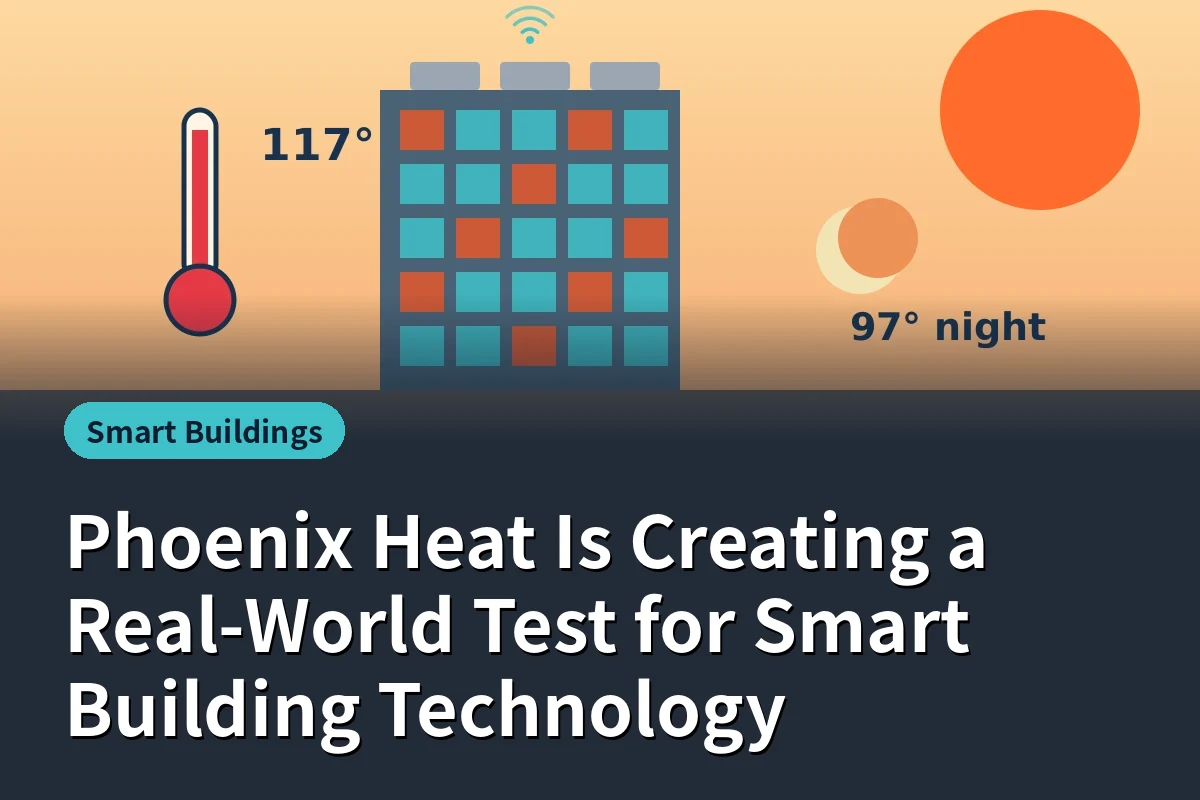
Most articles about smart buildings talk about the technology first and the location second. In Arizona, that order should probably be flipped. When outdoor temperatures regularly climb past 110 degrees for weeks at a time, a building's mechanical systems aren't a convenience, they're the difference between a functioning office and a liability. That single fact explains why property owners across Phoenix, Tucson, Scottsdale, and the fast-growing suburbs of Buckeye and Queen Creek are paying closer attention to connected building technology than owners in milder climates might.
The broader numbers back up how quickly this shift is happening nationally. Smart buildings, meaning facilities equipped with sensors, connected controls, and data platforms that manage systems like HVAC, lighting, and security, numbered around 45 million worldwide in 2022. Industry projections put that figure at 115 million by 2026, more than doubling in just a few years. Arizona's combination of extreme heat, rapid population growth, and a construction boom in commercial and multifamily real estate makes it a place where that curve is likely to bend even steeper than the national average.
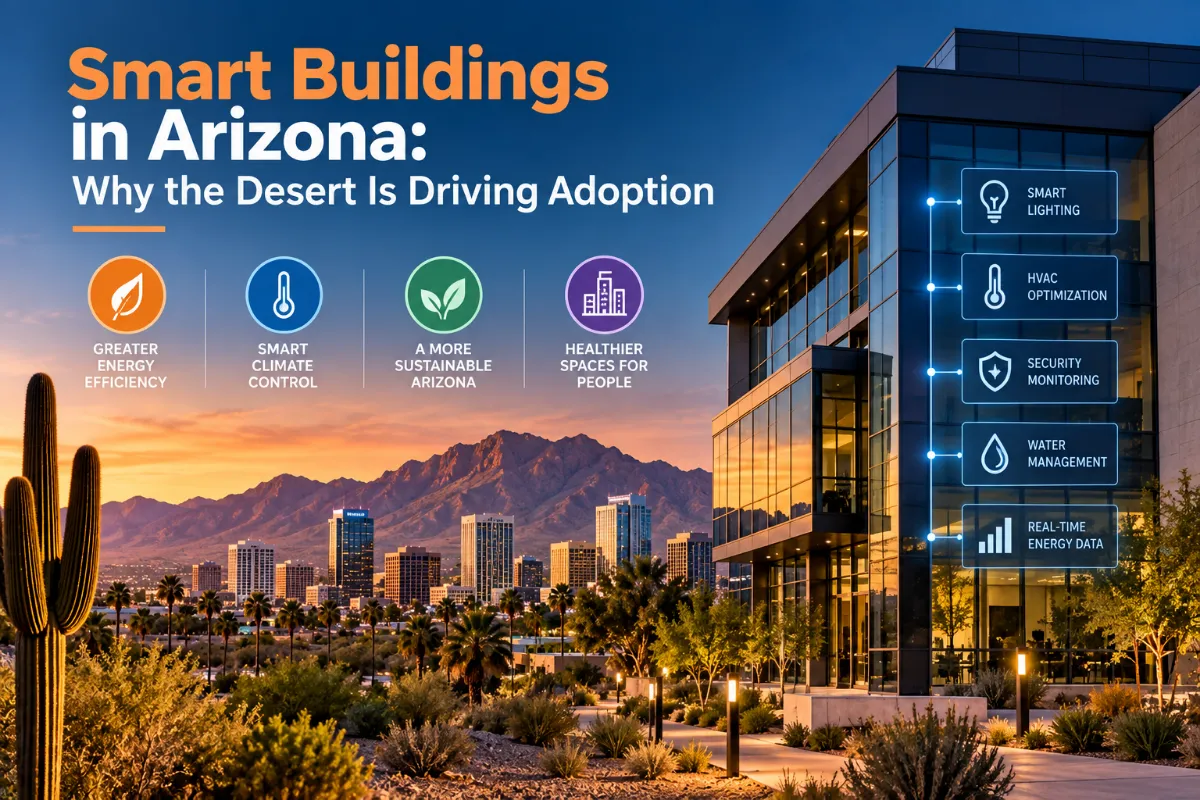
The term gets used loosely, so it helps to define it plainly. A smart building uses networked sensors and software to monitor and automatically adjust systems in real time, rather than relying on fixed schedules or manual overrides. That can include:
- HVAC systems that adjust cooling based on occupancy, time of day, and outdoor temperature rather than a static thermostat setting
- Lighting that dims or shuts off in unoccupied areas
- Water monitoring that flags leaks or unusual usage before they become expensive repairs
- Access control and security systems tied into a single dashboard
- Energy management platforms that track consumption by floor, tenant, or system
None of these are exotic technologies anymore. What's changed is the cost of sensors and connectivity, and the willingness of building owners to treat data as a management tool rather than a novelty.
In much of the country, HVAC systems cycle between heating and cooling depending on the season. In central and southern Arizona, cooling is close to a year-round demand, and it typically represents the single largest utility expense for commercial buildings. A smart HVAC system that reduces runtime by even ten percent, without sacrificing comfort, can translate into meaningful savings across a full year rather than a few summer months. Building owners in Phoenix have reported that connected HVAC controls paired with occupancy sensors cut cooling costs noticeably compared to older programmable thermostats, largely because the system reacts to actual conditions instead of a preset schedule that doesn't account for a 6 a.m. heat spike or an empty conference room running at full chill.
Arizona's relationship with water is different from almost anywhere else in the country. Municipalities and water providers have tightened restrictions in recent years, and both commercial and residential developments face more scrutiny over water usage than they did a decade ago. Smart water metering and leak detection systems, which can flag a slow leak in an irrigation line or a restroom fixture long before it shows up on a monthly bill, are becoming a practical necessity rather than an add-on feature, especially for large campuses, hotels, and multifamily complexes with extensive landscaping.
Because so much of the Phoenix metro area and parts of Tucson are still actively building, developers have an easier path to installing smart infrastructure from the ground up rather than retrofitting decades-old systems. Data center growth in the region, driven partly by the state's low natural disaster risk and available land, has also pushed connected building management further into the mainstream, since data centers depend heavily on precise environmental monitoring to protect equipment.
Energy savings get most of the attention, but they're not the only reason owners are investing in this technology. Commercial tenants increasingly ask about a building's operating efficiency and sustainability credentials before signing a lease, particularly larger corporate tenants with their own environmental commitments. A building that can document its energy performance and offer tenants visibility into their own usage has a tangible edge in lease negotiations.
Insurance is another quiet factor. Water damage and fire remain two of the most common and expensive commercial insurance claims, and some insurers now offer more favorable terms to properties with automated leak detection and monitored fire and life safety systems. For multifamily housing, smart access control and camera systems can also reduce liability exposure tied to break-ins or unauthorized entry, which matters in a state where property crime rates vary widely by neighborhood.
There's also a maintenance angle that's easy to underestimate. Predictive maintenance, where a system flags a failing component before it breaks down completely, can prevent the kind of emergency HVAC failure that shuts down a retail space or forces tenants out of an office building for days. In a climate where a broken air conditioner isn't just uncomfortable but potentially dangerous, that early warning has real value.
Building owners considering an upgrade often assume it requires a full system overhaul. In practice, most successful projects start smaller and expand once the value is proven. A reasonable sequence looks like this:
- Start with an energy and water audit to identify where the biggest inefficiencies actually are, rather than guessing
- Install monitoring on the highest-cost systems first, which in Arizona usually means HVAC and, where applicable, irrigation or water systems
- Choose a platform that can integrate with existing building management software rather than replacing it outright
- Pilot the system in one building or one floor before rolling it out across a portfolio
- Set clear performance benchmarks, such as a target reduction in kilowatt-hours per square foot, so the results can be measured objectively
Property managers who skip the audit step often end up installing sensors on systems that weren't actually the problem, which delays the payoff and makes the whole investment harder to justify internally.
None of this is as simple as installing a few sensors and walking away. A handful of recurring challenges show up across projects of every size.
Downtown Tucson and older sections of central Phoenix have plenty of buildings with electrical and mechanical systems that weren't designed with networked controls in mind. Retrofitting these properties often costs more upfront than installing the same technology in new construction, and owners sometimes discover mid-project that outdated wiring or panel capacity needs to be addressed first.
A building might have HVAC controls from one manufacturer, security cameras from another, and a lighting system from a third, none of which were designed to talk to each other. Getting these systems onto a single dashboard sometimes requires middleware or a systems integrator, which adds cost and complexity that isn't always obvious at the proposal stage.
Every sensor and connected control point is also a potential entry point for a network intrusion. Building owners who wouldn't think twice about firewalling their office network sometimes overlook the fact that a connected thermostat or camera system needs the same level of protection. This has become a bigger conversation industry-wide as more building systems move onto shared networks rather than isolated, closed loops.
A dashboard full of real-time data is only useful if someone on staff knows how to interpret it and act on it. Facilities teams accustomed to manual thermostat adjustments and paper maintenance logs need training, and without it, an expensive system can end up ignored or set to defaults that undo most of its benefit.
The next phase of growth is likely to lean heavily on artificial intelligence layered on top of existing sensor networks, using historical data to predict equipment failures and optimize energy use automatically rather than just reporting on what already happened. Utilities in Arizona, including Salt River Project and Arizona Public Service, have also expanded demand-response programs that reward large buildings for reducing electricity draw during peak summer hours. Smart buildings are naturally positioned to participate in these programs, since they can automatically shift non-essential loads without requiring a facilities manager to manually intervene during a heat advisory.
As more of Arizona's commercial and residential construction comes online over the next few years, the buildings going up today are far more likely to include this infrastructure from day one than those built even five years ago. For owners of older properties, the practical question isn't whether to modernize, but which systems to prioritize first and how quickly the investment can start paying for itself given the state's unusually high cooling demands.
Frequently asked questions
Extreme summer heat drives year-round cooling costs that make efficiency upgrades pay off quickly, and ongoing new construction across the Phoenix and Tucson metro areas makes it easier to build in connected systems from the start rather than retrofitting.
Most owners see the fastest return by starting with HVAC monitoring and controls, since cooling is typically the largest year-round utility expense for commercial buildings in the region.
Yes. Smart water metering and leak detection can catch issues like irrigation leaks or fixture malfunctions early, which matters in a state where water providers have tightened usage rules for new and existing developments.
It depends on the building's existing electrical and mechanical infrastructure. Older properties sometimes need panel or wiring upgrades before smart systems can be installed, which raises upfront cost but can still pay off given Arizona's high cooling demands.
Some insurers offer more favorable terms for properties with automated leak detection and monitored fire or security systems, since these reduce the likelihood of costly claims.
Utilities including Salt River Project and Arizona Public Service offer demand-response programs that reward reduced electricity use during peak hours, and smart buildings can automatically shift non-essential loads to participate without manual intervention.
Related articles

 Smart Buildings


