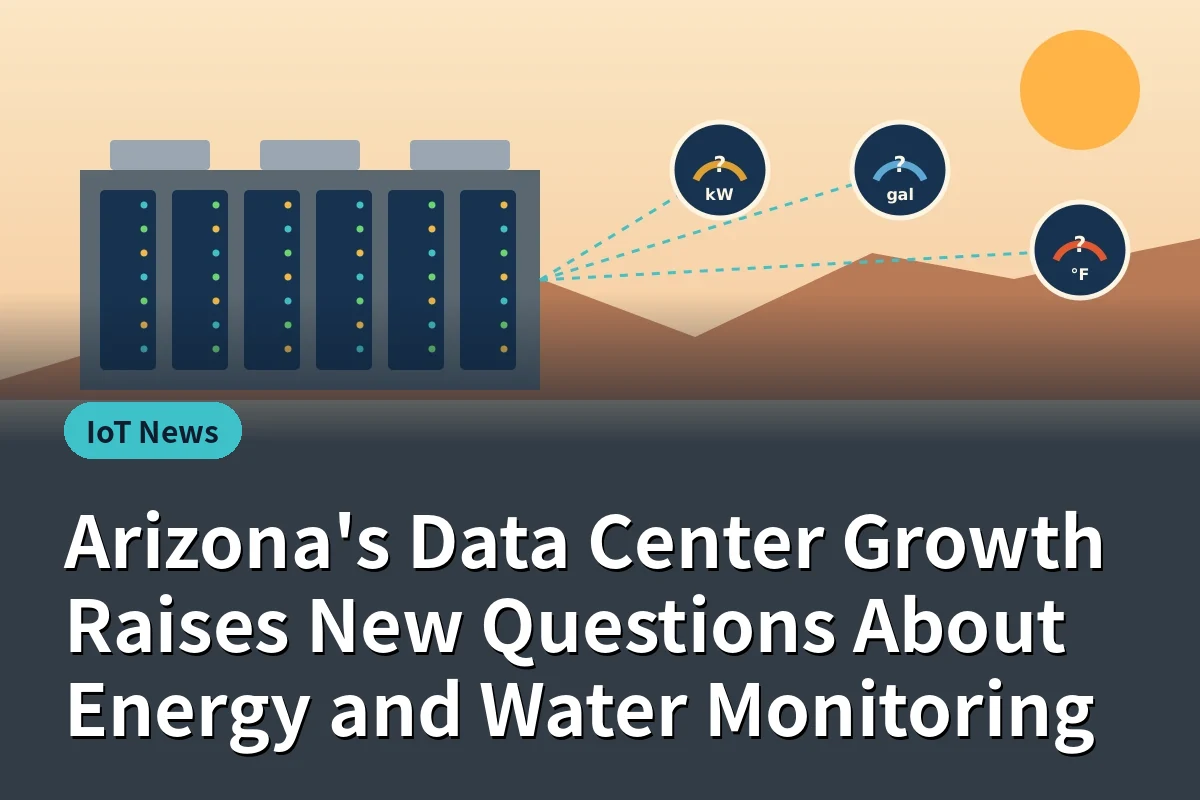
Arizona's debate over data centers sharpened in late summer 2026. On August 31, Attorney General Kris Mayes called for a statewide pause on approving and building new data centers, particularly large AI-focused projects, citing rising power bills and Arizona's reduced Colorado River supply. A week earlier, Pinal County supervisors had rejected a rezoning request for a large data center after residents packed the meeting. Mayes also pointed to an Arizona State University study finding that data centers can raise nearby temperatures by up to 4 degrees Fahrenheit, and scheduled an October 14 town hall in Ahwatukee about a planned 1 million square foot facility.
Utilities and industry offer a different picture. Salt River Project reports that large data centers contributed 5.1 percent of its record summer 2025 peak, and both APS and SRP say large-load tariffs are designed so data centers pay the costs of serving them. The debate is far from settled.
Lost in that argument is a quieter question: does all of Arizona's computing need to happen in giant campuses at all? Edge computing, which places smaller amounts of processing close to where data is created and used, offers a complementary model. This article looks at how edge and hyperscale data centers fit together in Arizona, and where edge makes practical sense.
It helps to separate workloads that need centralized scale from those that do not.
| Workload | Where It Fits Best | Why |
|---|
| Training large AI models | Hyperscale campuses | Requires massive, tightly connected computing clusters |
| Cloud storage and enterprise applications | Hyperscale and colocation | Benefits from scale, redundancy and centralized management |
| Real-time control of machines, vehicles and utilities | Edge | Needs low latency and must work during network outages |
| Video and sensor analytics at many sites | Edge | Avoids sending huge data volumes over limited links |
| AI inference close to users | Edge and metro data centers | Faster response, lower bandwidth costs, local data control |
| Privacy-sensitive processing | Edge or on-premises | Keeps data within an organization or jurisdiction |
Edge does not replace the hyperscale campuses that train AI models and run cloud services. But a meaningful share of everyday computing, especially for industry, cities, healthcare and transportation, can happen closer to the source. Our guide to edge computing in Arizona covers the technology in detail.
Edge sites range from a single ruggedized server at a pump station to a micro data center drawing tens or hundreds of kilowatts at a campus or substation. They connect to the grid in much smaller increments than hyperscale projects, which can request hundreds of megawatts each. That does not make them free of grid impact, but they fit into existing distribution capacity more easily and avoid the long interconnection queues large projects face.
Small edge facilities typically use air-cooled or closed-loop systems. Some fanless edge hardware needs no active cooling at all beyond a shaded, ventilated enclosure. In a state debating data center water use, that is a practical advantage, though heat remains a design challenge.
Processing data where it is created reduces the volume that must travel to central facilities. A city analyzing traffic camera video locally and sending only counts and alerts uses far less network capacity, and far less central computing, than one streaming raw video to the cloud.
- Autonomous vehicles. Waymo's driverless cars, covering more than 350 square miles of the Phoenix metro, make driving decisions on board. Each vehicle is effectively a mobile edge computer.
- Mining. Autonomous haul fleets such as the one at Freeport-McMoRan's Bagdad mine depend on onsite networks and processing rather than distant data centers.
- Manufacturing. Fabs and factories run fault detection, machine vision and process control locally. Our article on how semiconductor manufacturing uses IoT explains why.
- Utilities and public safety. Pump stations, flood warning systems and traffic controllers increasingly process data on site so they keep working during storms.
Between devices and hyperscale campuses sits a middle tier: smaller colocation and edge facilities within metro areas, often a few megawatts or less. These sites host content delivery, AI inference for local applications, regional cloud services and interconnection between networks. They can be placed in existing buildings, near fiber routes and in areas where distribution capacity is available, rather than requiring new transmission lines.
For Arizona communities wary of hyperscale projects, metro edge facilities raise different questions about noise, appearance and energy use, but at a much smaller scale. For businesses, they offer lower latency to users across the Valley and Tucson than distant regions can provide.
Distributed computing brings its own challenges:
- Total energy may not fall. Many small sites can be less efficient per unit of computing than one optimized campus. The benefit comes from processing less data overall, not from magic efficiency.
- Management is harder. Hundreds of sites need updates, monitoring and physical security.
- Heat still matters. Edge hardware in Arizona enclosures faces extreme temperatures and needs careful thermal design.
- Security exposure grows. Physically accessible devices are easier to tamper with. Our IoT security guide covers protections.
- Which of our workloads need real-time response or must run during outages?
- How much raw data do we send to the cloud that could be summarized locally?
- Would processing near users or devices reduce latency enough to improve service?
- Can our edge hardware handle summer enclosure temperatures with minimal cooling?
- Do we have the tools and staff to manage many distributed sites securely?
Answering these questions often shows that a hybrid model, with time-sensitive processing at the edge and heavy or shared workloads in central facilities, offers the best balance of performance, cost and resource use.
As Arizona weighs how to manage data center growth, edge computing deserves a place in the discussion. Planning that distinguishes between very large single-site loads and smaller distributed facilities could help communities and utilities manage growth more precisely. At the same time, edge sites still consume power, need cooling and must be secured, so they are not exempt from scrutiny. The right policy mix is a matter for lawmakers, regulators and communities to decide, and reasonable people disagree on how restrictive it should be.
Consider a Valley city with 400 signalized intersections, each with cameras or radar detectors. Streaming continuous video from every intersection to a central data center would require substantial bandwidth and computing. Instead, each signal cabinet runs a compact edge computer that counts vehicles, cyclists and pedestrians, detects stalled cars and adjusts timing locally. Only summaries, alerts and short clips for incidents travel to the city's traffic management center, which uses a modest central system for coordination and reporting.
The result is faster local response, lower network costs and less central computing. The city still relies on cloud services for long-term analysis and planning, but the heavy, time-sensitive work happens at the edge. The challenge shifts to managing hundreds of cabinets that sit in direct sun, need regular software updates and must be protected from tampering. Similar patterns apply to utilities, retailers and healthcare networks with many distributed sites across Arizona.
Edge infrastructure can often use spaces that already exist: telecom huts, utility substations with spare capacity, the back rooms of commercial buildings, cell tower sites and existing industrial facilities. Reusing these locations avoids new land disturbance and can simplify permitting, though each site still needs adequate power, cooling, connectivity and physical security.
Whether a facility is a 300 megawatt campus or a 30 kilowatt edge cabinet, measuring power, cooling and environmental conditions is essential. Operators that can show verified data on energy and water use are better placed with regulators and neighbors. Our guides to IoT for Arizona data centers and IoT energy monitoring for data centers cover what to measure.
For edge operators, monitoring also covers the health of the computing hardware itself: enclosure temperatures, storage condition and power quality. A failed edge node in a remote location can be costly to reach in summer, so early warning matters.
Expect Arizona's data center debate to continue through the 2027 legislative session, the APS rate case decision expected by the end of 2026 and ongoing local zoning fights. Meanwhile, AI inference is moving steadily toward devices and local servers, autonomous vehicles and equipment are spreading, and cities are adopting edge analytics for traffic and public safety. The state's computing future will likely include both large campuses and a growing layer of smaller, distributed edge sites, each suited to different jobs.
Our guide to AIoT in Arizona explores AI running on edge devices. Find edge and data center partners in the IoT Arizona company directory, including technology providers in Phoenix. For the bigger picture, see our overview of how IoT is transforming Arizona. Browse more of our IoT News coverage.
Frequently asked questions
Hyperscale campuses provide massive centralized computing for cloud services and AI training. Edge sites place smaller amounts of processing near devices and users for fast, local work.
No. AI training and large cloud workloads still need centralized scale. Edge handles real-time control, local analytics and inference, reducing how much data must move to central facilities.
Attorney General Kris Mayes called for a statewide pause in August 2026, citing power bills and water cuts, while utilities say large-load tariffs make data centers pay their costs. The debate continues.
Many edge sites use air-cooled or closed-loop systems, and some fanless hardware needs only shaded, ventilated enclosures, so water use is typically low. Heat remains a design challenge.
In autonomous vehicles across metro Phoenix, autonomous mining fleets, factory process control and machine vision, and utility, traffic and flood warning systems that must work during outages.
Many small sites can be less efficient per unit of computing, harder to manage and update, exposed to heat and more physically accessible to tampering.
Related articles


 IOT News