 IOT News

AIoT in Arizona: What Robotaxis and Autonomous Mines Teach Everyone Else About AI and IoT
IOT News
Published by IOT Arizona Research & Editorial Team
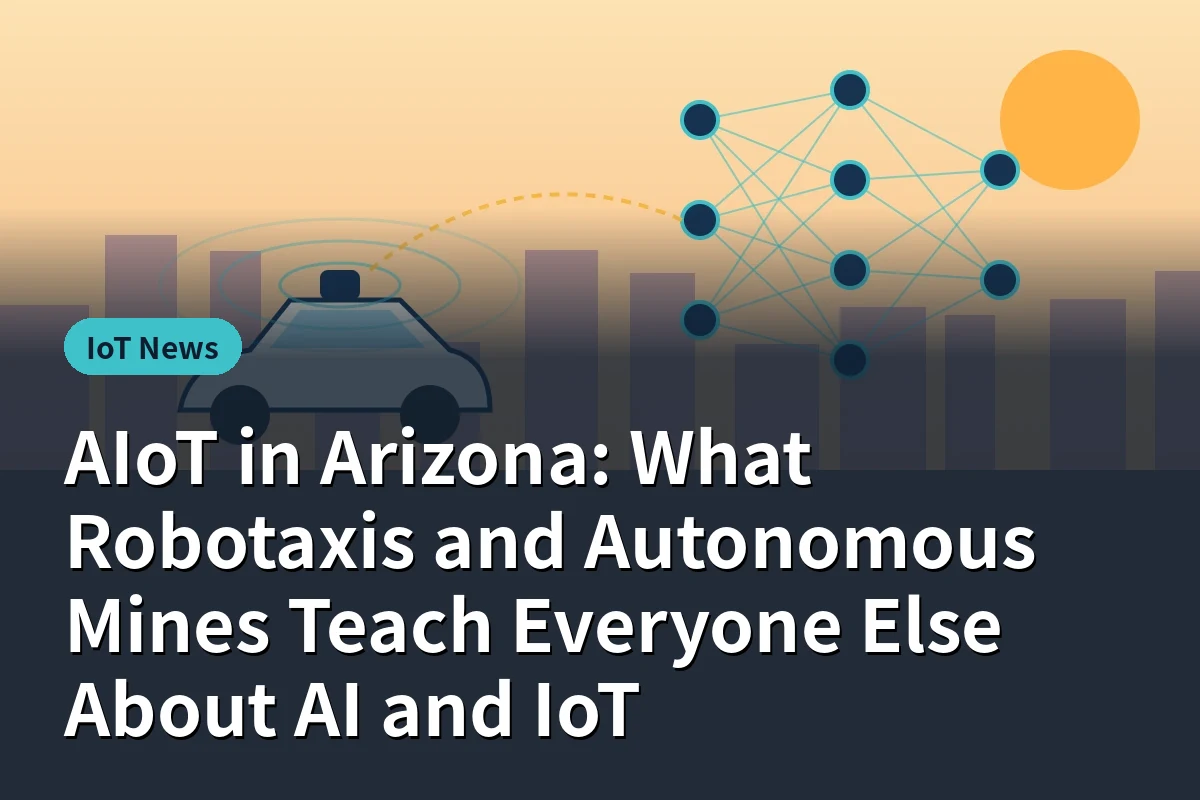
AIoT, the combination of artificial intelligence and the Internet of Things, can sound like a buzzword stacked on another buzzword. In metro Phoenix, it is something residents can hail from their phones. Waymo's driverless vehicles now cover more than 350 square miles of the Valley after an August 2026 expansion into Gilbert, more of Chandler and San Tan Ranch. Each vehicle is a dense cluster of sensors feeding AI models that make driving decisions in real time. Up north, Freeport-McMoRan's Bagdad mine runs a fully autonomous haul truck fleet, the first major U.S. mine to do so.
Most Arizona organizations will never build a robotaxi or an autonomous mine. But the same idea, sensors that feed AI models which then drive decisions or actions, is reaching factories, utilities, buildings, farms and hospitals across the state. This article looks at what AIoT really involves, where it delivers value beyond simpler automation, and why Arizona's seasons create a challenge that many AI projects underestimate.
What AI Adds to IoT
A traditional IoT system collects data and applies rules: if temperature exceeds a limit, send an alert. That works well for simple, well-understood conditions. AI becomes useful when the patterns are too complex, too subtle or too variable for fixed rules. Typical AIoT capabilities include:
- Anomaly detection that learns normal behavior across many signals and flags unusual combinations.
- Prediction of failures, demand, quality issues or energy use based on historical patterns.
- Computer vision that interprets images and video, from defect inspection to traffic analysis.
- Optimization that adjusts setpoints, schedules or routes to balance cost, output and risk.
- Natural language interfaces that let technicians ask questions about equipment history and manuals.
AIoT Use Cases Across Arizona
| Sector | AIoT Application | Data It Needs | Maturity |
|---|---|---|---|
| Transportation | Autonomous driving, traffic signal optimization | Cameras, lidar, radar, traffic detectors | Operating at scale in Phoenix for robotaxis; growing for traffic management |
| Mining | Autonomous haulage, predictive maintenance, ore sorting | Positioning, equipment telemetry, sensors on crushers and conveyors | Operating at scale at leading mines |
| Manufacturing | Visual inspection, predictive maintenance, process optimization | Machine data, images, quality results | Widespread in large plants; emerging in smaller shops |
| Utilities | Leak detection, demand forecasting, grid fault prediction | Smart meter intervals, pressure and acoustic sensors, weather | Growing rapidly |
| Buildings | HVAC optimization, fault detection, occupancy prediction | Zone sensors, equipment data, occupancy counts, weather forecasts | Commercially available and maturing |
| Agriculture | Irrigation scheduling, crop stress detection, yield prediction | Soil moisture, weather, satellite and drone imagery | Early to moderate adoption |
| Healthcare | Remote monitoring alerts, patient deterioration prediction | Vital signs from home and hospital devices | Growing, with regulatory oversight |
The Desert Seasons Problem
Here is an issue that deserves more attention in Arizona than it gets. AI models learn from historical data. If that data comes mostly from one season, the model learns what "normal" looks like in that season only.
Consider a model trained on six months of equipment data collected from November through April. It learns typical motor temperatures, compressor runtimes and energy use under mild conditions. When summer arrives and everything runs hotter and harder, the model may flag perfectly normal behavior as anomalous, generating floods of false alarms. Or, worse, it may treat genuine problems as part of the new summer baseline and miss them.
The monsoon adds another layer: sudden humidity swings, dust, power quality disturbances and storms that affect everything from sensors to traffic patterns. Waymo offers a useful parallel. The company paused its Phoenix freeway operations for about two months earlier this year for software updates to handle construction zones better before resuming in July 2026. Even highly sophisticated AI systems encounter situations their training did not fully cover.
Practical safeguards include:
- Train on at least a full year of data where possible, so models see every season.
- Include weather and ambient conditions as inputs so models can separate seasonal effects from real problems.
- Monitor model performance continuously and retrain when accuracy drifts.
- Keep humans in the loop for consequential decisions, especially during the first summer of any deployment.
AI at the Edge
Many AIoT applications run models directly on devices or local servers rather than in the cloud. Edge AI reduces latency, keeps working during outages and avoids sending large volumes of video or sensor data across limited networks. That matters for Arizona's remote sites and for safety-critical systems. Our guide to edge computing in Arizona covers the hardware and architecture choices involved.
A common pattern is to train models in the cloud using large historical datasets, then deploy compact versions to edge devices. Updates flow down as models improve, and selected data flows back up to support retraining.
Data Readiness: The Real Bottleneck
Most AIoT projects that stall do so because of data, not algorithms. Common problems include sensors that were never calibrated, gaps from connectivity outages, inconsistent naming across sites and, especially for predictive maintenance, too few recorded failures to learn from. Before investing in AI, organizations should confirm they have:
- Reliable, well-maintained sensors on the assets or processes that matter.
- Consistent data collection over a meaningful period, ideally including a full Arizona summer.
- Records of outcomes, such as failures, defects or leaks, that link to the sensor data.
- A way to integrate AI outputs into daily workflows, such as work orders, alerts or control systems.
Our industrial IoT sensor guide covers the hardware side of data quality.
Building Internal Skills
AIoT works best when people who understand the operation help shape the models. Pair data specialists with experienced operators, technicians or clinicians who can explain what the data means and judge whether recommendations make sense. Arizona's universities and community colleges offer growing programs in data science and industrial automation, and many vendors provide training. Organizations that build this internal understanding avoid depending entirely on outside providers and get more value from their AI investments over time.
Start small with a cross-functional team of three or four people who meet weekly to review model results. That rhythm builds shared understanding faster than formal training alone.
Governance, Privacy and Trust
AIoT systems increasingly make or influence decisions that affect people: which patients get a call, which water customers receive a leak alert, which areas get more traffic enforcement or cooling resources. Arizona organizations should document how models work, what data they use and how decisions can be reviewed or appealed. Camera-based systems in public spaces deserve particular care, with clear policies on data retention and use.
Security matters too. AI models deployed on connected devices can be targets, and compromised sensors can feed misleading data. The same practices that protect industrial controls, including segmentation, authentication and patching, apply to AIoT systems.
Energy Costs of Intelligence
AI workloads consume power, and Arizona's grid is under strain. Data centers drew up to 630 megawatts during APS's record peak in July 2026. Running efficient models at the edge, scheduling heavy training outside peak hours and choosing AI applications with clear operational payback are sensible ways to align AI ambitions with the state's energy realities.
A Practical Path for Arizona Organizations
- Start with a problem, not a technology. Pick a costly, recurring issue such as summer equipment failures, water loss or quality defects.
- Check whether rules would work. If simple thresholds solve the problem, use them. Reserve AI for patterns rules cannot capture.
- Collect a full year of good data. Make sure the data covers Arizona's seasonal extremes.
- Pilot with human review. Let AI recommend while people decide, and track how often recommendations prove right.
- Automate gradually. Move to automatic actions only where accuracy is proven and safeguards exist.
Questions to Ask AIoT Vendors
- What data was your model trained on, and does it include hot desert conditions similar to ours?
- How does the system handle seasonal changes, and how often are models retrained?
- Can the model run at the edge if our connection drops?
- How do you measure and report accuracy, false alarms and missed events?
- Can our team see why the model made a recommendation?
- Who owns the data and the trained models, and can we export them?
- How are models and devices secured and updated?
- What happens to our operations if your service is unavailable?
Vendors with strong answers to these questions tend to deliver systems that keep working after the pilot ends. Those who struggle to answer them may be selling a demonstration rather than a dependable operational tool.
What Comes Next
AIoT in Arizona will keep expanding along several fronts: more autonomous vehicles and equipment, smarter buildings responding to grid conditions, utilities using AI to find leaks and forecast demand, and factories deploying vision and predictive tools at every scale. The organizations that benefit most will be those that respect the fundamentals: good sensors, good data across every season and clear human oversight.
Our overview of how IoT is transforming Arizona places AIoT in the wider context of water, heat, power and industry, and our smart manufacturing roadmap shows where AI fits in a factory's maturity journey. Local AI and IoT partners are listed in the IoT Arizona company directory, including technology firms in Tempe. Browse more of our IoT News coverage.