Arizona has quietly become one of the more interesting places in the country to watch Industrial IoT in action. Between the semiconductor fabs rising around Phoenix and Chandler, the sprawling farmland in Yuma and Pinal County, and the logistics corridors connecting the Southwest, the state offers a working laboratory for connected sensors, real-time monitoring, and automated decision-making. This isn't theoretical technology sitting in a slide deck somewhere. It's already running on factory floors, in irrigation canals, and inside distribution centers across the state.
This article looks at where Industrial IoT is actually taking hold in Arizona, what businesses are learning from early deployments, and what to watch out for if your own operation is considering a move in this direction.
A few things make Arizona distinct from other manufacturing and industrial hubs. First, the state has attracted enormous investment in semiconductor production, with major chipmakers building or expanding fabrication plants in the Phoenix metro area. These facilities depend on extremely precise environmental control, equipment monitoring, and yield tracking, all of which lean heavily on sensor networks and connected machinery.
Second, Arizona's agricultural regions operate under real water scarcity pressure. Farmers in the Yuma area, which supplies a large share of the country's winter vegetables, have had to get smarter about every gallon of water used, which has pushed adoption of soil moisture sensors, automated valves, and remote monitoring systems.
Third, the state sits on a major logistics artery between California, Texas, and Mexico, so warehousing, cold storage, and freight operations have strong incentive to use connected tracking and fleet monitoring to keep goods moving efficiently through the desert heat.
Put together, you get three very different industries, each with its own reason to invest in connected industrial technology, all operating in the same state and often drawing from the same pool of local engineering talent and internet infrastructure.
Chip fabrication is one of the most demanding environments for Industrial IoT because tolerances are measured in nanometers and a single contaminated batch can cost millions of dollars. Fabs use dense networks of sensors to track temperature, humidity, particle counts, and vibration in real time, feeding that data into systems that can halt production before a defect spreads across an entire wafer lot.
Predictive maintenance plays a particularly large role here. Instead of servicing equipment on a fixed schedule, sensors monitor vibration patterns and thermal signatures on tools like etchers and deposition chambers, flagging small deviations that suggest a part is wearing out. This lets maintenance teams intervene before a breakdown forces an unplanned shutdown, which in chip manufacturing can mean lost production runs worth far more than the sensor equipment itself.
For companies supplying parts, chemicals, or services to these fabs, there's a growing expectation that vendors can plug into similar monitoring systems, sharing quality data and delivery status in near real time rather than through manual reports.
Arizona's farmers have been early adopters of connected irrigation because the alternative, guessing at soil conditions or over-watering to be safe, simply isn't sustainable given the region's water allocation pressures. Soil moisture probes placed at different depths report conditions back to a central dashboard, letting growers apply water only where and when it's actually needed.
Some operations have gone further, pairing weather station data with automated valve controls so irrigation adjusts on its own when a storm rolls through or temperatures spike. Livestock operations use similar principles for water trough monitoring and herd tracking, cutting down on the labor needed to manually check equipment spread across large properties.
The business case here is straightforward. Water costs money, water is limited by regulation in much of the state, and crop yield depends on getting moisture levels right. Sensors that pay for themselves through reduced water use and fewer crop losses tend to have an easy return on investment argument, which is part of why adoption has moved faster in agriculture than in some other sectors.
Extreme summer heat is a real operational hazard for freight moving through Arizona, particularly for temperature sensitive goods like produce, pharmaceuticals, and certain electronics components. Fleet operators increasingly rely on connected temperature sensors inside trailers, combined with GPS tracking, to catch problems before a shipment is ruined rather than after.
Inside distribution centers, connected sensors track everything from dock door status to forklift utilization, helping warehouse managers spot bottlenecks. Cold storage facilities use continuous monitoring to meet food safety and pharmaceutical handling requirements, since a brief equipment failure that goes unnoticed for hours can spoil an entire shipment.
For smaller trucking and warehousing operations in the state, the barrier to entry has dropped considerably. Sensor kits and monitoring platforms that once required a dedicated IT department are now available as subscription services, which has opened the door for mid-sized logistics companies to compete on reliability with larger players.
Companies looking at Industrial IoT for the first time often make the mistake of trying to connect everything at once. A more workable approach usually looks like this:
- Identify one costly, recurring problem, whether that's unplanned equipment downtime, water waste, or spoiled inventory, and target that specifically.
- Pilot a small sensor deployment on a limited set of equipment or acreage before committing to a facility-wide rollout.
- Choose a connectivity approach suited to the physical environment, since a chip fab with metal-heavy construction has very different wireless needs than an open field of crops.
- Build in a plan for who reviews the data daily, because sensors that generate reports nobody reads deliver no value at all.
- Expand only after the pilot proves out cost savings or risk reduction in measurable terms.
This staged approach tends to work better than a large upfront investment, partly because it lets a business learn the quirks of its own environment (dust, heat, distance from cell towers) before scaling up spending.
Rural stretches of the state, particularly agricultural areas and remote logistics routes, don't always have reliable cellular coverage. Businesses operating outside metro areas often need to combine cellular connectivity with private wireless networks or satellite backup to keep sensor data flowing consistently. Inside dense manufacturing facilities, thick concrete and metal structures can interfere with standard wireless signals, which is why many fabs and large warehouses are moving toward private 5G or dedicated Wi-Fi networks designed specifically for industrial equipment rather than relying on consumer-grade connectivity.
| Challenge | Why It Happens | Practical Response |
|---|
| Data overload | Sensors generate far more data than teams can review manually | Set clear alert thresholds so only meaningful deviations get flagged |
| Cybersecurity gaps | Older industrial equipment wasn't designed with network security in mind | Segment IoT devices onto separate networks from core business systems |
| Workforce skills gap | Traditional maintenance and farm staff may lack data analysis experience | Pair new sensor systems with training, not just installation |
| Equipment durability | Desert heat and dust shorten the lifespan of poorly rated hardware | Choose sensors rated for extreme temperature and particulate exposure |
| Integration with legacy systems | Older machinery wasn't built to communicate digitally | Use retrofit gateways rather than replacing entire equipment lines |
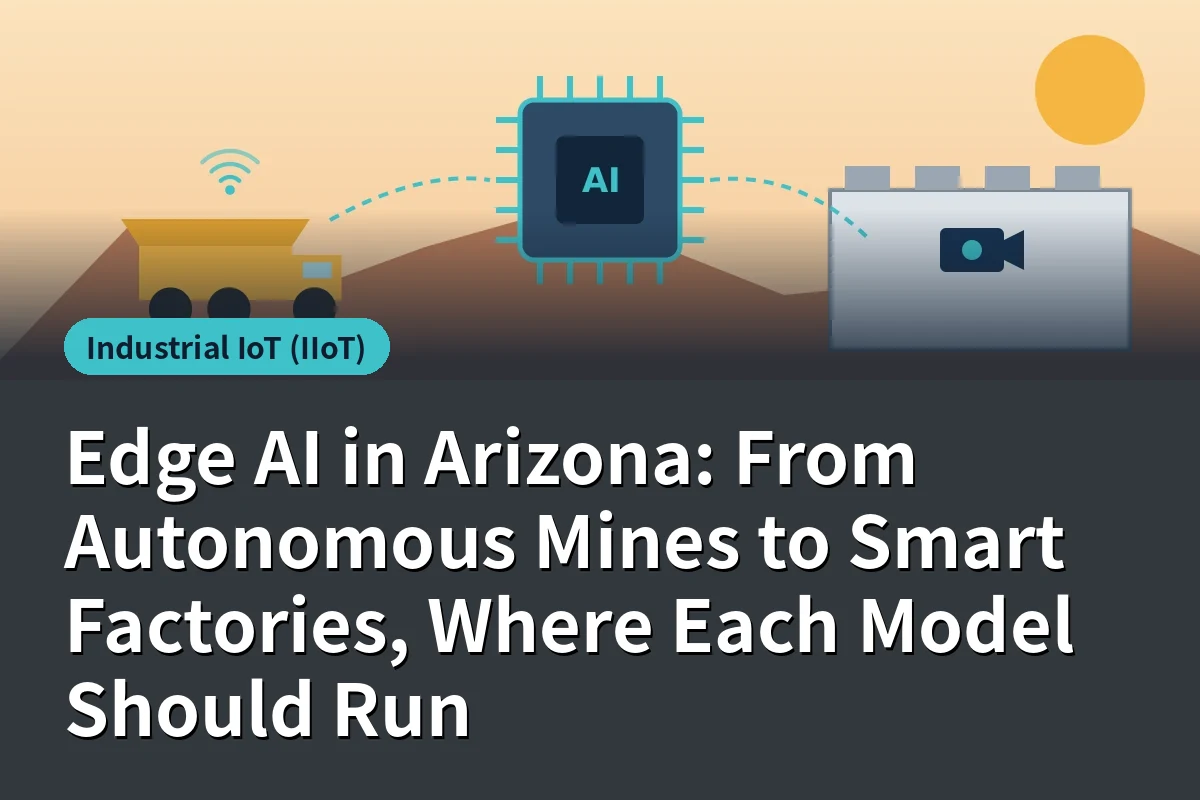
A few trends are worth watching over the next several years. Edge computing, where data gets processed locally on or near the sensor rather than sent to a distant server, is becoming more common in facilities that need instant responses, such as halting a production line the moment a defect is detected. This reduces the delay that comes with sending data back and forth to the cloud and can matter enormously in high speed manufacturing.
Digital twins, essentially detailed virtual models of a physical facility or piece of equipment, are gaining traction among larger manufacturers who want to simulate changes before making them on the actual production floor. This is particularly relevant for semiconductor plants where a production change carries significant financial risk if it doesn't work as expected.
On the agricultural side, expect tighter integration between weather forecasting, soil sensors, and automated equipment, reducing the amount of manual decision making required for irrigation and fertilization. And across logistics, real-time visibility into shipment condition is becoming less of a premium feature and more of a baseline expectation from customers, particularly for food and pharmaceutical shipments moving through the state's transportation corridors.
None of this means every business needs to adopt cutting edge tools immediately. What it does mean is that the businesses paying attention now, testing small deployments and learning what works in their specific environment, will be in a stronger position as these tools become standard practice rather than a competitive edge.
Frequently asked questions
The state's growth in semiconductor manufacturing, its water-constrained agricultural sector, and its role as a logistics hub between California, Texas, and Mexico all create strong business reasons to adopt sensor-based monitoring and automation.
Start with a single, well-defined problem, such as tracking one piece of equipment prone to breakdowns, rather than attempting a full facility rollout. A small pilot lets you learn what works before committing more budget.
Soil moisture probes, weather station data, and automated irrigation valves work together to apply water only when and where it's needed, helping conserve a resource that's tightly regulated in much of Arizona.
Rural agricultural and logistics operations often deal with spotty cellular coverage, while large manufacturing facilities with metal and concrete construction can experience wireless interference, pushing many businesses toward private networks or satellite backup.
Not anymore. Many sensor and monitoring platforms are now offered as subscription services, making it feasible for mid-sized farms, trucking companies, and manufacturers to adopt targeted solutions without a major upfront investment.
Collecting far more data than anyone actually reviews. Sensors are only useful if someone is set up to act on the alerts and trends they generate, so planning for data review is as important as the hardware itself.
Related articles


 Industrial IoT (IIoT)